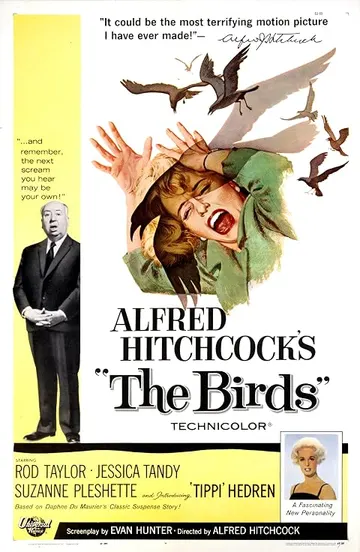
Alfred Hitchcock / 阿尔弗雷德·希区柯克 · 1963
The Birds
The Birds
Cinema 1, p. 204 directly calls the first gull attacking the heroine a demark and the thousands of birds or flock as a whole a symbol, but it does not analyze the pet-shop or playground editing for the atlas. The three scene records therefore separate evidentiary levels: the pet shop at 00:02:00–00:07:10 only proposes an ordinary relation of merchandise, gift, and captivity; the bay crossing at 00:25:00–00:25:42 receives direct primary support for a gull that reroutes that relation; the playground at 01:09:45–01:12:15 tests how the flock changes school/play, song/alarm, perching/encirclement, and classroom order/urgent evacuation together. The children's song continues through the flock's accumulation, timing each cutback and delaying alarm.
Film details
- Original title
- The Birds
- Director
- Alfred Hitchcock / 阿尔弗雷德·希区柯克
- Year
- 1963
- Region
- United States
Film analysis: how shots organize concepts
Close-reading questions
The pet shop places birds within an ordinary order of merchandise, gifts, and captivity; the first strike over the bay breaks that order. How does the playground flock then join the children's song, school space, and urgent evacuation into one threat?
- 01From 00:02:00 to 00:07:10, how do cages, species names, the lovebird gift, and Melanie pretending to be a shop assistant establish everyday human–bird relations? If those functions do not form a later series, why must the claim that the pet shop is a mark be withdrawn?
- 02From 00:25:00 to 00:25:42, a gull wounds Melanie while the skiff still advances toward its destination. Does it become a demark through strange appearance, harmful result, or its sudden departure from the environmental bird's position and rerouting of the prior series?
- 03From 01:09:45 to 01:12:15, the children's song continues as crows accumulate on the climbing frame, and the school shifts from play and study to urgent evacuation once Melanie turns. Which relations among sound, architectural use, and humans and birds must the flock change before it qualifies as a symbol candidate?
Shots, relations, and concepts
- 1Record
Melanie pilots the skiff alone toward the dock while Mitch watches her approach; the bay crossing still advances toward a clear goal. The skiff engine, water, and harbour ambience sustain the ordinary continuity of the crossing; a sharp bird cry cuts in with the impact.
Open the scene currently used to ground this chain: The first strike over the bay: a demark is not another mark - 2Judge the relation
The crossing originally carries Melanie toward Mitch's dock. The gull interrupts this goal-directed action from outside, so landing immediately becomes a matter of treating a wound and questioning the attack. The sudden attack invites the spectator to reinterpret the earlier caged birds, lovebirds, and environmental birds: the same kind of creature has shifted from display, gift, and landscape to attack.
- 3Name the concept last
Relation-image、Mental-image. Only concepts whose scene relation resolves to “supports” under the current record are named here; candidates, adjacent terms, and countertests are not merged into the conclusion.
- 4Countertest
Cinema 1, p. 204 makes the first gull attacking the heroine a demark. If a clip begins only after the wound or supplies no prior habitual series to be rerouted, the card cannot establish the claim by itself. Nor can the gull be called another mark: it departs from and reroutes an established habitual series.
Shots and scenes
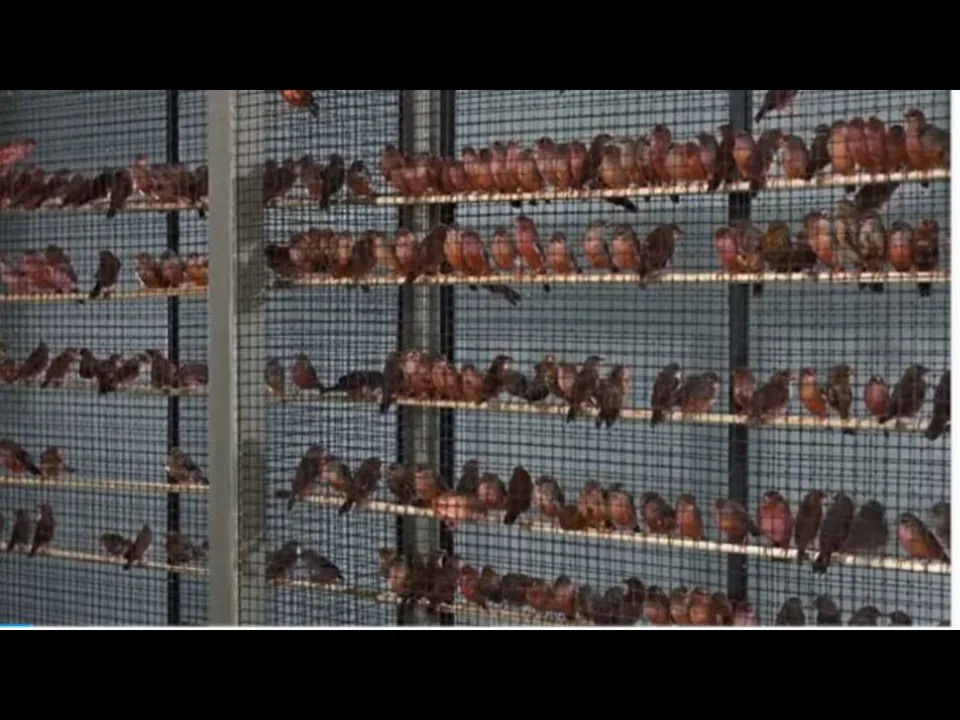
The pet shop does not become a mark merely because it contains many birds. The atlas retains the candidate only if merchandise, gift, captivity, and environmental presence form a recognizable habitual series across later passages. If the analysis reduces to a romantic meeting or the birds do not recur within a series, the mark claim must be withdrawn.
Open viewing position ↗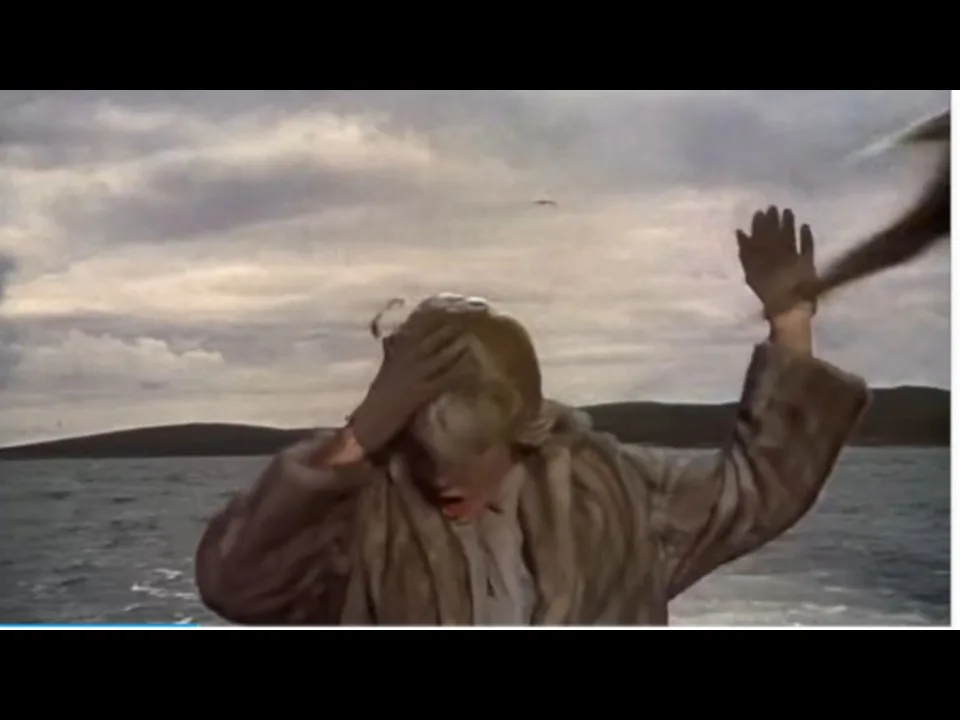
Cinema 1, p. 204 makes the first gull attacking the heroine a demark. If a clip begins only after the wound or supplies no prior habitual series to be rerouted, the card cannot establish the claim by itself. Nor can the gull be called another mark: it departs from and reroutes an established habitual series.
Open viewing position ↗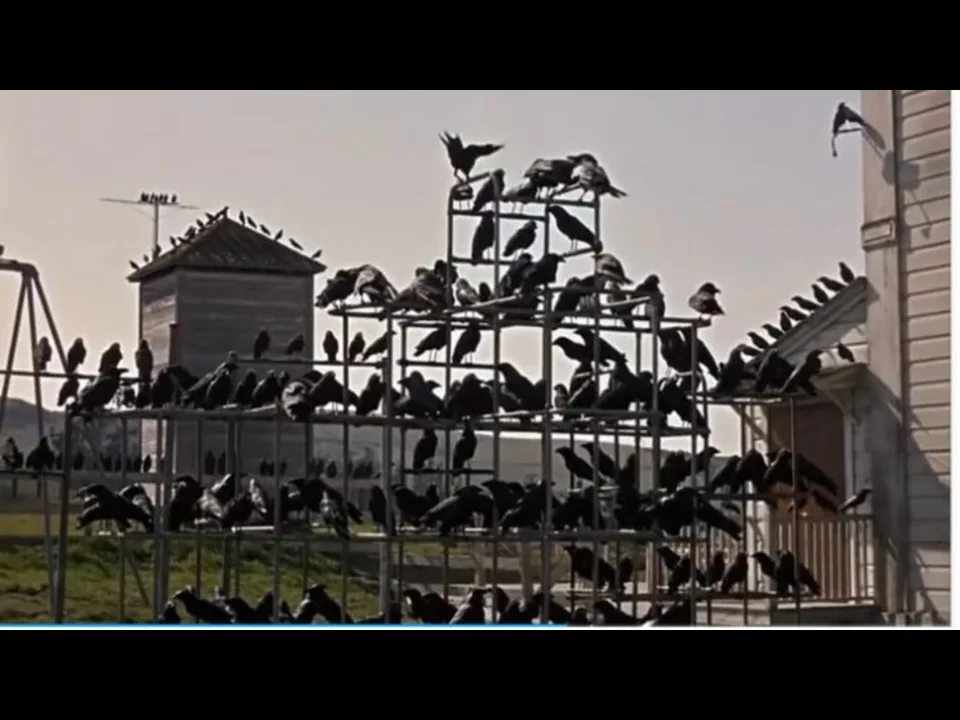
Numerical increase and greater danger are insufficient to establish a symbol. The playground passage can serve as a shot-level candidate for p. 204's flock-as-a-whole only if the flock changes school/play, song/alarm, perching/encirclement, classroom order/urgent evacuation, and the human–nature relation together. If the account reduces to a numerical threshold, the symbol claim must be downgraded.
Open viewing position ↗Primary texts, scholarship, and locators
Theory coordinate: Cinema 1, Minnesota 1986, ch. 2, p. 20; ch. 12, pp. 203–204
- 01Cinema 1: The Movement-Image
Standard Minnesota English translation and a principal citation edition in Anglophone scholarship.
Open the atlas source record →
Scholarship cited by the scene records: Each study is listed once, with its locators and supported scenes retained together.
- 01Deleuze’s Cinema Books: Three Introductions to the Taxonomy of Images
Locator(s): David Deamer, Deleuze’s Cinema Books (2016), pp. 132–137
Cited by scene(s): Caged birds, the shop-assistant role, and lovebirds: how ordinary relations are established · The first strike over the bay: a demark is not another mark · The song continues as the flock takes form: when number begins to bear relations
Deamer reconstructs the operative difference among mark, demark, and symbol: a habitual series, an anomalous term departing from that series, and a concrete term bearing abstract relations. The pages provide criteria rather than classifying these three passages for the atlas.
Open the atlas source record → - 02Cinema After Deleuze
Locator(s): Richard Rushton, Cinema After Deleuze (2012), p. 50
Cited by scene(s): Caged birds, the shop-assistant role, and lovebirds: how ordinary relations are established
Rushton lists Melanie and Mitch's meeting as an initiating event in the relational chain; he does not thereby classify the pet-shop passage shot by shot as a mark.
Open the atlas source record →
Viewing gateways and editions
- Official Bilibili feature page: 群鸟bilibili.comOpen film page ↗
- Page access
- Region restricted
- Version extent
- Recorded as a complete version
- Source type
- Distributor or streaming platform
Edition note: Official Bilibili feature · 1:59:30, subject to regional and account conditions. The three scene analyses use the 1:59:24 edition, BV1jJ411g7Yj. The runtimes differ by about six seconds; timecodes identify their respective editions.
Link checked: 2026-09-01