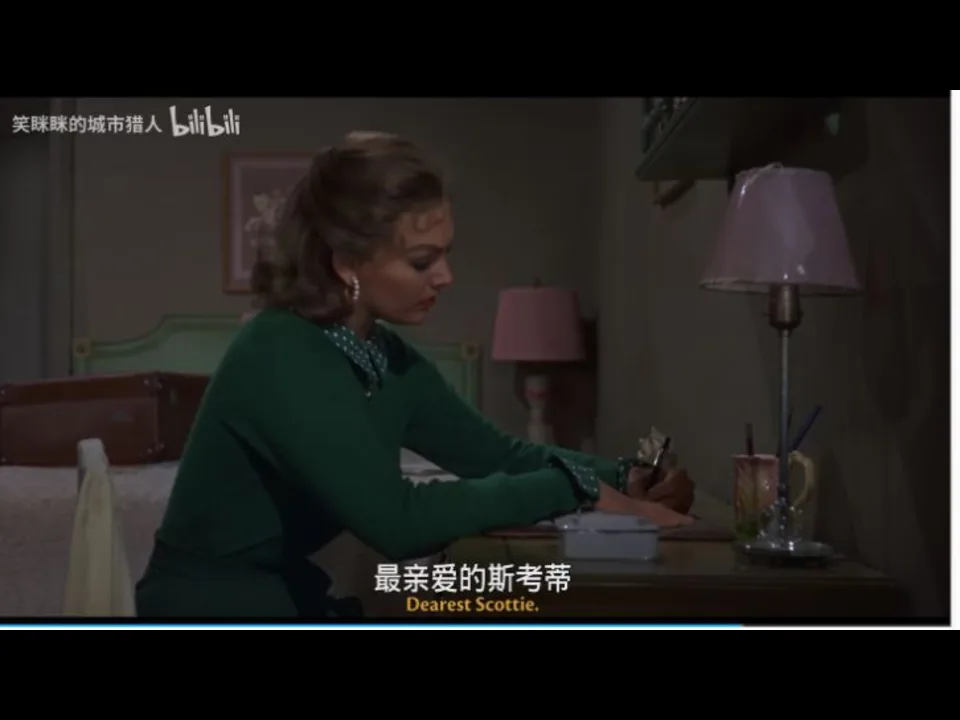
 01:39:20
Mental and relational image · SHOT EVIDENCE
The unsent letter moves the spectator ahead of Scottie
Why does this passage not end suspense? Once you know who Judy is, does the second half still wait for truth, or for how Scottie will remake a woman whose true identity remains concealed from him?
Film and viewing version
Vertigo · Vertigo · Alfred Hitchcock / 阿尔弗雷德·希区柯克 · 1958
Reviewed passage by passage on the 02:07:27 single-part Bilibili repost with hard Chinese and English subtitles. 01:39:20 is the still anchor and 01:38:30—01:40:30 is the atlas's working boundary. Bilibili's official feature page ep291561 runs 02:07:49, and the repost may trim opening or closing material, so their timelines are not interchangeable.
Version boundary: The timecodes on this page apply only to the named viewing carrier. Restorations, differing leaders, or platform transcodes may shift them.
Passage and still timecodes
approx. 01:38:30—01:40:30 (01:39:20 still shows Judy writing at the desk as the English hard subtitle reads “Dearest Scottie”)
The window locates the passage; its boundaries remain approximate
The passage window and still anchor are separate coordinates: the Bilibili still at 01:39:20 was checked on 2026-09-01; it does not turn an approximate passage on another carrier into exact bounds.
Visible facts
- 01
Alone in the hotel room, Judy begins packing, then sits to write. A recollection shows her dressed as Madeleine ascending the tower and another body falling.
- 02
After finishing the letter, she tears it up; the letter is not given to Scottie.
Audible facts
- 01
Judy's voice-over reading gives the prior deception directly to the spectator, including Elster's arrangement and her position in playing Madeleine.
- 02
Scottie is absent from the room and does not hear Judy's voice-over reading.
Action relation
Writing could end the deception, while not sending the letter permits Scottie's remaking to continue. The key is not an object transmitting information but information reaching only the spectator and changing the significance of every later action.
Temporal relation
The recollection does not merely complete the past; it redistributes who possesses that past in the present. The spectator henceforth watches a past Scottie does not yet know and Judy tries to conceal again.
Conceptual reading
The letter as prop is not itself the demark. Rushton's claim is that Judy disrupts the established Carlotta–Madeleine series and acquires a new function. Detached from the first half's doubling series and the spectator's knowledge gap, the writing becomes mere exposition and both demark and relation-image claims must be withdrawn.
Concepts used in the judgement
- Relation-imageimage-relation · SCENE SUPPORT
The unsent letter places the spectator within an asymmetrical knowledge network, while Judy as demark breaks the earlier Carlotta–Madeleine series.
→ - Mental-imageimage mentale · SCENE SUPPORT
Deception, identity, and who knows what become thought-objects directly organized by the image rather than a private secret inside one character.
→
Primary and scholarly coordinates
- 01Cinema 1: The Movement-Image
Minnesota 1986 translation, chapter 12, pp. 197, 204–205
These pages define the mental image's objects, Hitchcock's relational web, and the spectator's position, and directly explain Vertigo through variations in the relations of the Same. They do not analyze the atlas's chosen commission, letter, or green-light passages shot by shot; Rushton and the atlas's scene review bear those specific classifications.
- 02Deleuze’s Cinema Books: Three Introductions to the Taxonomy of Images
David Deamer, Deleuze’s Cinema Books (2016), pp. 132–137
Deamer supplies general criteria for mark, demark, symbol, and relation-image; he does not establish that a particular letter, colour, or camera movement has already acquired any of those statuses.
- 03Cinema After Deleuze
Richard Rushton, Cinema After Deleuze (2012), pp. 55–57
Rushton writes that “Judy is no doubt the demark in Vertigo” and that “the audience must know more than Scottie.” The atlas's 01:39:20 coordinate and shot facts come from carrier review, not the book.
Terminological coordinates
Chapter relations
Viewing and still sources
Direct scene · Watch 01:38:30–01:40:30 continuously, separating packing, writing, voice-over reading, recollection, non-delivery, and the decision to stay, and record who gains knowledge at each step. The timecode applies only to the 02:07:27 repost BV1ECSHYoEwW; this carrier may trim opening or closing material, so the official feature page, Blu-ray, and other restorations require fresh location.