 02:15:59
Mental and relational image · SHOT EVIDENCE
From cliffside pull to train berth: how action and marriage reclose relation
Does this famous match cut elevate relation into an independent object of thought, or use one gesture to skip every interval and return danger, love, and marriage to an action-outcome?
Film and viewing version
North by Northwest · North by Northwest · Alfred Hitchcock / 阿尔弗雷德·希区柯克 · 1959
Reviewed passage by passage on the 02:16:25 single-part dubbed BV1m2XTYuERk carrier. 02:15:59 is the still anchor and 02:15:40—02:16:08 the atlas's working passage, not a claim to final cut-by-cut boundaries. Credits, transitions, and end titles may introduce seconds of drift across masters.
Version boundary: The timecodes on this page apply only to the named viewing carrier. Restorations, differing leaders, or platform transcodes may shift them.
Passage and still timecodes
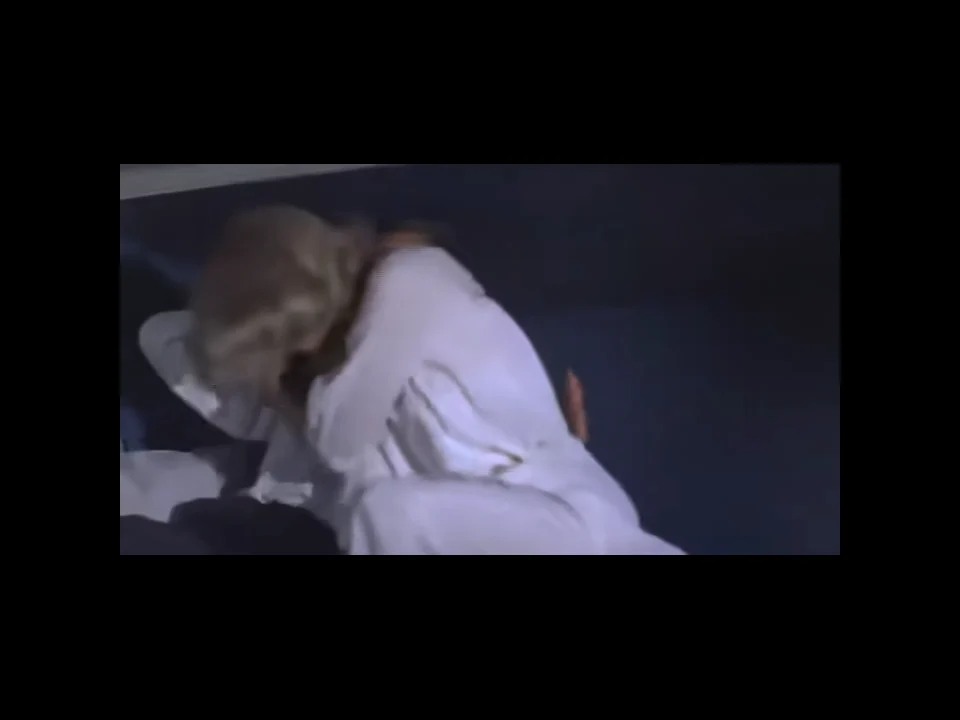
approx. 02:15:40—02:16:08 (the ending after the match cut, with the couple embracing in the train berth containing the 02:15:59 still)
The window locates the passage; its boundaries remain approximate
The passage window and still anchor are separate coordinates: the Bilibili still at 02:15:59 was checked on 2026-09-01; it does not turn an approximate passage on another carrier into exact bounds.
Visible facts
- 01
On the Mount Rushmore cliff, Eve hangs at the rock edge while Thornhill holds her hand and pulls upward.
- 02
Before the rescue is shown as a completed climb, the film matches the upward pull into a train berth: Thornhill draws Eve toward him and the couple embrace in the compartment.
- 03
The 02:15:59 anchor shows the berth embrace, not the cliff; an exterior train view at the passage's end carries the journey forward.
Audible facts
- 01
After the match cut, the dubbed dialogue addresses Eve with a married form of address, presenting the relation as an accomplished marriage. This record does not invent the unshown wedding process from that line.
Action relation
An incompletely shown cliff rescue is finished by the same pulling gesture in a safe berth: rescue, embrace, and onward travel become one effective action-outcome. Relation does not vanish; successful action consumes and recloses it.
Temporal relation
The match cut skips the intermediate duration of escape, departure from the monument, and marriage, compressing unseen events into one gestural change. The ellipsis rapidly completes causal and romantic resolution and should not be called a time-image merely because time is compressed.
Conceptual reading
If a relation-image requires relation itself to keep governing action as an unresolved problem, this passage supplies a countertest: cliffside action closes as successful rescue, while marriage is resolved through the final form of address and berth embrace. Relational support should return only if identity, spectatorial knowledge, or relational conflict retains autonomous force across the cut; if the cut primarily completes action and marriage, withdraw the supportive classification.
Concepts used in the judgement
- Relation-imageimage-relation · COUNTERTEST
The cut asks the spectator to understand the relation between two spaces and omitted events, yet primarily closes relation as action and marital resolution. It tests the tendency to classify every ingenious cut as a relation-image.
→ - Mental-imageimage mentale · ADJACENT
The spectator must supply the unseen escape, marriage, and travel between cliff and berth, but filling a narrative ellipsis is not the same as relation persisting as an autonomous image-object.
→ - Sensory-motor schemaschème sensori-moteur · SCENE SUPPORT
Pull, rescue, and embrace compress danger and successful response into a continuous gesture, showing clearly how sensory-motor action regains the ending.
→
Primary and scholarly coordinates
- 01Cinema 1: The Movement-Image
Minnesota 1986 translation, chapter 12, pp. 204–205
Pages 204–205 discuss the spectator's inclusion in the relational network and Hitchcock's completion of the movement-image at the threshold of the mental image. The primary text does not name the 02:15:40–02:16:08 cliff-to-berth cut; the atlas is responsible for the passage facts and countertest.
- 02Cinema After Deleuze
Richard Rushton, Cinema After Deleuze (2012), pp. 48–53
Across these pages Rushton develops five general features of Hitchcock's relation-image through Strangers on a Train and Vertigo. North by Northwest enters only as a listed example of wrong identity, the exchange-of-crime tradition, and the crop-duster demark. The book does not supply the atlas's shot-level analysis of the title grid, the attack, or the final match cut.
Terminological coordinates
- relation-imageimage-relation
Countertests an overextended relational classification through the closure of action and marriage.
→ - mental imageimage mentale
Distinguishes spectatorial completion of an ellipsis from relation persisting as an object of thought.
→ - sensory-motor schemaschème sensori-moteur
Tracks how one gesture completes rescue and outcome across a cut.
→
Chapter relations
Viewing and still sources
Direct scene · Still anchor 02:15:59; watch 02:15:40–02:16:08 and separately record the cliffside hand pull, cut point, berth pull and embrace, married form of address, and exterior train view to test whether relation remains unresolved. The timecode applies only to the 02:16:25 single-part dubbed BV1m2XTYuERk carrier. The specific master or restoration was not independently established; other editions require fresh location.