 00:02:15
Mental and relational image · SHOT EVIDENCE
Camera, racing photographs, and cast: how a viewing position is explained
Does the opening tell us who he is, or first organize body, profession, apparatus, and visual restriction into a relation the later film must keep operating?
Film and viewing version
Rear Window · Rear Window · Alfred Hitchcock / 阿尔弗雷德·希区柯克 · 1954
Reviewed passage by passage on the 01:50:54 single-part Bilibili carrier with hard Chinese and English subtitles. 00:02:15 is the still anchor and 00:01:40—00:02:25 is the atlas's working boundary; opening credits and transitions may introduce seconds of drift across masters.
Version boundary: The timecodes on this page apply only to the named viewing carrier. Restorations, differing leaders, or platform transcodes may shift them.
Passage and still timecodes
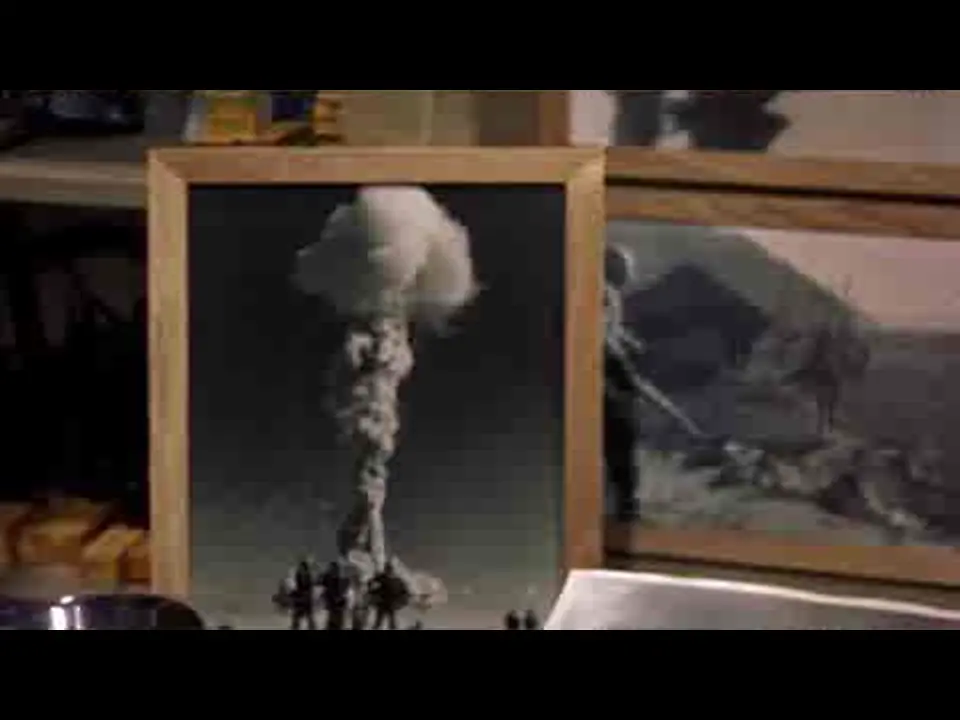
approx. 00:01:40—00:02:25 (the opening tour across two racing-crash photographs containing the 00:02:15 still)
The window locates the passage; its boundaries remain approximate
The passage window and still anchor are separate coordinates: the Bilibili still at 00:02:15 was checked on 2026-09-01; it does not turn an approximate passage on another carrier into exact bounds.
Visible facts
- 01
The camera moves from the courtyard and sleeping Jeff to his leg cast, then across racing-crash photographs, a damaged camera, and magazine covers.
- 02
The 00:02:15 anchor juxtaposes two racing-crash photographs; it does not by itself show the injury occurring.
Audible facts
- 01
The visual inventory has no explanatory voice-over; the following telephone exchange more explicitly supplies Jeff's profession and condition.
Action relation
Jeff formerly entered danger through the camera; camera and crash traces now explain why he can only watch from the window. Capacity for action first appears through its damaged apparatus.
Temporal relation
The past accident is not replayed as a flashback but persists in cast, damaged equipment, and photographs. Present objects compress an unseen past into the viewing position.
Conceptual reading
If these objects merely provide rapid exposition and cease to govern how Jeff observes, infers, and delegates action, the relation-image claim should be downgraded. The passage becomes relational only because that fixed position continues to govern the film.
Concepts used in the judgement
- Mental-imageimage mentale · SCENE SUPPORT
Body, profession, and apparatus become an object of thought through the opening tour rather than an account of private interiority.
→ - Relation-imageimage-relation · SCENE SUPPORT
Camera, accident, and cast interpret one another and establish the later triad of observer, object, and inference; if only exposition remains, the relation should be withdrawn.
→ - Sensory-motor schemaschème sensori-moteur · ADJACENT
The cast separates perception from direct action without thereby making the film a time-image; action is delegated to others and optical apparatuses.
→
Primary and scholarly coordinates
- 01Cinema 1: The Movement-Image
Minnesota 1986 translation, chapter 12, p. 201
Page 201 directly uses Rear Window's opening: the camera passes sleeping Jeff, cast, racing photographs, and a damaged camera to explain his work as a photographer and his broken leg. The primary text names this opening relation; the atlas is responsible for the 00:01:40–00:02:25 boundary and shot-by-shot description.
- 02Deleuze’s Cinema Books: Three Introductions to the Taxonomy of Images
David Deamer, Deleuze’s Cinema Books (2016), pp. 132–135
Deamer reconstructs the general taxonomy here: mark and demark are compositional signs of natural relations, while symbol is the genetic sign of abstract relations. These pages do not perform the atlas's shot analysis of Rear Window.
Terminological coordinates
- mental imageimage mentale
Tests whether relation is performed by the image rather than housed in character psychology.
→ - relation-imageimage-relation
Reconstructs the viewing relation from concrete terms that interpret one another.
→ - sensory-motor schemaschème sensori-moteur
Distinguishes bodily inability to act directly from a total collapse of sensory-motor linkage.
→
Chapter relations
Viewing and still sources
Direct scene · Still anchor 00:02:15; watch 00:01:40–00:02:25 continuously, recording what each object explains and whether that explanation remains operative in the later viewing apparatus. The timecode applies only to the 01:50:54 single-part BV1zvyTYMEqk carrier with hard Chinese and English subtitles; Blu-ray, DVD, and other streaming editions require fresh location.