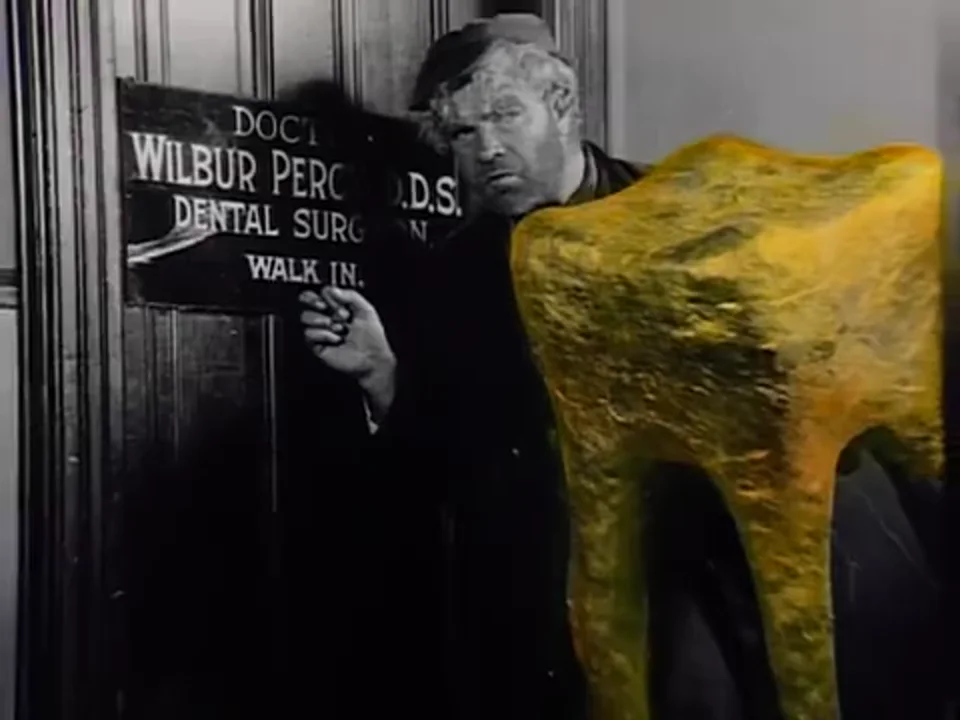
 02:51:55
Impulse and originary world · SHOT EVIDENCE
The gold tooth is first something saleable, not a fetish on sight
How can saving under poverty be distinguished from impulse's seizure of an object-fragment without calling every golden object a fetish?
Film and viewing version
Greed · Greed · Erich von Stroheim / 埃里克·冯·施特罗海姆 · 1924
Reviewed passage by passage on the long-reconstruction Bilibili carrier with a decoded-stream duration of 03:56:21. 02:51:55 is the still anchor and 约 02:51:30—02:57:31 is the atlas's working boundary. Still photographs, reconstruction cards, and moving footage must be read as distinct layers.
Version boundary: The timecodes on this page apply only to the named viewing carrier. Restorations, differing leaders, or platform transcodes may shift them.
Passage and still timecodes
约 02:51:30—02:57:31 (gold-tooth sign, meat purchase, and change passage containing the 02:51:55 still)
The window locates the passage; its boundaries remain approximate
The passage window and still anchor are separate coordinates: the Bilibili still at 02:51:55 was checked on 2026-09-01; it does not turn an approximate passage on another carrier into exact bounds.
Visible facts
- 01
The large gold tooth changes from the dental parlour's professional sign into an object McTeague can move and sell; the subsequent meat purchase turns on budget, payment, and change.
- 02
Trina demands saving, asks about change, and makes McTeague bear the expense; these acts first belong to economic behaviour under scarcity.
Audible facts
- 01
Narrative information in the silent film is supplied mainly by intertitles; the edition of the reconstruction score could not be independently established and is not used as impulse-image evidence.
Action relation
Proposing the sale of the gold tooth, buying cheaper meat that is three days old, and demanding change can still be explained by poverty, budgeting, and exchange. They first form ordinary economic action rather than seizure of an object detached from use.
Temporal relation
The sign preserves the collapsed past of the dental profession while present poverty rewrites it as a short-term survival resource. Degradation is present, but not enough to establish the fetish sign.
Conceptual reading
These are first ordinary economic actions: if the tooth remains an exchangeable commodity, meat an actual use, and change a real budget, the fetish classification should be withdrawn. A fetish candidate arises only when the object is detached from exchange and use to become a partial object repeatedly seized by impulse.
Concepts used in the judgement
Primary and scholarly coordinates
- 01Cinema 1: The Movement-Image
Minnesota 1986 translation, chapter 8, pp. 125–130, especially pp. 125 and 128
Page 125 generally defines originary world or derived milieu, elementary impulse or real behaviour, and symptom or fetish, while directly listing Greed's desert ending as a localized originary world. Pages 126–127 discuss Stroheimian descent, entropy, and degradation. Page 128 directly names the film's impulse for gold, then defines partial object and fetish in general; pp. 129–130 address exhaustion of milieu, fragments, and remnants. The primary text does not classify the atlas's three anchors one by one as symptom or fetish; specific gestures, objects, and withdrawal criteria remain the atlas's responsibility.
Terminological coordinates
Chapter relations
Viewing and still sources
Direct scene · Still anchor 02:51:55; watch 02:51:30–02:57:31 and separately record the tooth's function, the cheaper meat that is three days old, the payer, and the demand for change. This long-reconstruction carrier has a decoded-stream duration of 03:56:21 and is not the lost original full cut.