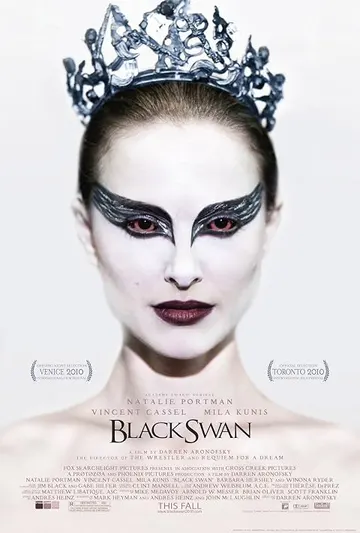
Darren Aronofsky / 达伦·阿伦诺夫斯基 · 2010
Black Swan
Black Swan
The rehearsal mirror first corrects Nina's body, then reflections hesitate, slip out of phase, and even move before she does. The mirror no longer confirms a whole self; it compresses Nina and Lily, White Swan and Black Swan, into one body. Scratches, feathers, toes, and stage transformation are therefore more than illustrations of subjective hallucination: actual and reflected bodies rewrite one another, filming 'becoming the role' as a circuit that produces the performer in return.
Film details
- Original title
- Black Swan
- Director
- Darren Aronofsky / 达伦·阿伦诺夫斯基
- Year
- 2010
- Region
- United States
Film analysis: how shots organize concepts
When does a mirror stop reflecting a body and begin prescribing its actions, desires, and failures?
Nina's ‘split personality’ is not a secret hidden inside her awaiting revelation. The White/Black Swan role system, rehearsal instructions, Lily's body, misaligned mirrors, and wounds jointly produce an exchanging actual-virtual circuit.
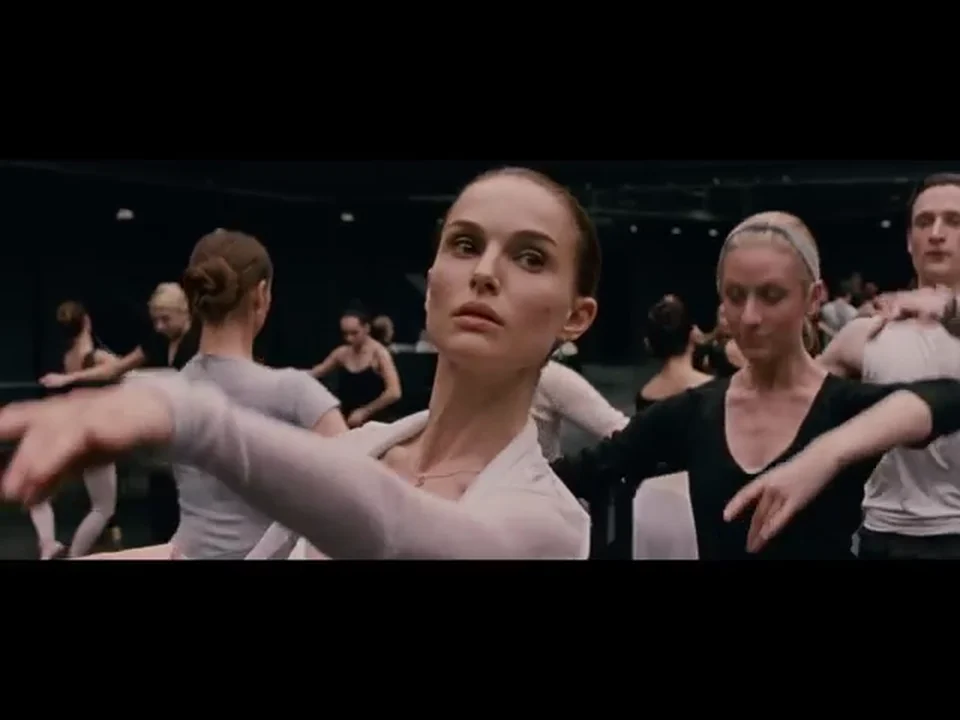
The opening dream-dance places Nina within the relations of White Swan, dark figure, and metamorphosis before waking inspection and mirror rehearsal appear.
The dream is not a fictional detour opposed to reality. It acts as a virtual role-script that organizes what the actual body must perform.

Thomas assigns control to Nina and defines letting go as her lack; framing and rehearsal then form Lily as the external body of that lack.
The double does not begin with resemblance and then become rivalry. The institution distributes incompatible capacities across two bodies. Body/brain cinema asks how that command enters posture and sensation.
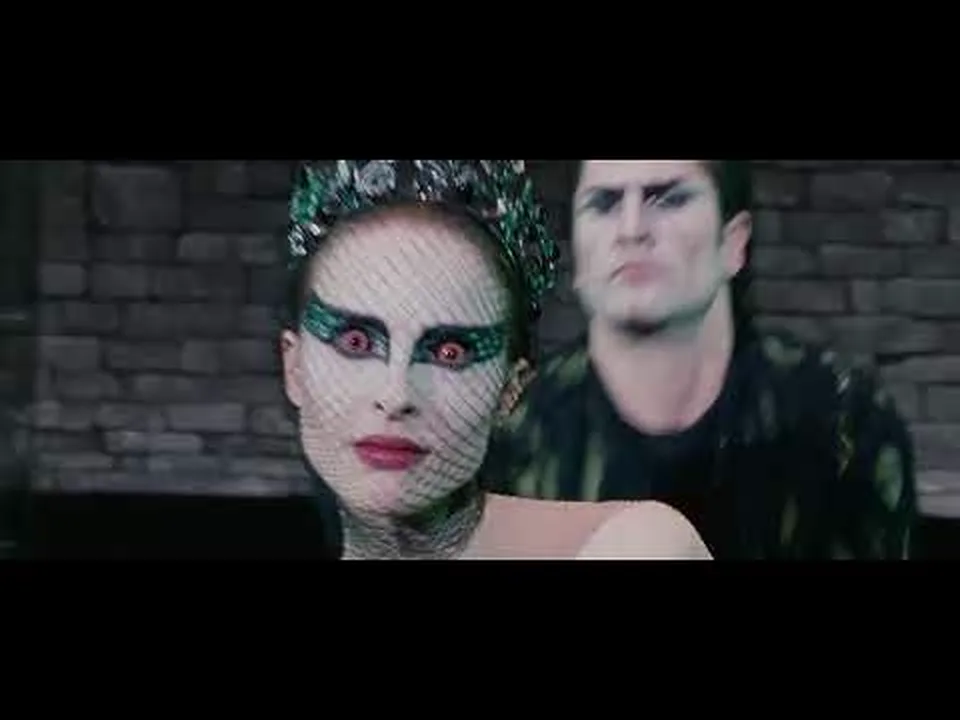
The shattered-mirror struggle first attributes the wound to Lily; when Lily appears unharmed, the wound returns to Nina's body while applause still demands completion of the role.
Actual body and role-image no longer occupy stable inside and outside positions but exchange around the wound. The crystal lies in that reciprocal exchange and its lethal consequence, not in the mirror alone.
EDITION NOTE The three images come from Searchlight's official trailer. Feature locators follow the common 108-minute edition; trailer stills are not presented as frames from the same feature seconds.
The mirror first trains the body; then reflection, role, and wound acquire the power to shape it in return. The Black Swan is not a second personality hidden inside Nina but an assemblage of rehearsal discipline, competitive gazes, mirrors, and stage that produces her.
- 01Mirror corrects the body
The studio encloses Nina within mirrored walls, instruction, and repeated movement; each posture receives immediate reflected feedback.
Reflection initially serves sensory-motor training, reducing the body to a correctable and comparable unit of performance. - 02Reflection starts prescribing the original
Mirrored movement hesitates or slips, while Lily's face, Black Swan makeup, and Nina's bodily surface pass into one another; scratches and feathers intervene in seeing and acting.
The two visible materials no longer form original and copy. The virtual here is not another fictional personality inside Nina's mind but a differential structure composed of role memory, movement patterns, others' gazes, and bodily habits; it acts on actual movement and is altered again by each rehearsal. - 03Perfection drives capacity to rupture
In the finale, choreography, light, applause, and winged transformation reach maximum coherence while the bleeding body loses the possibility of continuing after 'I was perfect.'
As the role acquires full actuality it exhausts the performer; becoming is not psychological reconciliation but one event in which capacity increases and life contracts.
Close-reading questions
- 01Compare frame by frame three moments when Nina's reflection remains synchronized, begins to hesitate, and clearly slips out of phase. When does reflection stop correcting the body and start prescribing how it must next move?
- 02For scratches, toes, and feathers, record who sees them, whether the film cuts to another person's response, and whether sound has a visible source. How does bodily change move among visible fact, Nina's perception, and stage performance without being reduced to 'hallucination'?
- 03In the finale, choreography becomes more complete while the body is increasingly damaged. Compare applause, Thomas's gaze, Nina's wound, and 'I was perfect.' What capacity does becoming the Black Swan increase, and whose capacity to continue living does it cancel?
Analysis and scene sources
Shots and scenes
Primary texts, scholarship, and locators
Theory coordinate: Deamer, 2016, pp. 305–308
- 01Deleuze’s Cinema Books: Three Introductions to the Taxonomy of Images
Detailed reconstruction with a film index; the nine-cell grid and eleven film cases carry the evidence status of Deamer’s later interpretation.
Open the atlas source record →
This film in books and research
The Cinematic Body · Further discussion
Can intensity escape the viewing position?
pp. 9–10
Claim: A body being affected does not mean the apparatus has been dismantled. Viewpoint, suture, sound, and institutions can use intensity to secure an existing position.
Extension: Mulvey and Doane keep the gendering of the gaze in view and track how spectatorship moves among identification, voyeurism, and masquerade.
Tension: Apparatus theory loses uncontrolled shock, disgust, and pleasure when it reduces bodies to positions; treating dislocation as sufficient evidence of escape also misses how intensity can serve domination.
Mulvey: Visual Pleasure and Narrative CinemaDoane: Film and the Masquerade
The Cinematic Body · Further discussion
Desire exceeds identity; costs are still distributed by identity
pp. 72–73
Claim: Molecular mobility can undo naturalized identities, but it cannot cancel the unequal distribution of law, labor, medicine, and violence through identity categories.
Extension: Rizzo tests Deleuzian embodiment and becoming through feminist analysis; Clover returns cross-gendered spectator identification, pain, and survival to the institutions of horror genre.
Tension: The book's molecular transsexuality and claim that all desire is homosexual are 1993 philosophical provocations, not present-day trans identity theory, and they cannot erase communities, consent, or material sanctions.
Rizzo, Deleuze and Film: A Feminist IntroductionClover, Men, Women, and Chain Saws
Viewing gateways and editions
- Searchlight officialsearchlightpictures.comOpen film page ↗
- Source type
- Official source