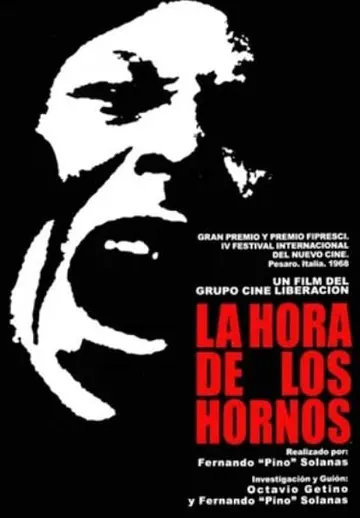
Fernando Solanas & Octavio Getino / 费尔南多·索拉纳斯、奥克塔维奥·赫蒂诺 · 1968
The Hour of the Furnaces
La hora de los hornos
Montage, intertitles, pauses, and discussion organize projection as political action. Because the film presupposes a revolutionary people available to be addressed, it becomes a decisive comparison for testing the boundary of Deleuze's claim that the people are missing.
Film details
- Original title
- La hora de los hornos
- Director
- Fernando Solanas & Octavio Getino / 费尔南多·索拉纳斯、奥克塔维奥·赫蒂诺
- Year
- 1968
- Region
- Argentina
Film analysis: how shots organize concepts
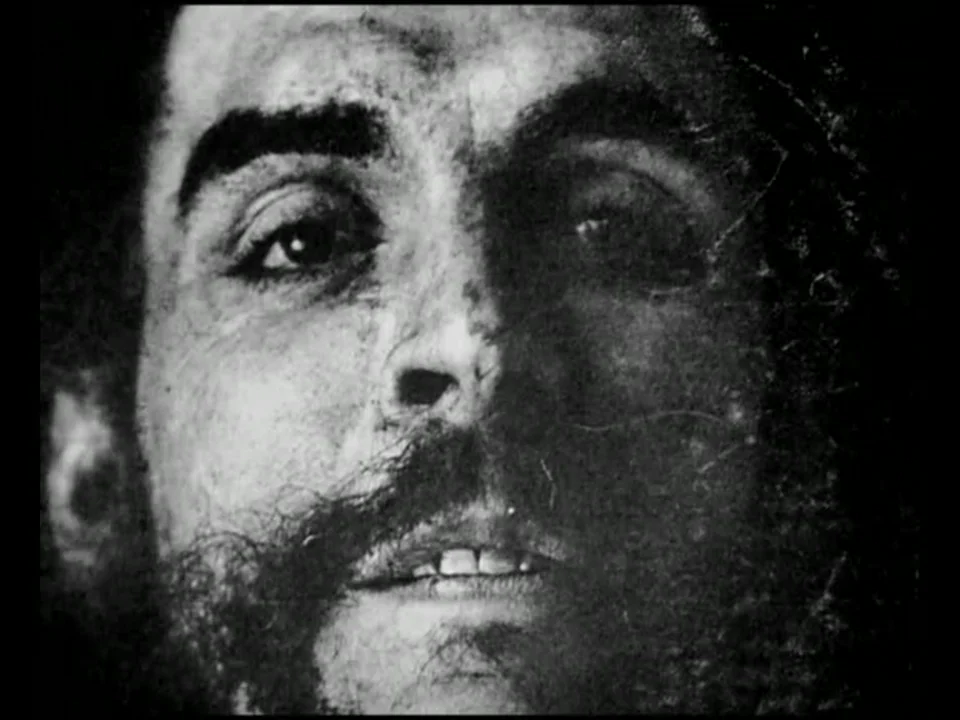 第1分段 01:22:30 / Part 1 01:22:30
The photograph is held for several minutes, turning projection from argument into a direct demand on the audience.
The same death photograph continues to fill the screen; eyes, wounds, and facial texture are not quickly displaced by another montage item.
The extended still is supported only by continuing percussion; no character dialogue supplies the audience's conclusion.
SITE ANALYSISThe prolonged gaze of the death image and percussion turn the absent revolutionary into a direct relation of address, presupposing a revolutionary audience able to respond and continue the action.
Bilibili at 第1分段 01:22:30 / Part 1 01:22:30 Open original still ↗The extended final image of Che Guevara in part 1 was frame-checked.Complete Bilibili carrier; the shot at 第1分段 01:22:30 was checked frame by frame, and the still and timestamp come from the same public upload.
Bilibili · The Hour of the Furnaces, part 1 · verified 2026-08-14Close-reading questions
- 01How do intertitles, photographs, statistics, black screens, and music organize viewing as a political action that demands a response?
- 02In which passages does the film presuppose a revolutionary people already available to address, and how does that premise delimit comparison with the people being missing?
Shots and scenes
Primary texts, scholarship, and locators
Theory coordinate: Third Cinema boundary study; Cinema 2, ch. 8, pp. 216–24
- 01Cinema 2: The Time-Image
Authoritative source for the standard translation, translators, ISBN, and publication date.
Open the atlas source record →
This film in books and research
The Cinematic Body · Further discussion
The body is never an unmarked universal
pp. 88–89
Claim: Visibility, tactility, identification, and the right to refuse viewing are differentiated by racial histories, archival regimes, and relations of production.
Extension: hooks historicizes the oppositional gaze as a practice of Black female spectatorship; this site further tests refusal of identification as a bodily survival practice. Keeling tests cinematic perception through Black feminist and queer temporalities.
Tension: Universal contagion and passivity can erase who is more likely to be misrecognized, surveilled, or killed. Intensity has no inherently anticolonial direction, and both forming and dissolving identity can be political acts.
bell hooks, Black LooksStam and Spence: Colonialism, Racism and RepresentationDiawara: Black Spectatorship, Identification and ResistanceKeeling, The Witch's Flight
Fabulation: How the Speech Act Prefigures a People to Come
Collective enunciation prefigures a people to come
Claim: A plural speaking position forms through disagreement, relay, response, and delegation; the people remains minor, unfinished, and future-facing.
Conclusion: The full chain requires double becoming, real consequences, a plural speaking position, and an unfinished collective.
Fabulation: How the Speech Act Prefigures a People to Come
A presupposed revolutionary addressee
Film comparison: Begins from an addressable people, contrasting with a speaking position generated inside the film.
Viewing gateways and editions
- Verified complete Bilibili multipart carrier: 【纪录片 / 历史 / 战争】燃火的时刻 Hora de los hornos 【1970】【阿根廷】bilibili.comOpen film page ↗
- Page access
- Accessible when checked
- Version extent
- Recorded as a complete version
- Source type
- User-uploaded page
Edition note: The complete three-part work totals 3:49:53 and retains the final credit of part three. This 25 fps edition corresponds to Cannes's description of a roughly four-hour trilogy.
Link checked: 2026-08-13
- Festival de Cannesfestival-cannes.comOpen film page ↗
- Source type
- Institutional source