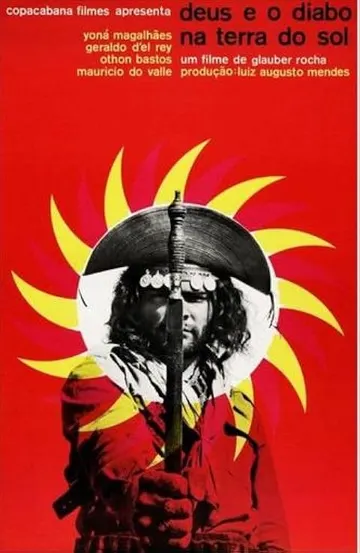
Glauber Rocha / 格劳贝尔·罗恰 · 1964
Black God, White Devil
Deus e o Diabo na Terra do Sol
Popular myth, trance, violence, and shifting allegiance reveal a missing people and the task of creating them.
Film details
- Original title
- Deus e o Diabo na Terra do Sol
- Director
- Glauber Rocha / 格劳贝尔·罗恰
- Year
- 1964
- Region
- Brazil
Film analysis: how shots organize concepts
Drought, trance, song, and changing leaders prevent a people from being represented by one myth; it remains unfinished through flight and narration.
- 01The land first closes action
Cracked sertão, dead cattle, debt, and the landowner's whip compress Manuel's labour into killing and flight.
Action does not improve the milieu; it drives the body from one apparatus of domination to another. - 02Myths contest the body
Sebastião's rites and Corisco's cangaceiro performance use song, dance, blades, guns, and trance to demand absolute allegiance.
A people is not completed in its leaders; bodily attitudes expose how myth produces and exhausts collectivity. - 03Running gives the conclusion to the future
After the leaders die, Manuel and Rosa keep running across open land while song declares that the sertão will become sea.
The image does not show a people already present; the speech act preserves transformation as a relation still to come.
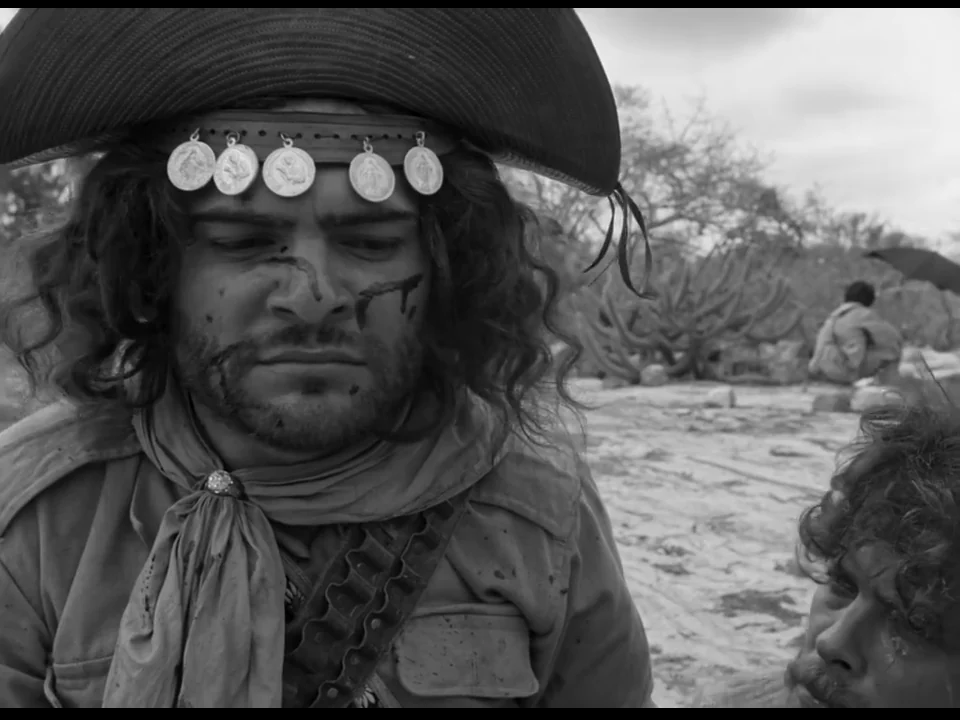 01:30:00
Bandit, mythical figure, and speaker are compressed into one face while allegiance remains in motion through speech.
Corisco's coin-hung hat, facial streaks, and frontal close-up bind costume, body, and mythical identity.
Manuel enters only from the lower edge, so their positions are not stabilized by balanced shot/reverse-shot.
Corisco challenges Manuel in loud, rhythmic speech closer to public performance than private conversation.
SITE ANALYSISFigures change allegiance among peasant, believer, bandit, and myth; the collective is not pre-completed, and Corisco's performative speech turns that absence into a condition of creation.
Cinema 2, chapter 8, pp. 222–223.Bilibili at 01:30:00 Open original still ↗The verbal challenge between Corisco and Manuel was frame-checked.Complete Bilibili carrier; the shot at 单片 01:30:00 was checked frame by frame, and the still and timestamp come from the same public upload.
Bilibili · Black God, White Devil complete film · verified 2026-08-14Close-reading questions
- 01How do myth, trance, violence, and shifting allegiance reveal a missing people?
- 02When does collective enunciation create a new political position from existing myth?
Shots and scenes
Primary texts, scholarship, and locators
Theory coordinate: Cinema 2, ch. 8, pp. 222–223
- 01Cinema 2: The Time-Image
Authoritative source for the standard translation, translators, ISBN, and publication date.
Open the atlas source record →
This film in books and research
Deleuze and Cinema: The Film Concepts · Book case
Black God, White Devil
pp. 153–159
Film relation: Myth, banditry, song, and face compress into minor cinema's collective enunciation.
Shot question: Who speaks, how does the addressee answer, and how does allegiance change after speech?
Cinema After Deleuze · Further discussion
Race, nation, and the large action form
Question: When community is refounded, who becomes citizen, exception, or external threat?
Extension: Connect SAS′ in Ford, Kazan, and Spielberg to colonial frontier, racialized law, and national myth.
Tension: Truth rescuing one exceptional person does not mean the institution has changed.
Film test: Record the legal-racial order of S, authorization of A, beneficiaries of S′, and unresolved loss.
Gilles Deleuze : cinéma et philosophie · Atlas analysis
Black God, White Devil
Marrati pp. 114–118 · site test
Film relation: This site returns Marrati's criteria of belief in the world and a missing people to the Brazilian sertão, with Cinema 2, chapter 8, pp. 222–223 as a primary return point: prophet and bandit each attempt to occupy the position of speaking for 'the people.'
Shot question: How do religious leader and bandit compete for bodies and collective authority to speak? Why does the final run refuse to cash the unseen sea out as an image of victory?
Conclusion: A people to come is not a pre-existing national essence; the run preserves the people as a position still to be made through new speech, bodies, and relations.
The Cinematic Body · Further discussion
The body is never an unmarked universal
pp. 88–89
Claim: Visibility, tactility, identification, and the right to refuse viewing are differentiated by racial histories, archival regimes, and relations of production.
Extension: hooks historicizes the oppositional gaze as a practice of Black female spectatorship; this site further tests refusal of identification as a bodily survival practice. Keeling tests cinematic perception through Black feminist and queer temporalities.
Tension: Universal contagion and passivity can erase who is more likely to be misrecognized, surveilled, or killed. Intensity has no inherently anticolonial direction, and both forming and dissolving identity can be political acts.
bell hooks, Black LooksStam and Spence: Colonialism, Racism and RepresentationDiawara: Black Spectatorship, Identification and ResistanceKeeling, The Witch's Flight
Deleuze and World Cinemas
Black God, White Devil
Reading relation: Atlas extension: Latin American political cinema
Fabulation: How the Speech Act Prefigures a People to Come
Collective enunciation prefigures a people to come
Claim: A plural speaking position forms through disagreement, relay, response, and delegation; the people remains minor, unfinished, and future-facing.
Conclusion: The full chain requires double becoming, real consequences, a plural speaking position, and an unfinished collective.
Fabulation: How the Speech Act Prefigures a People to Come
Minor cinema: making a collective voice inside a major language
Claim: Minor cinema is not a label for an author's identity or a small production; it is a formal operation that pushes singular experience toward collective enunciation. Stutter, borrowed names, translation, and displacement create new addressee positions inside a major language.
Conclusion: Map speaker, addressee, translation path, and consequence. Minor cinema becomes testable when linguistic deviation changes who can be heard and who bears the response.
Cinema 2: The Time-Image · Chapter 8, pp. 215–224Gilles Deleuze's Time Machine · ‘Series and Fabulation: Minor Cinema,’ pp. 139–169
Fabulation: How the Speech Act Prefigures a People to Come
The missing people as creative condition
Film comparison: Myth, trance, and changing allegiance keep the collective unfinished.
Viewing gateways and editions
- Verified complete Bilibili carrier: 黑上帝白魔鬼 Deus E o Diabo na Terra do Sol 1964bilibili.comOpen film page ↗
- Page access
- Accessible when checked
- Version extent
- Recorded as a complete version
- Source type
- User-uploaded page
Edition note: Complete single-part film.
Link checked: 2026-08-13