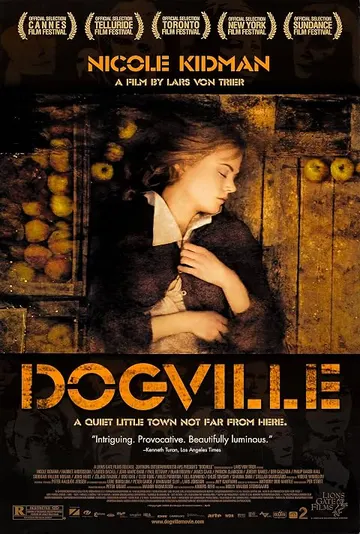
Lars von Trier / 拉斯·冯·提尔 · 2003
Dogville
Dogville
Black stage, white lines, and invisible doors turn setting into a map of thought and reveal space as a relational machine.
Film details
- Original title
- Dogville
- Director
- Lars von Trier / 拉斯·冯·提尔
- Year
- 2003
- Region
- Denmark
Close-reading questions
- 01How do the black stage, white lines, and invisible doors turn space into a map of thought?
- 02How do overhead views, narration, and chapters form a noosign?
- 03How are shifts in power rendered directly as spatial relations?
Analysis and scene sources
Shots and scenes
Primary texts, scholarship, and locators
Theory coordinate: Deamer, 2016, pp. 335–336
- 01Deleuze’s Cinema Books: Three Introductions to the Taxonomy of Images
Detailed reconstruction with a film index; the nine-cell grid and eleven film cases carry the evidence status of Deamer’s later interpretation.
Open the atlas source record →
This film in books and research
The Cinematic Body · Further discussion
Can intensity escape the viewing position?
pp. 9–10
Claim: A body being affected does not mean the apparatus has been dismantled. Viewpoint, suture, sound, and institutions can use intensity to secure an existing position.
Extension: Mulvey and Doane keep the gendering of the gaze in view and track how spectatorship moves among identification, voyeurism, and masquerade.
Tension: Apparatus theory loses uncontrolled shock, disgust, and pleasure when it reduces bodies to positions; treating dislocation as sufficient evidence of escape also misses how intensity can serve domination.
Mulvey: Visual Pleasure and Narrative CinemaDoane: Film and the Masquerade
Viewing gateways and editions
- Verified complete Bilibili carrier: 狗镇bilibili.comOpen film page ↗
- Page access
- Accessible when checked
- Version extent
- Recorded as a complete version
- Source type
- User-uploaded page
Edition note: Complete single-part film · 2:57:55.
Link checked: 2026-08-13
- Danish Film Institutedfi.dkOpen film page ↗
- Source type
- Institutional source