The Irrational Cut: How the Interstice Becomes a Lectosign
A method for reading images through autonomous audio-visual series, incommensurable limits, and stratigraphic relinking
Concept relation
- 01Sound and image form autonomous series→
- 02The transition leaves action and unified space-time→
- 03The gap relinks both sides through difference→
- 04The viewer relinks text, strata, and absence
The irrational cut makes the gap between shots, sounds, or audio-visual series structurally operative. The series no longer follow from action, causality, or a unified whole, yet are relinked at an incommensurable limit; the lectosign demands their stratigraphic relinking.
Cinema 2 chapters 7, 9, and 10 establish the interstice, irrational cut, and lectosign and directly analyze La Femme du Gange, India Song, and From the Clouds to the Resistance. All three Tropical Malady scene readings are atlas analyses.
Primary coordinates
DELEUZE PRIMARY TEXTthe irrational cut
FACT → RELATION → TEST
The cut changes from transition into relation
The irrational cut belongs to neither adjoining series; with a duration of its own, it determines how the two relate.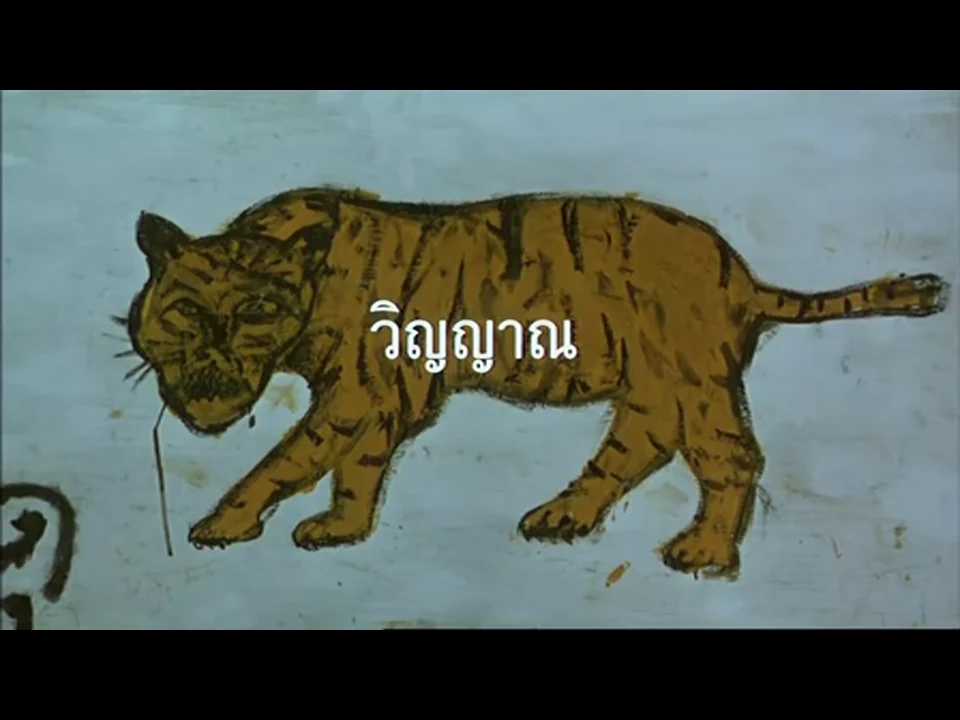
Photographs, black screen, and a second title sequence headed 'A Spirit's Path' sever the everyday love story of the first half. Bilibili timecode 00:58:55.
Bilibili at 00:58:55 Open scene evidenceClassical linkage assigns a cut to the end of one shot or the beginning of the next, with action and causality explaining the transition. The irrational cut releases the cut from both sides: blackout, false continuity, heterogeneous intertitle, or sudden regrouping gives the gap a duration of its own.[1, pp. 173–180, 245–248][3, pp. 165–196]
Tropical Malady moves from the couple's photograph into blackout, an intertitle bearing a tiger and the word 'spirit,' and then the night forest. The second movement cannot be deduced from the preceding romantic action, yet the same actor, tiger, legend, and sound layer keep the movements in relation. The gap resets their rule of linkage without erasing either side.
FACT → RELATION → TEST
Audio-visual disjunction establishes an incommensurable common limit
Sound-image and visual image unfold autonomously and touch through distance rather than restored synchronization.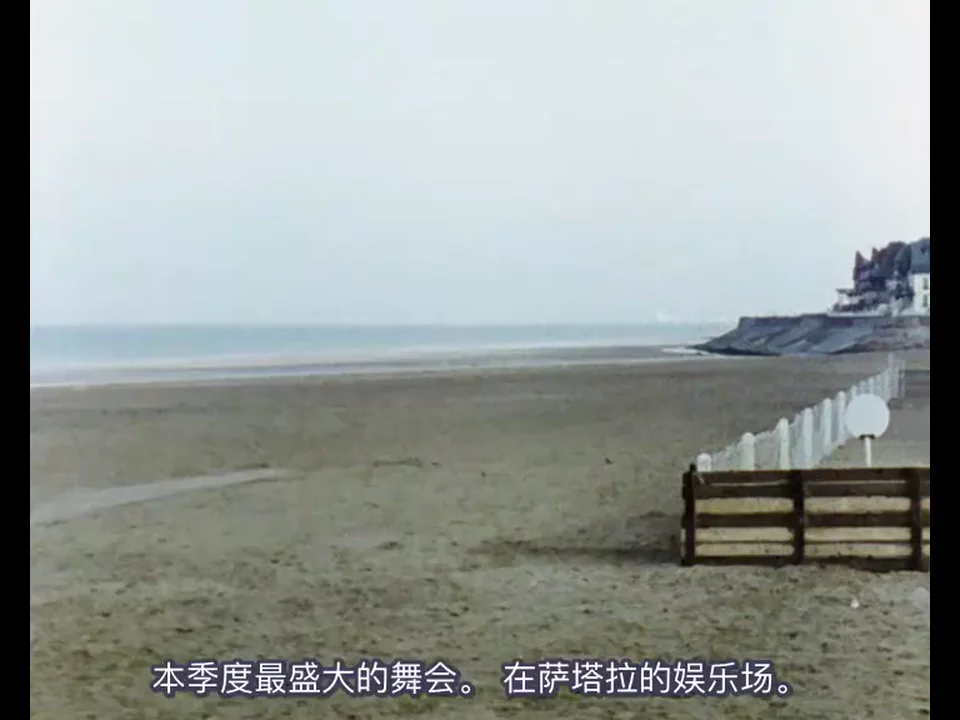 第1分段 00:08:20 / Part 1 00:08:20
The voice points toward a ball and its figures while the image holds on a place with no speaker.
Beach, bench, fence, and distant buildings remain empty; neither the ball nor a speaker appears.
An off-screen voice speaks of a grand ball without receiving a synchronized source in the empty view.
SITE ANALYSISSound and image unfold independently rather than through synchronized explanation; the viewer must read the interval among empty place, absent figures, and off-screen narration.
Cinema 2, chapter 7, pp. 173–180; chapter 9, pp. 245–261.Bilibili at 第1分段 00:08:20 / Part 1 00:08:20 Open original still ↗Part 1's empty-beach and off-screen voice passage was frame-checked.Complete Bilibili carrier; the shot at 第1分段 00:08:20 was checked frame by frame, and the still and timestamp come from the same public upload.
Bilibili · La Femme du Gange, part 1 · verified 2026-08-14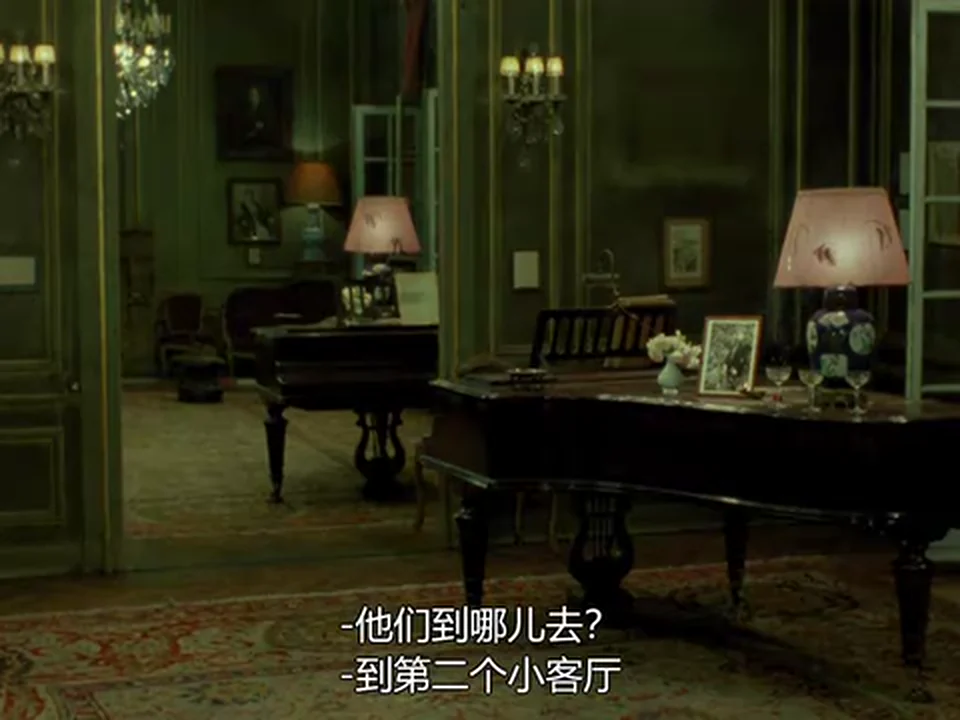 第9分段 00:48
Voices ask where the figures have gone while the image holds on an empty salon. The event remains in sound; the present space remains visible.
Two connected salons show pianos, lamps, mirrors, and framed photographs; no person enters the image.
Burned-in Chinese subtitles place a dialogue about the figures' location over an unoccupied space.
Two off-screen voices ask where the figures went and answer that they moved to the second salon.
The voices continue with references to the ambassador and champagne while the image supplies no speaking body.
SITE ANALYSISSound preserves relations and an event already underway while the empty rooms form another present. Sound and image do not complete each other; they remain autonomous series meeting at absence.
Cinema 2, chapters 7 and 9; atlas shot analysis.Bilibili at 第9分段 00:48 Open original still ↗Bilibili part 9 timeline, frame-verified to within one second.Complete 20-part film, total runtime 1:54:08; player, playurl, and anonymous media responses were verified for all twenty parts. Bilibili submission label: repost.
Bilibili complete 20-part upload · 忆君夕阳时 · verified 2026-08-14In La Femme du Gange, two timeless voices and the visible image unfold separately; voices do not belong to visible mouths and the visual does not illustrate sound. The series touch only at their limits and at a point at infinity, turning incommensurability into a new relation.[1, pp. 251, 257, 260–261]
In India Song, voices preserve a history of vanished relations, while empty rooms, bodily attitudes, and closed mouths form another visual stratum. Neither sound can own the absent event nor image restore it; the series meet at the edge of absence.[1, pp. 250, 256–258][2, pp. 162–171]
FACT → RELATION → TEST
Reading means relinking strata
The lectosign requires the viewer to rebuild an open route across image, sound, text, history, and absence.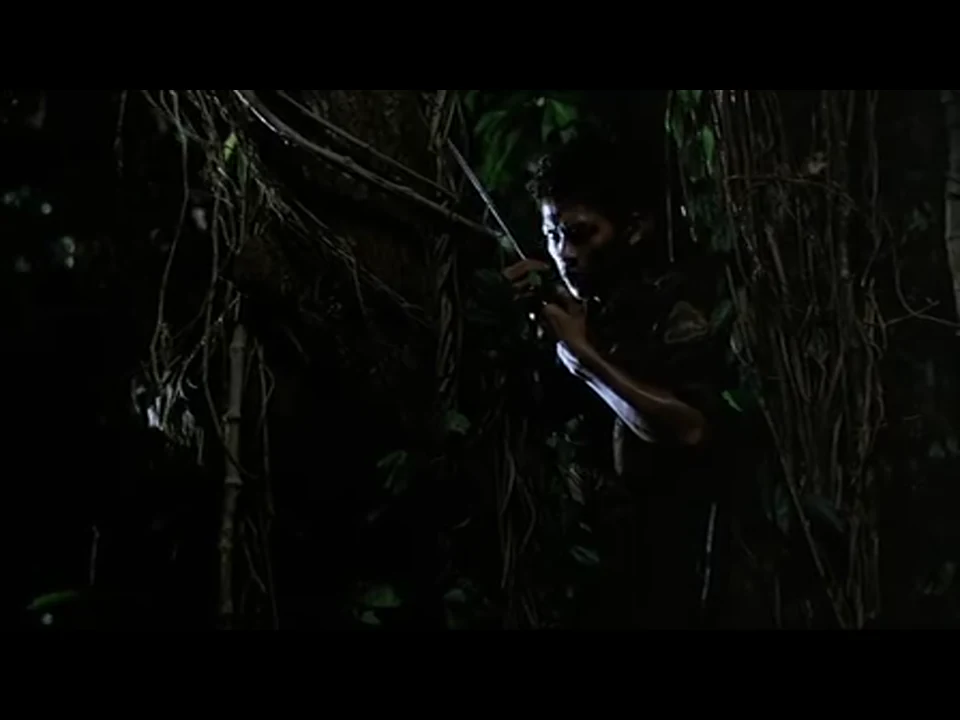
The communication device sends a call but does not turn the forest back into a mappable action-space. Bilibili timecode 01:08:47.
Bilibili at 01:08:47 Open scene evidence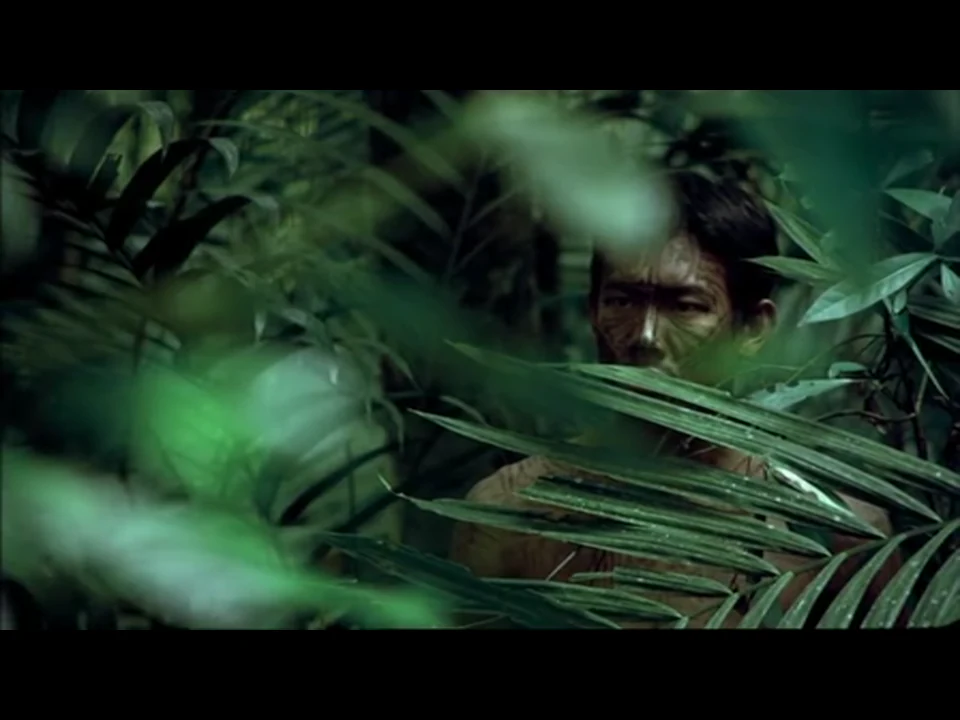
The body first appears as a difficult-to-identify fragment; a following intertitle links the gaze to the soldier's sound device. Bilibili timecode 01:17:54.
Bilibili at 01:17:54 Open scene evidence 01:10:00
Speech does not explain the land; voice and fields inscribed by struggle must be read together.
The man speaks at the field's edge while crops, paths, and parcels remain clearly visible behind him.
The shot does not cut to dramatic action as an illustration of the speech.
The man delivers Pavese's text in a continuous, measured voice without erasing the outdoor sound field.
SITE ANALYSISThe land is read as a stratum marked by struggle while speech crosses without exhausting it; the two series reconnect history at their respective limits.
Cinema 2, chapter 9, pp. 253, 255, 259.Bilibili at 01:10:00 Open original still ↗The monologue-in-the-fields passage was frame-checked.Complete Bilibili carrier; the shot at 单片 01:10:00 was checked frame by frame, and the still and timestamp come from the same public upload.
Bilibili · From the Clouds to the Resistance complete film · verified 2026-08-14In From the Clouds to the Resistance, mythical text, speech act, and land do not form an explanatory relation. The land is read as a stratum inscribed by struggle, while speech crosses it without exhausting it; reading relinks history after both series reach their limits.[1, pp. 253, 255, 259][4, pp. 362–365]
In Tropical Malady, radio calls restore neither command nor coordinates while forest sound occupies the auditory field; a partial body among leaves is then supplemented by an intertitle naming a relation of looking absent from the image. The viewer must combine failed communication, occlusion, text, and memory of the first movement to read the forest relation.
FACT → RELATION → TEST
The provenance of sound and image must also be tracked separately
Audio-visual disjunction is not merely asynchrony but a separation of provenance, body, and historical address; the lectosign begins by asking whose voice this is and which present the image belongs to.Cinema 2 places autonomy at the level of relation rather than technical form: an old soundtrack, live performance, offscreen voice, or silence acquires signifying force only when it changes the image's temporal address.[1, Chapters 9–10, pp. 251–279]
Chronicle of Anna Magdalena Bach places document, hands, and sound in one extended duration; Son nom de Venise puts India Song's old soundtrack over new ruins. The former lets history happen again in a body, while the latter removes history's former visual address. Both ask the viewer to read difference rather than recover a synchronized explanation.
Film comparisons
The Ganges Woman
Two timeless voicesSound and image unfold separately and touch only at their limits and a point at infinity.
Deleuze discusses this film directly here · pp. 251, 257, 260–261第1分段 00:08:20 / Part 1 00:08:20The voice points toward a ball and its figures while the image holds on a place with no speaker.
Beach, bench, fence, and distant buildings remain empty; neither the ball nor a speaker appears.
An off-screen voice speaks of a grand ball without receiving a synchronized source in the empty view.
SITE ANALYSISSound and image unfold independently rather than through synchronized explanation; the viewer must read the interval among empty place, absent figures, and off-screen narration.
Cinema 2, chapter 7, pp. 173–180; chapter 9, pp. 245–261.Bilibili at 第1分段 00:08:20 / Part 1 00:08:20 Open original still ↗Part 1's empty-beach and off-screen voice passage was frame-checked.Complete Bilibili carrier; the shot at 第1分段 00:08:20 was checked frame by frame, and the still and timestamp come from the same public upload.
Bilibili · La Femme du Gange, part 1 · verified 2026-08-14India Song
Two strata of an absent eventVoices preserve relational history while rooms and attitudes form a visual stratum.
Deleuze discusses this film directly here · pp. 250, 256–258第9分段 00:48Voices ask where the figures have gone while the image holds on an empty salon. The event remains in sound; the present space remains visible.
Two connected salons show pianos, lamps, mirrors, and framed photographs; no person enters the image.
Burned-in Chinese subtitles place a dialogue about the figures' location over an unoccupied space.
Two off-screen voices ask where the figures went and answer that they moved to the second salon.
The voices continue with references to the ambassador and champagne while the image supplies no speaking body.
SITE ANALYSISSound preserves relations and an event already underway while the empty rooms form another present. Sound and image do not complete each other; they remain autonomous series meeting at absence.
Cinema 2, chapters 7 and 9; atlas shot analysis.Bilibili at 第9分段 00:48 Open original still ↗Bilibili part 9 timeline, frame-verified to within one second.Complete 20-part film, total runtime 1:54:08; player, playurl, and anonymous media responses were verified for all twenty parts. Bilibili submission label: repost.
Bilibili complete 20-part upload · 忆君夕阳时 · verified 2026-08-14From the Cloud to the Resistance
The land must be readMyth, speech act, and strata of struggle are relinked at their limits.
Deleuze discusses this film directly here · pp. 253, 255, 25901:10:00Speech does not explain the land; voice and fields inscribed by struggle must be read together.
The man speaks at the field's edge while crops, paths, and parcels remain clearly visible behind him.
The shot does not cut to dramatic action as an illustration of the speech.
The man delivers Pavese's text in a continuous, measured voice without erasing the outdoor sound field.
SITE ANALYSISThe land is read as a stratum marked by struggle while speech crosses without exhausting it; the two series reconnect history at their respective limits.
Cinema 2, chapter 9, pp. 253, 255, 259.Bilibili at 01:10:00 Open original still ↗The monologue-in-the-fields passage was frame-checked.Complete Bilibili carrier; the shot at 单片 01:10:00 was checked frame by frame, and the still and timestamp come from the same public upload.
Bilibili · From the Clouds to the Resistance complete film · verified 2026-08-14Tropical Malady
A second opening resets the rulesBlackout, tiger image, forest sound, and text test the chain from cut to reading.
00:58:55Photographs, black screen, and a second title sequence headed 'A Spirit's Path' sever the everyday love story of the first half. Bilibili timecode 00:58:55.
After the final interior shot of the first half, photographs of the two men appear and the image turns black.
The black screen gives way to a hand-drawn tiger, the Thai word for 'spirit,' and a second set of credits; the exact-release English SRT renders the written sequence as 'A Spirit's Path' and a shaman legend, after which the image enters the forest at night.
The preceding sound stops at the black interval, so the aural break coincides with the visual rupture.
After the photographs turn to black, the track settles into sustained near-silence; no spoken dialogue or narration is heard over the tiger cards.
SITE ANALYSISThe two halves are not directly deducible through one continuous action chain, while tiger, legend, and the same performers keep them related; both conditions hold.
Bilibili at 00:58:55 Open original still ↗Frame-checked against the single-part Bilibili repost stream BV12QcAzME5g: the page API reports 6,867 seconds and the retrieved qn16 media runs 6,866.48 seconds. Bilibili supplies no subtitle track; dialogue sense was cross-checked against a third-party English SRT bearing the same DVDRip release name.Single-part user repost on Bilibili; the page and anonymous Player API were verified as playable. No platform subtitle track is present.
Bilibili · 冰山阴影_ · public repost page · verified 2026-08-13Put the claim back into more films
These films are not a list of examples but pressure tests: when the same concept meets different spaces, bodies, sounds, and narrations, which relations still hold and which must be withdrawn?
When does action give way to seeing?
Begin with postwar situations in Rossellini and Antonioni: first test whether action can still change the world, then track which sights and sounds leave time in a situation the character cannot master.
Germany Year Zero
Ruins break the action-chain from within
Edmund still walks, trades, poisons, and climbs, yet none of these movements repairs the family or opens a future. Time is no longer an interval measured between acts; it is the present the child endures before the intolerable.
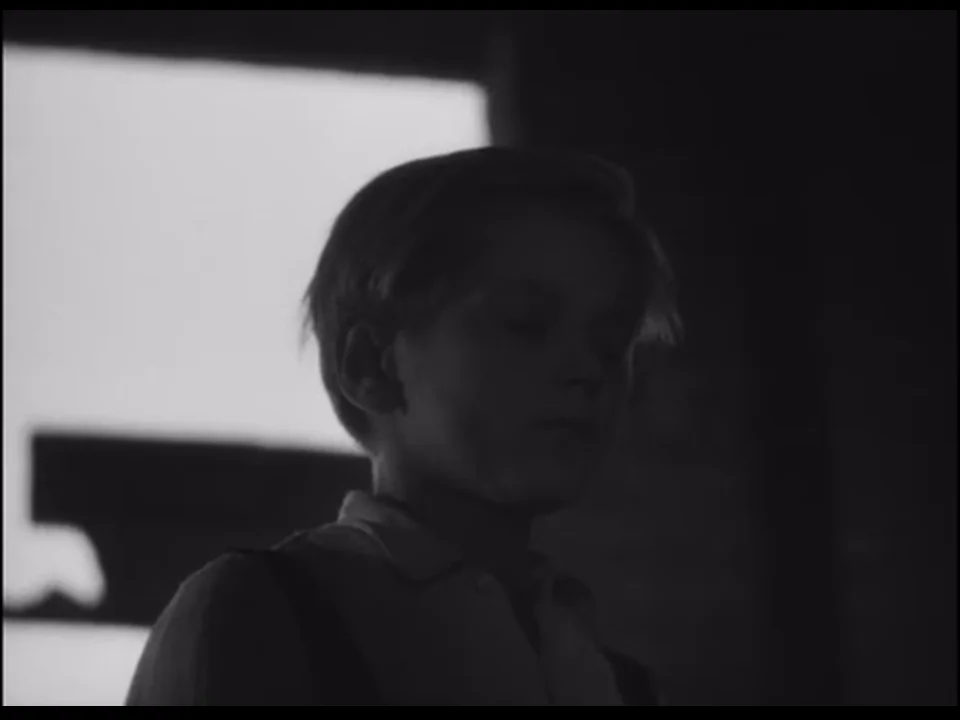 01:12:18
- CONCEPT MOVE
- Movement succeeds locally while the situation remains unmastered; the agent becomes a seer.
- SHOT EVIDENCE
- Replay the ending and log each walk, pause, pickup, look, and climb; ask whether the image supplies an actionable next task.
- BOUNDARY
- The tragic theme of the ruins is not the rupture by itself; the test is the continuing failure of action to alter the situation.
Cinema 2, ch. 1, p. 2
LOCATORFinal wandering and climb; Cinema 2, ch. 1, p. 2
Europe ’51
The factory turns ethical action into an optical situation too strong to master
Once Irene enters the factory, machines, workers, rollers, and passages no longer await her management. She encounters not a social task ready to solve but an intensity that changes her perceptual regime; seeing comes before a new ethics of action.
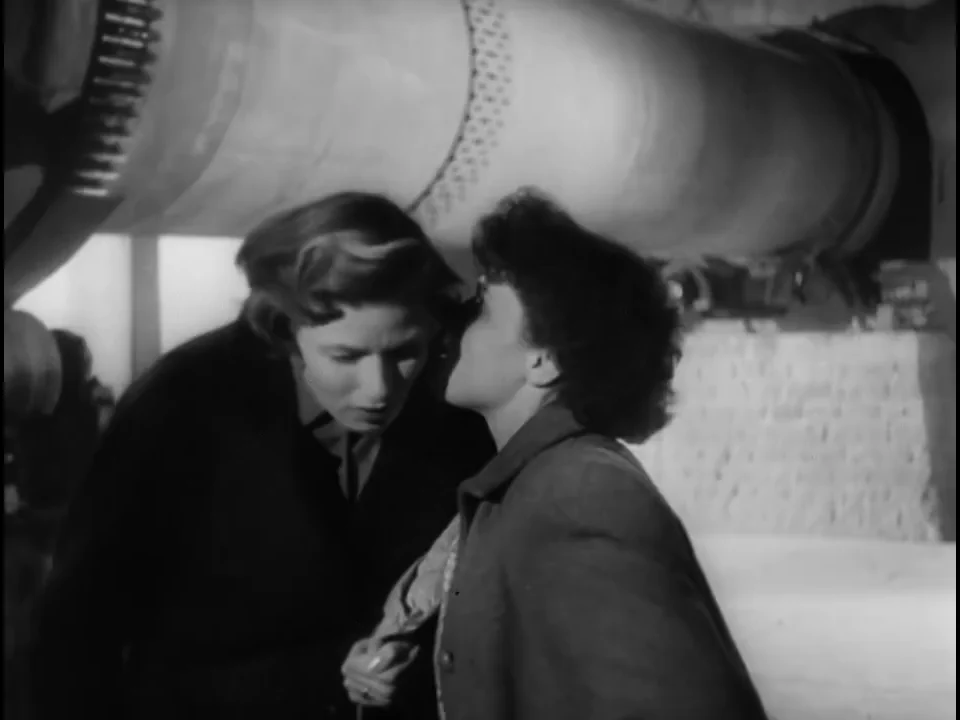 01:00:00
- CONCEPT MOVE
- The situation escapes the character's inherited moral task, and the pure optical situation acquires its own pressure.
- SHOT EVIDENCE
- Compare the factory entrance, machine rhythm, and Irene's facial response: does her seeing still gather information for a predetermined act?
- BOUNDARY
- Factory subject matter or a changed opinion is insufficient; the image must show the old recognition–response chain losing its command.
Cinema 2, ch. 1, p. 2; ch. 3, pp. 45–46
LOCATORFactory passage; Cinema 2, ch. 3, pp. 45–46
When does sound stop serving the image?
From Duras's autonomous voices to Straub's live performance, separate the times of sound and image first, then locate their contact at the boundaries of absence, body, and history.
India Song
Voices leave bodies and sound and image form autonomous series
Voices no longer explain the psychology of visible bodies. Image and sound unfold along separate temporal lines and meet at the edge of an absent event. Viewing must track who speaks, who is seen, and who never appears.
第9分段 00:48- CONCEPT MOVE
- Sound and image remain heterogeneous, and the interval itself bears the event's temporal pressure.
- SHOT EVIDENCE
- Listen once with eyes closed, then replay with the image: record the past addressed by sound, the present shown by image, and where they touch through absence.
- BOUNDARY
- Voice-over or asynchrony is not automatically audio-visual reading; sound must have a temporal series not governed by the image.
Cinema 2, ch. 9, pp. 250, 256–258
LOCATORDance, empty corridors, and the crossing of absent voices
Tropical Malady
Black screen cuts intimacy into another forest-time, while sound and gaze suspend the hunt before action
Touch, smiles, and everyday dialogue in the first half are severed by the tiger title card. The radio does not restore the forest as a mappable command-space, and the frontal gazes of tiger and soldier prevent recognition from becoming an immediate shot. Sound, writing, animal, and body jointly change the rules of viewing.
00:58:55- CONCEPT MOVE
- The irrational cut withdraws the first half's action coordinates; sound and image then extend separate series of waiting, recognition, and prophecy.
- SHOT EVIDENCE
- Replay the black title card, unanswered radio, gaze through leaves, monkey's address, and tiger/soldier encounter in order; record how sound or writing gains priority over action in each passage.
- BOUNDARY
- Black screen, forest sound, or animal gaze alone is insufficient; the action-chain must be severed across the two halves while sound and image generate a new temporal relation in the interval.
Eight atlas shot records with Bilibili timecodes
Cinema 2, ch. 9: conceptual baseline for audio-visual autonomy
LOCATOR00:58:55, 01:08:47, 01:17:54, 01:29:20, 01:45:12, 01:48:40
How scholarship advances the problem
David Deamer
Deleuze's Cinema BooksPlaces the lectosign within Deleuze's taxonomy and connects its silent and audible forms.
Used to build the three-stage method of autonomous series, common limit, and relinking.Open full citation ↓Ronald Bogue
Deleuze on CinemaSystematically explains the audio-visual thought structure of noosigns and lectosigns.
Used to distinguish structural reading from explanatory sound and symbolic decoding.Open full citation ↓David Deamer
A Deleuzian CineosisPlaces lectosigns within syntheses of time and cinematic semiosis.
Used to render each relinking route as a testable relation map.Open full citation ↓References
- 01
DELEUZE PRIMARY TEXT Gilles Deleuze, Cinema 2: The Time-Image, trans. Hugh Tomlinson and Robert Galeta (University of Minnesota Press, 1989).
Chapter 7, pp. 173–180; chapter 9, pp. 245–261; chapter 10, pp. 262–265, 277–279Publisher record and purchase access - 02
SCHOLARSHIP David Deamer, Deleuze's Cinema Books: Three Introductions to the Taxonomy of Images (Edinburgh University Press, 2016).
Chapter 16, “Lectosigns,” pp. 162–171Publisher chapter record - 03
SCHOLARSHIP Ronald Bogue, Deleuze on Cinema (Routledge, 2003).
Chapter 6, “Noosigns and Lectosigns,” pp. 165–196Publisher record and preview - 04
SCHOLARSHIP David Deamer, “A Deleuzian Cineosis: Cinematic Semiosis and Syntheses of Time,” Deleuze Studies 5.3 (2011), pp. 358–382.
Lectosign chain at pp. 362–365DOI and journal access · DOI 10.3366/dls.2011.0026