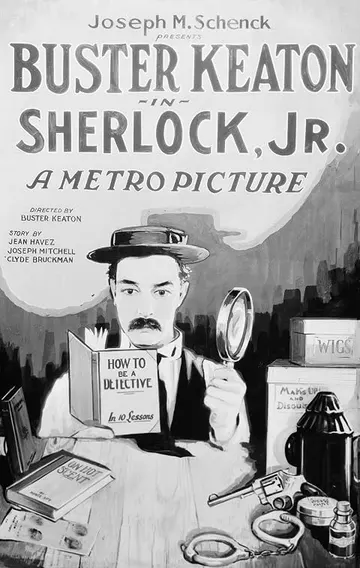
Buster Keaton / 巴斯特·基顿 · 1924
Sherlock Jr.
Sherlock Jr.
When the projectionist enters the screen, his body remains still while garden, street, precipice, snowfield, and shore strike through cuts. The train passage reverses the relation, carrying him continuously across roof, water tower, and track in one shot. Disjunctive editing and bodily trajectory make the cinema-machine a comic agent.
Film details
- Original title
- Sherlock Jr.
- Director
- Buster Keaton / 巴斯特·基顿
- Year
- 1924
- Region
- United States
Film analysis: how shots organize concepts
The screen world alternates between disjunctive editing and continuous bodily trajectory, turning the cinema-machine from tool into comic partner.
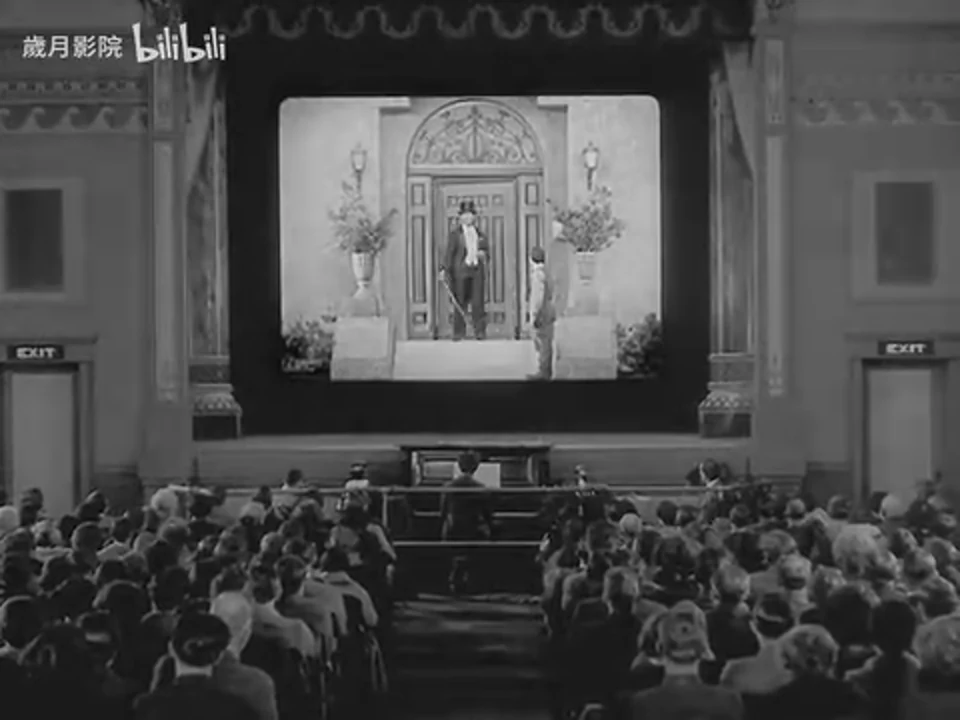 00:19:45
- 01Space attacks the body
After the projectionist enters the screen, his position stays fixed while garden, street, cliff, snowfield, and shore replace one another by cuts.
Editing no longer serves continuous space; environmental change becomes a force acting directly on the body. - 02Trajectory overtakes editing
In one shot, Keaton climbs through a train hatch, is swept to the track by a water tower, and runs into the distance.
Physical causality and bodily continuity produce a pure trajectory, extending action from minor cue into machine circuit. - 03The screen teaches action
At the end, he watches the screen couple and imitates proposal, embrace, and kiss step by step.
Life becomes executable only through cinematic mediation; the machine becomes the third term in the relation.
Close-reading questions
- 01When the projectionist crosses into the screen, his bodily position remains continuous while garden, street, cliff, and snowfield change by cuts; how does editing make space attack the stationary body?
- 02In the single shot where he climbs through a train hatch, is swept down by the water tower, and runs away, how does physical causality replace editing to produce a pure continuous trajectory?
- 03At the end he learns an embrace from the screen: cinematic example → bodily imitation → hesitation. Is the machine a guide to action or a third term that keeps postponing life?
Analysis and scene sources
Shots and scenes
Primary texts, scholarship, and locators
Theory coordinate: Cinema 1, Minnesota 1986, ch. 10, p. 175
- 01Cinema 1: The Movement-Image
Standard Minnesota English translation and a principal citation edition in Anglophone scholarship.
Open the atlas source record →
Viewing gateways and editions
- Verified complete Bilibili carrier: 經典默片《福爾摩斯二世》(1924)伯士達·傑頓bilibili.comOpen film page ↗
- Page access
- Accessible when checked
- Version extent
- Recorded as a complete version
- Source type
- User-uploaded page
Edition note: Complete single-part film · 44:45.
Link checked: 2026-08-14