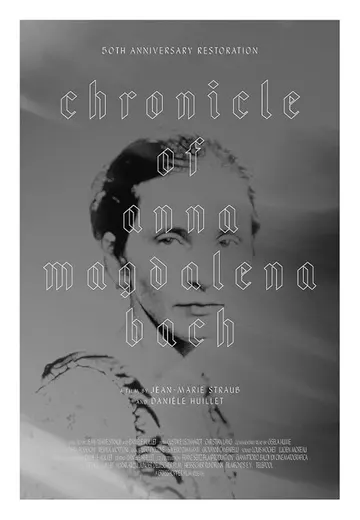
Danièle Huillet & Jean-Marie Straub / 达尼埃尔·于伊耶、让-马里·斯特劳布 · 1968
Chronicle of Anna Magdalena Bach
Chronik der Anna Magdalena Bach
Anna's narration, letters, and the son's account form free indirect discourse. Live performance lets music acquire a resistant force independent of score and biographical explanation.
Film details
- Original title
- Chronik der Anna Magdalena Bach
- Director
- Danièle Huillet & Jean-Marie Straub / 达尼埃尔·于伊耶、让-马里·斯特劳布
- Year
- 1968
- Region
- West Germany / Italy
Close-reading questions
- 01How do narration, letters, documents, and live performance form autonomous yet intersecting layers of sound?
- 02In which sustained performances does music leave biographical illustration and become bodily and historical resistance?
Analysis and scene sources
Shots and scenes
Primary texts, scholarship, and locators
Theory coordinate: Cinema 2, Minnesota 1989, ch. 9, pp. 253–54, 260
- 01Cinema 2: The Time-Image
Authoritative source for the standard translation, translators, ISBN, and publication date.
Open the atlas source record →
This film in books and research
Sensory-Motor Rupture: How a Character Becomes a Seer
Opsign and sonsign: not slowness, but autonomous series beyond action
Claim: The key to a pure optical or sound situation is not a slower rhythm but the moment when image or sound no longer supplies information for the next action; each preserves a time that reaction cannot exhaust.
Conclusion: Separate image and sound into two columns and track which one escapes action cues and acquires its own duration. Either column may independently form an opsign or sonsign; only when both unfold autonomously and meet at a common limit should the analysis proceed to audio-visual disjunction and the lectosign.
Cinema 2: The Time-Image · Chapter 9, pp. 251–261; chapter 10, pp. 262–265Deleuze on Cinema · Sections on ‘Opsigns’ and the sound-image, pp. 107–118, 165–177
The Irrational Cut: How the Interstice Becomes a Lectosign
The provenance of sound and image must also be tracked separately
Claim: Audio-visual disjunction is not merely asynchrony but a separation of provenance, body, and historical address; the lectosign begins by asking whose voice this is and which present the image belongs to.
Conclusion: Build a provenance ledger for sound and image, then locate how the interval changes historical address; this explains the lectosign more precisely than ‘asynchrony.’
Viewing gateways and editions
- Verified complete Bilibili carrier: 安娜·玛格达丽娜·巴赫的编年史 Chronik der Anna Magdalena Bach (1968)【古斯塔夫·莱昂哈特】bilibili.comOpen film page ↗
- Page access
- Accessible when checked
- Version extent
- Recorded as a complete version
- Source type
- User-uploaded page
Edition note: Complete single-part film · 1:34:10.
Link checked: 2026-08-13