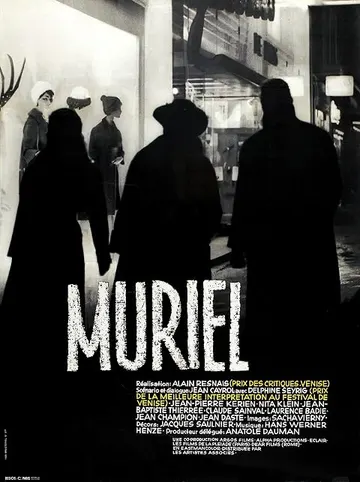
Alain Resnais / 阿伦·雷乃 · 1963
Muriel
Muriel ou Le Temps d’un retour
The Algerian War past remains fragmentary as short montage, rooms, and speech continually transform it across different sheets.
Film details
- Original title
- Muriel ou Le Temps d’un retour
- Director
- Alain Resnais / 阿伦·雷乃
- Year
- 1963
- Region
- France / Italy
Film analysis: how shots organize concepts
Muriel keeps the wartime past fractured across short shots, rooms, and repeated speech; the present cannot assemble them into one completed memory and must continue under their pressure.
- 01Everyday surfaces cover the wartime sheet
Apartment arrangement, furniture movement, and walks by the sea form a present of continuous action, while Algerian fragments intrude as abrupt short shots.
The past is not explanatory background but a coexisting sheet that can alter the present's rhythm; Cinema 2, ch. 5, pp. 116, 118, 120, and 122–123 are film-level primary coordinates, while the present shot mechanism is this site's analysis. - 02Repetition mutates rather than completes
The same wartime word, photograph, and bodily attitude recur in different rooms, each time with one less piece of confirmable causality.
Repetition presses the sheet back onto the present without becoming a complete flashback; the spectator must read how absence organizes responsibility. - 03Fragments become ethical pressure
Bernard's silence, Hélène's arrangements, and Alphonse's return never reduce Muriel to a solvable case.
Read beside Hiroshima mon amour, private and wartime pasts remain incommensurable; the audio-visual gap becomes a lectosign rather than an information deficit.
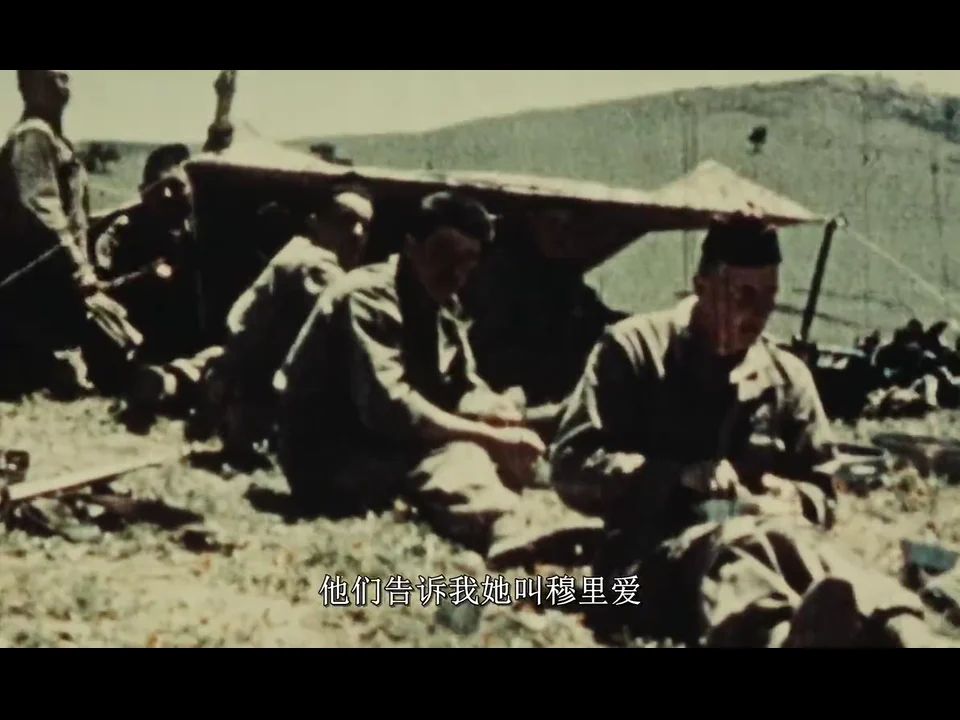 第11分段 00:00:25 / Part 11 00:00:25
The routine soldiers' footage does not show torture; Bernard's present voice presses the absent event into the image.
The 8mm footage shows soldiers sitting and resting in the hills; it does not show the torture Bernard describes.
Grain, faded colour, and projected-film texture mark the footage as another layer of record.
Over 8mm images without synchronized location sound, Bernard's present voice names Muriel and continues his account.
SITE ANALYSISThe wartime past is neither fully restored by the footage nor contained in speech; the split between routine images and torture testimony makes the past act in the present as an untotalizable sheet.
Cinema 2, chapter 5, pp. 116, 118, 120, 122–123; these are film-level primary-text coordinates, while the present shot relation is this site's analysis.Bilibili at 第11分段 00:00:25 / Part 11 00:00:25 Open original still ↗Part 11 was frame-checked; the anchor lies in the disjunction between silent 8mm footage and Bernard's narration.Complete Bilibili carrier; the shot at 第11分段 00:00:25 was checked frame by frame, and the still and timestamp come from the same public upload.
Bilibili · Muriel, part 11 · verified 2026-08-14Close-reading questions
- 01How does the wartime past mutate among short montage, rooms, and speech?
- 02Why do the fragments refuse to converge into a complete recollection?
- 03When the same word and attitude recur with one piece of causality missing, how does absence become ethical pressure rather than narrative information?
Analysis and scene sources
Shots and scenes
Primary texts, scholarship, and locators
Theory coordinate: Cinema 2, Minnesota 1989, ch. 5, pp. 116, 118, 120, 122–123; ch. 6, p. 134; ch. 9, p. 240
- 01Cinema 2: The Time-Image
Authoritative source for the standard translation, translators, ISBN, and publication date.
Open the atlas source record →
This film in books and research
The Neuro-Image · Book case
Muriel
pp. 127–146
Film relation: Algerian trauma moves within the present through rooms, objects, amateur film, sound, and montage.
Shot question: How does violence erased from amateur footage continue organizing the present?
Gilles Deleuze : cinéma et philosophie · Atlas analysis
Muriel
Marrati pp. 95–101 · site test
Film relation: This site extends Marrati's criterion of sheets of past to memory of the Algerian War: 8mm footage, torture narration, and the apartment present cut into one another without composing a past that can be fully restored.
Shot question: What visible facts does the amateur footage provide? How does Bernard's narration redistribute an apparently ordinary present through a violent past that remains unseen?
Conclusion: Sheets of past are not archival drawers leading to one truth; the choice of which sheet to enter already changes relations among present bodies and spaces.
Sheets of Past and Peaks of Present: How the Order of Time Enters the Image
Temporal relation takes over image linkage
Claim: A chronosign appears when coexistence of sheets or simultaneity of peaks directly organizes shots.
Conclusion: Record version, temporal position, mode of evidence, and action-consequence; when temporal relation links shots directly, the order of time becomes an image principle.
Cinema 2: The Time-Image · ch. 5, pp. 116, 118, 120, 122–123Deleuze's Cinema Books · pp. 151–156
Sheets of Past and Peaks of Present: How the Order of Time Enters the Image
Stratigraphic historical memory
Film comparison: A wartime past moves within the present through space, objects, speech, and montage.
Cinema 2: The Time-Image · ch. 5, pp. 116, 118, 120, 122–123
Viewing gateways and editions
- Verified complete Bilibili multipart carrier: 莫里埃尔 Muriel ou Le temps d'un retour (1963/阿伦·雷乃)bilibili.comOpen film page ↗
- Page access
- Accessible when checked
- Version extent
- Recorded as a complete version
- Source type
- User-uploaded page
Edition note: Complete 20-part film · 1:56:38.
Link checked: 2026-08-13