Concept definition
Chronosign is the superordinate classification used when temporal relations directly organize the connection of images rather than merely measuring or resulting from action. Chapter 5 distinguishes two branches that are distinct and non-interchangeable: sheets of past make the virtual past coexisting with the present into regions of recollection-search, while peaks of present sustain incompossible presents and deactualize the single present. Both are signs of direct time, but they answer different problems.
What the concept explains
A chronosign requires an order or series of time to connect images directly rather than merely measure action. Analysis must name the branch at work: sheets of past, peaks of present, or a temporal series that places before and after into becoming.
Sheets of Past and Peaks of Present: How the Order of Time Enters the ImageDiagrams and film passages
Citizen Kane
Citizen Kane (1941)
Atlas discussion reading
The investigation does not return to one past; it enters one sheet through a witness document.
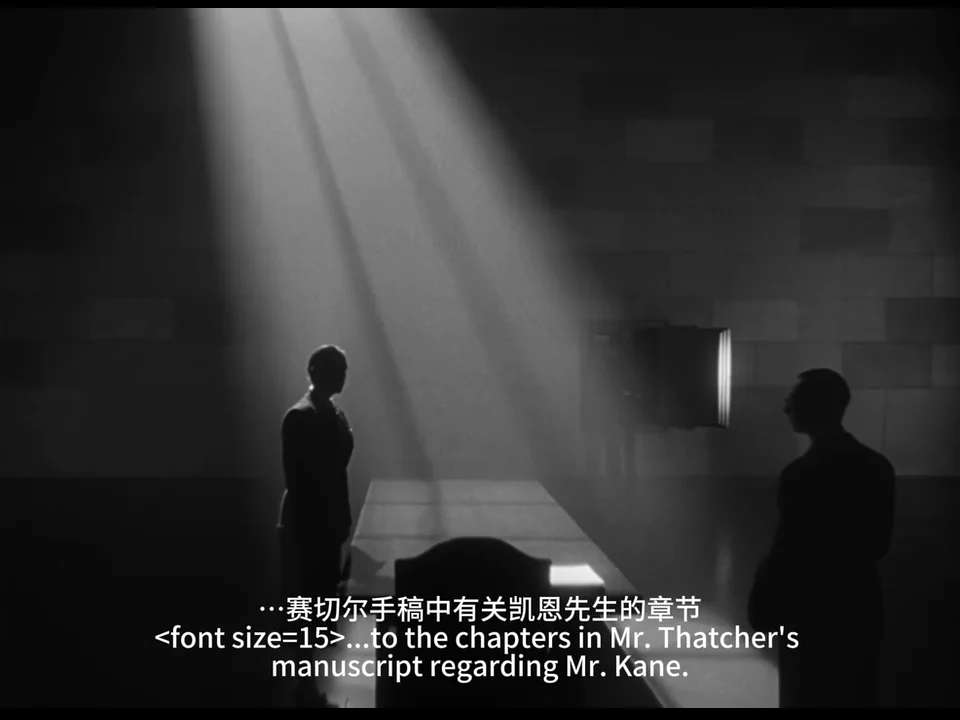
The investigation does not return to one past; it enters one sheet through a witness document.
Open full-size still- Displayed still
- 第3分段 00:00:15 / Part 3 00:00:15
- Discussion passage
- 第3分段 00:00:00–00:00:40 / Part 3 00:00:00–00:00:40
- Carrier part
- 3
Part 3 was frame-checked; the anchor is the entrance into Thatcher's manuscript.
Complete Bilibili carrier; the shot at 第3分段 00:00:15 was checked frame by frame, and the still and timestamp come from the same public upload.
Still checked: 2026-08-14
Image
A single overhead beam cuts out the large reading table and manuscript while the figures recede into silhouettes.
The archive material lies between the two figures as a material entrance into Kane's past.
Sound
The attendant directs Thompson to the chapters of Thatcher's manuscript concerning Kane.
Relation to the concept
The manuscript is not a key that solves a life but one sheet opened by witness, document, and image; later testimonies enter other sheets.
Sources and further reading
- Bilibili · Citizen Kane, part 3
第3分段 00:00:15 / Part 3 00:00:15 · Complete Bilibili carrier; the shot at 第3分段 00:00:15 was checked frame by frame, and the still and timestamp come from the same public upload.
- Cinema 2: The Time-Image
Cinema 2, chapter 5, pp. 105, 110–111, 115–119.
Muriel
Muriel ou Le Temps d’un retour (1963)
Atlas discussion reading
The routine soldiers' footage does not show torture; Bernard's present voice presses the absent event into the image.
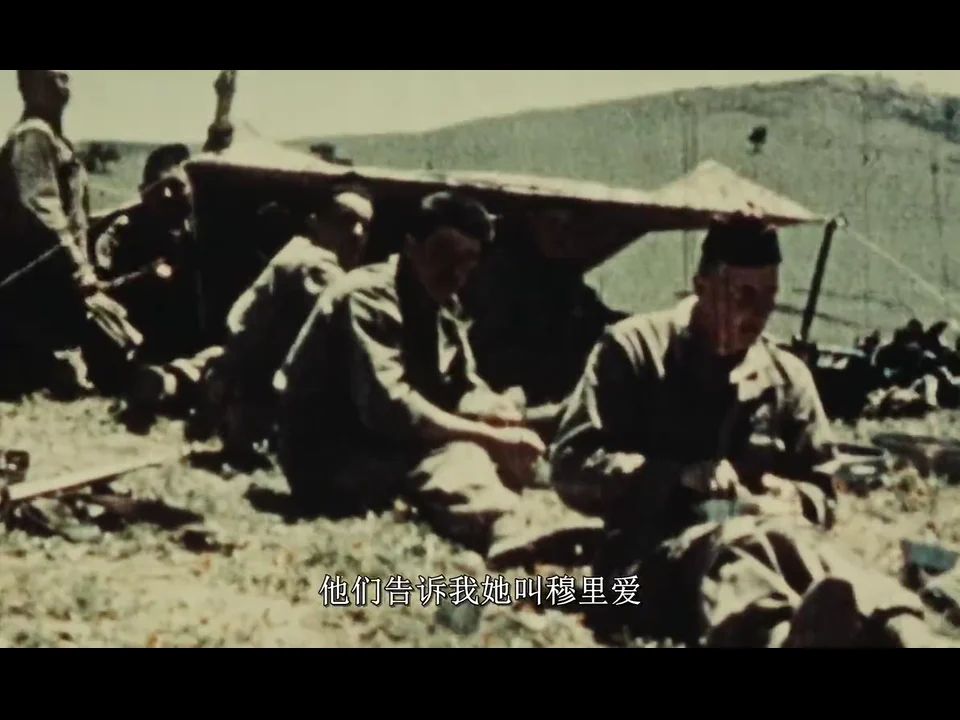
The routine soldiers' footage does not show torture; Bernard's present voice presses the absent event into the image.
Open full-size still- Displayed still
- 第11分段 00:00:25 / Part 11 00:00:25
- Discussion passage
- 第11分段 00:00:00–00:01:25 / Part 11 00:00:00–00:01:25
- Carrier part
- 11
Part 11 was frame-checked; the anchor lies in the disjunction between silent 8mm footage and Bernard's narration.
Complete Bilibili carrier; the shot at 第11分段 00:00:25 was checked frame by frame, and the still and timestamp come from the same public upload.
Still checked: 2026-08-14
Image
The 8mm footage shows soldiers sitting and resting in the hills; it does not show the torture Bernard describes.
Grain, faded colour, and projected-film texture mark the footage as another layer of record.
Sound
Over 8mm images without synchronized location sound, Bernard's present voice names Muriel and continues his account.
Relation to the concept
The wartime past is neither fully restored by the footage nor contained in speech; the split between routine images and torture testimony makes the past act in the present as an untotalizable sheet.
Sources and further reading
- Bilibili · Muriel, part 11
第11分段 00:00:25 / Part 11 00:00:25 · Complete Bilibili carrier; the shot at 第11分段 00:00:25 was checked frame by frame, and the still and timestamp come from the same public upload.
- Cinema 2: The Time-Image
Cinema 2, chapter 5, pp. 116, 118, 120, 122–123; these are film-level primary-text coordinates, while the present shot relation is this site's analysis.
Kaili Blues
路边野餐 (2015)
Atlas shot reading
Song proves the long take is not mute spatial virtuosity
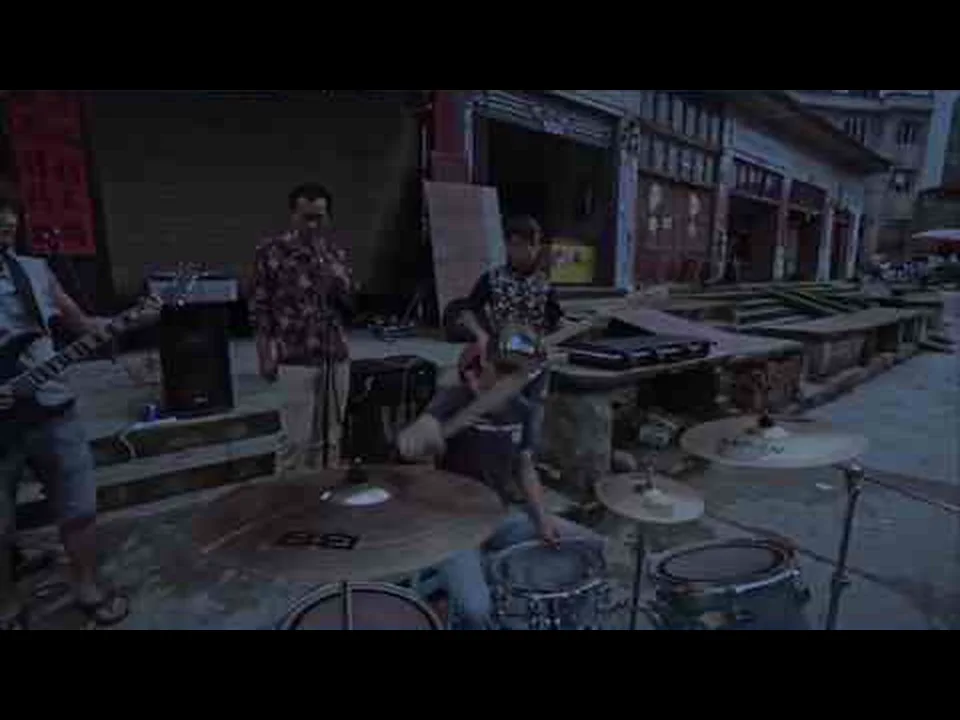
The same continuous passage has already travelled by motorcycle, pickup, ferry, and barbershop before reaching an outdoor band; its route continues only through other people’s work and vehicles.
Open full-size still- Displayed still
- 03:31:00
- Feature time
- 01:31:05
The user carrier runs 04:50:33. The target film occupies approximately 01:59:55–03:50:00, with unrelated padding on both sides; its first narrative shot appears around 02:00:25. Storyboard review places the celebrated Dangmai take at roughly 02:55:35–03:36:40 on the carrier (about 41:05). The atlas displays both feature and carrier axes.
The still and link retain the film guide's recorded shot locator.
Image
The same continuous passage has already travelled by motorcycle, pickup, ferry, and barbershop before reaching an outdoor band; its route continues only through other people’s work and vehicles.
Sound
The live song ‘Little Jasmine’ occupies public space and changes with the camera’s distance; it is not score but a local event that can be entered and left.
Relation to the concept
The take gives time to relay: every encounter provisionally redirects the route. Its enduring present is not a homogeneous container but an open field repeatedly reoriented by others, technologies, and virtual futures.
Sources and further reading
- From temporal directions to actual / virtual
Test exchange instead of treating the reversed clock as a single symbol
- Cinema 2, Chapter 5
Sheets of past, peaks of present, and searches through memory
- MCLC review of Kaili Blues
Verify the continuous route through motorcycle, pickup, ferry, barbershop, and concert
- Minnesota: distinguishing the two long takes
Avoid confusing the title passage near minute 29 with the forty-one-minute Dangmai take
- Compare Long Day’s Journey into Night
Move from relayed transport to a 3D viewing regime and continuous dream-space
L’Eclisse
L’eclisse (1962)
Atlas shot reading
Once protagonists are absent, place becomes event
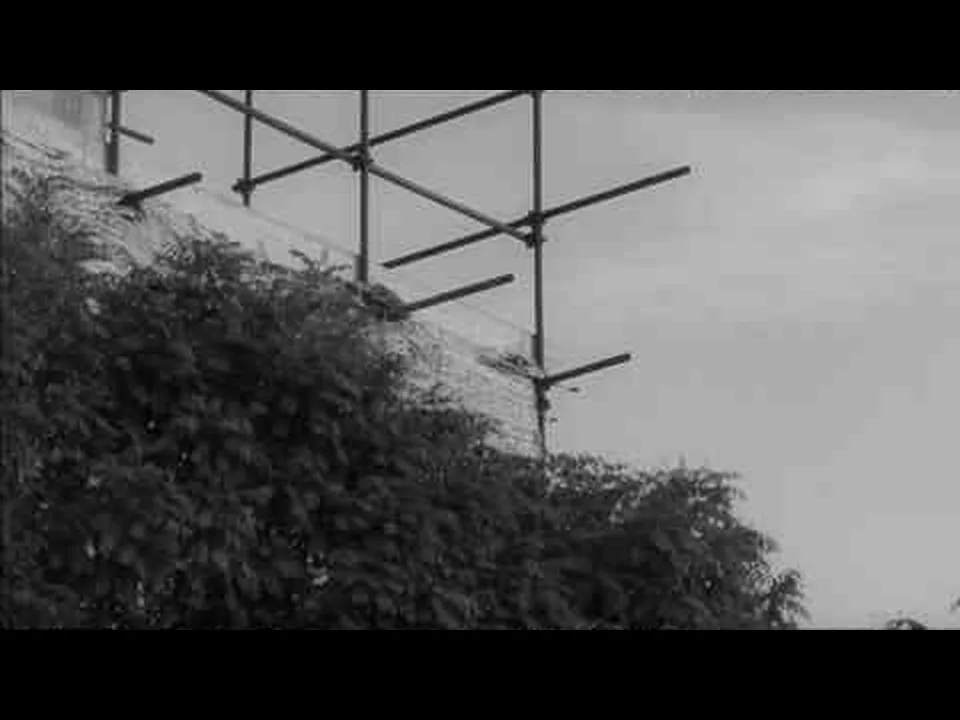
Hoarding, fence, tree, building material, water stain, newspaper, streetlight, and strangers successively occupy the meeting place; Vittoria and Piero never appear.
Open full-size still- Displayed still
- 01:59:00
- Feature time
- 01:59:00
- Carrier part
- 1
The user page aggregates two editions of the same film into 04:13:13. Part 1 is the complete 02:06:02 feature; parts 2–11 are a ten-part duplicate. All three stills and jumps are locked to part 1, and the aggregate page runtime is excluded from the film time axis.
The still and link retain the film guide's recorded shot locator.
Image
Hoarding, fence, tree, building material, water stain, newspaper, streetlight, and strangers successively occupy the meeting place; Vittoria and Piero never appear.
Sound
Character dialogue and explanatory melody withdraw, leaving traffic, footsteps, wind, and urban resonance. Sound does not fill absence with a conclusion; it keeps the place open.
Relation to the concept
Dead time is not nothingness but the persistence of lights, objects, and routes after action’s purpose recedes. What disappears is the protagonists’ privilege over the image, not the world.
Sources and further reading
- Cinema 2, Chapter 1
Broken action, pure optical/sound situations, and empty periods
- Cinema 2, Chapter 9
Readable relations after sound becomes an autonomous series
- Rushton: L’eclisse, pp.65–71
Unpeopled space, relational residues, and a world not filled by inhabitants
- BFI: audiovisual reading of the seven-minute ending
Verify lights, objects, and sounds continuing after character exit
- Senses of Cinema: objects and fractured desire
Return opening composition and object-rhythm to Antonioni’s form
- Compare Goodbye, Dragon Inn
Move from an unoccupied meeting place to a cinema persisting after dispersal
Films and scenes
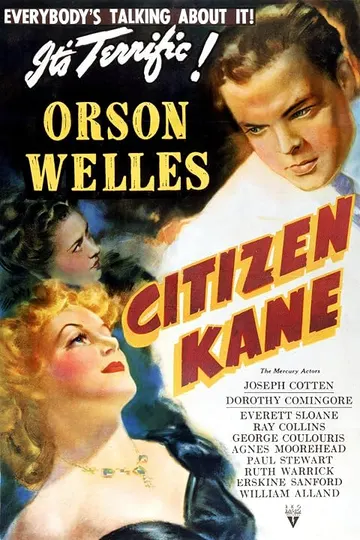
Testimonies search for one figure across different sheets, connecting images through an order of coexisting past rather than the investigative action itself.
IMDb identification poster ↗Related film readings · 17 films
Citizen Kane · 1941 · Candidate reading — Testimonies search for one figure across different sheets, connecting images through an order of coexisting past rather than the investigative action itself.
Last Year at Marienbad · 1961 — Bifocal structure: Robbe-Grillet organizes incompatible peaks of the present, while Resnais places characters in coexisting sheets of the past.
Hiroshima mon amour · 1959 — Private memory and historical catastrophe remain incommensurable; sound and image place both experiences within one interval, making forgetting temporal structure.
Je t’aime, je t’aime · 1968 — The time machine throws the protagonist among repeatedly contracting sheets of the past; the former present remains irretrievable.
Death in Venice · 1971 — Artistic ideal, aristocratic world, and decaying body are caught in a crystal of too late; preservation simultaneously reveals decomposition from within.
L’Eclisse · 1962 — After characters and rendezvous withdraw from the ending, places, objects, wind, and city noise persist. Time appears independently of relational action.
Early Summer · 1951 — The camera withdraws to hold the figure, then advances into a corridor that now belongs to her home. False continuity detaches space from action’s coordinates.
An Autumn Afternoon · 1962 — The father’s tears after the wedding remain within the everyday; death, separation, and grief flow through the same temporal series.
All About Eve · 1950 — Multiple recollections return to conditional points where time might have taken another course, exposing its forks.
L’Immortelle · 1963 — Differences among repeated scenes exceed a single true version. Each present holds in its own right, forming inexplicable peaks of the present.
Muriel · 1963 — The Algerian War past remains fragmentary as short montage, rooms, and speech continually transform it across different sheets.
Jeanne Dielman, 23 quai du Commerce, 1080 Bruxelles · 1975 — Cooking, cleaning, waiting, and counting appear in their full duration. Minute disorder first develops in body and ceremony.
Russian Ark · 2002 — The single take turns the Hermitage into traversable sheets of the past, carrying history beyond a linear present.
Kaili Blues · 2015 — Criterion: the Dangmai sequence lets search, past, future premonition, and spatial traversal coexist within one present.
Long Day’s Journey into Night · 2018 — Criterion: whether dream repairs action or opens an indiscernible actual/virtual circuit.
Groundhog Day · 1993 — The same morning first becomes an optimizer of action: Phil uses memory to predict others and manipulate outcomes. The loop changes direction when knowledge no longer serves escape; practice, care, and action without return turn repetition into the production of capacities and relations.
Readings in the same thematic group
Late Spring · 1949 — The vase still life intervenes between the daughter’s smile and tears, placing change within time’s unchanging form.
Criteria
First decide whether the connection comes from recollection-search or a fork of the present: do images change regions within the pure past, or sustain incompossible presents? Then remove the action-goal and test whether that temporal relation still organizes the shots.
Distinctions and counterexamples
Clock, countdown, slow motion, long take, or nonlinear narration does not automatically make a chronosign. If a task and final causal order still govern those forms, time remains subordinate to action.
Common confusion: A clock, countdown, slow motion, long take, flashback, or nonlinear narration does not automatically produce a chronosign. If a task and final causal order still govern the connections, time remains subordinate to action; the analysis must also name the branch it uses.
Texts and sources
Cinema 2, ch. 5, pp. 98–125 (Minnesota 1989)
- 01Cinema 2: The Time-Image
Authoritative source for the standard translation, translators, ISBN, and publication date.
View source and edition →
Research disagreements
Replacement or coexistence?
The time-image reverses the subordination of time to movement; both regimes persist and can shift locally within one film.
Taxonomy or generator?
Fixed labels invite mere example-hunting; an open taxonomy requires new concepts to transform existing relations and explain across cases.
How do we use Deleuze precisely?
Test four layers: sensory-motor relation, actual/virtual circuit, audio-visual connection, and regime of truth.
Where contemporary images push this concept

Testing the concept against a new mechanismCandidate reading · versioned passage review pending
The Beast: branch or replayed risk?
The juxtaposition of 1910, 2014, and 2044 establishes only a multi-period structure. A chronosign becomes a candidate when the institution of 2044 rereads the earlier lives as risks to be cleansed, making a later tense directly alter how the past exists in the present.
Scope and limits If repetition across eras is fully explained by a linear cycle, reincarnation premise, or character psychology, the periods remain governed by one causal line; this is multi-period narration, not a direct visibility of temporal relations.
- BFI: The Beast reviewScholarly/institutional review · film facts and countertestA review is secondary interpretation; it does not replace shots or a director interview.
- Venice: The Beast official competition pageFestival official page · T1 film factsThe synopsis does not prove the editing mechanism of three eras; verify that claim with BFI/director material and the film.
A concept relation that remains contestedCandidate reading · versioned passage review pending
With Hasan in Gaza: the future-perfect old recording
The atlas term 'future-perfect archive' is a contested heuristic for examining archival tense, not a ready-made Deleuzian chronosign. The relation becomes a candidate only where a specific passage makes the filming present of 2001, archival dormancy, and viewing in 2025 coexist directly in the current image rather than merely follow chronologically; later events must not be rewritten as prophecies contained in the early footage.
Scope and limits Even with the recording edition, recutter, caption date, and access conditions established, the term merely dresses hindsight as a new sign taxonomy if versioned passages only explain old footage through later captions rather than directly presenting heterogeneous times together; the claim should then be reduced to archival history.
- Marrakech International Film Festival: With Hasan in GazaFestival official page · edition and footage factsThe festival synopsis establishes the work and footage trail, not any Deleuzian concept; shot relations still require a specific release edition.
- International Documentary Association: Aljafari on With Hasan in GazaDirector interview · tape discovery and editing processThe edited interview is the director's first-person account of the footage history; it does not replace a tape inventory, release copy, or timecode verification.
- Pisters: The Neuro-Image guide and author pageScholarly monograph · author page and local PDFAuthor description and book synopsis are not independent film facts; concept pages must be checked against the published edition.
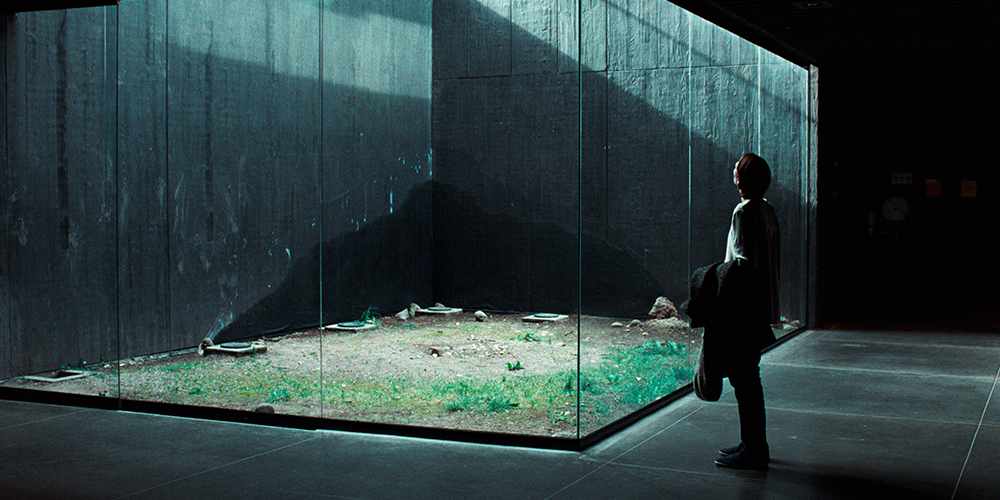
A concept relation that remains contestedCandidate reading · versioned passage review pending
Memoria: a sound pulls the present toward an undecided past
The blast returns through hearing, recollection, technical imitation, and search, allowing its temporal relation to organise viewing before any solution. It approaches a chronosign only if distinct moments of hearing cease to accumulate as successive clues and coexist within a present act of listening, changing how the same image endures; historical violence and nonhuman scale cannot be added by thematic association alone.
Scope and limits If each return of the sound merely adds information toward one solution, every temporal relation remains subordinate to investigation; chronosign terminology should yield to an analysis of delayed revelation.
- Mariela Herrero: Los tiempos resuenan…Scholarly article · sound, landscape, and nonlinear timeThe article provides a theoretical bridge, not the timecodes of appearances, repetitions, or before/after confirmation.
- Pisters: The Neuro-Image guide and author pageScholarly monograph · author page and local PDFAuthor description and book synopsis are not independent film facts; concept pages must be checked against the published edition.
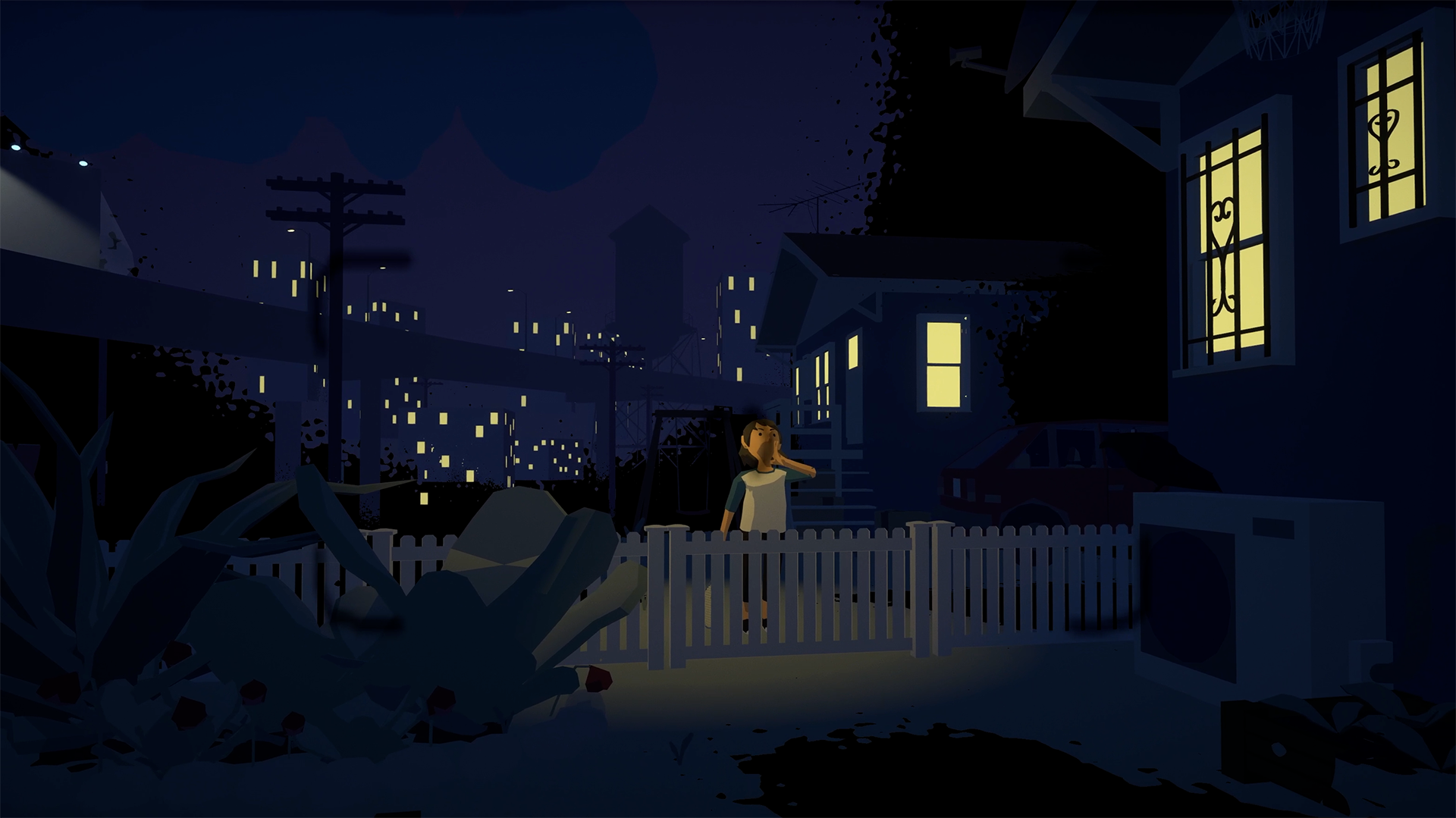
Counterexample against conceptual overreachCandidate reading · build and state-transition record pending
Before Your Eyes: the eyelid cuts the present for you
A blink irreversibly ending the current passage first shows a controller coupling bodily rhythm to linear progression; it does not automatically constitute a chronosign. The countertest requires state records showing temporal relations directly organising experience beyond action goals.
Scope and limits If eye tracking functions only as a page-turn button and missed passages can be replayed without cost, the body has produced no irreversible time; the device is a novel controller rather than a chronosign.
- Before Your Eyes: developer site and Steam listingOfficial project page · physiological input factsMechanic descriptions do not prove every player’s bodily experience or narrative branching; log results chapter by chapter.
- Vanderhoef / Payne: Blink and you’ll miss itPeer-reviewed article · blinking and felt timeThe article is a scholarly bridge between experience and mechanism; physiological input is not automatically the virtual or freedom.
Concepts to distinguish
Compare them
- Sheets of the pastnappes de passé
Sheets of the past are not former presents stacked in chronological order but virtual regions in which the pure past exists at different degrees of contraction; the whole past coexists virtually with every present. Recollection does not retrieve a ready-made copy from storage. Starting from a present problem, it leaps into a region, searches along a sheet, and actualizes a recollection-image; the search may also change sheets, misrecognize, or fail.
→ - Peaks of the presentpointes de présent
Peaks of the present make several mutually incompossible presents persist as present and thereby deactualize the single continuous and decidable 'real present.' This is not a set of viewpoints upon an already settled event. The image sustains mutually exclusive present worlds without an external master version that can reduce the others to errors.
→ - Powers of the falsepuissances du faux
Narration abandons a recoverable model of truth and lets characters, testimonies, memories, and worlds mutate through a series of falsifiers. The false gains creative power by freeing itself from a model of truth.
→ - Falsifying narrationnarration falsifiante
Characters and narrative positions escape calibration by an omniscient centre. Each falsifier refers to another, while identity and past mutate according to degrees of power.
→