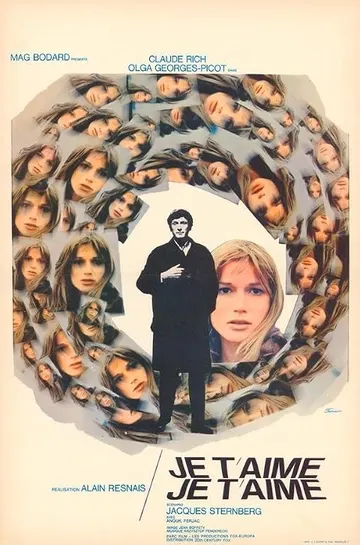
Alain Resnais / 阿伦·雷乃 · 1968
Je t’aime, je t’aime
Je t’aime, je t’aime
The time machine throws the protagonist among repeatedly contracting sheets of the past; the former present remains irretrievable.
Film details
- Original title
- Je t’aime, je t’aime
- Director
- Alain Resnais / 阿伦·雷乃
- Year
- 1968
- Region
- France
Film analysis: how shots organize concepts
The time machine is meant to reproduce one minute but throws Claude into a past that contracts, repeats, and misjoins; the more precisely memory returns, the less its former present can be repossessed.
- 01The experiment specifies a former present
Scientists place Claude, after his suicide attempt, inside a sealed capsule and plan to return him precisely to one minute on a beach with Catrine a year earlier.
The past is first treated as a locatable and measurable former present that technology can actualize again. - 02One minute splits into unequal fragments
After the apparatus fails, the beach pose and the same words recur, then abruptly cut to bedroom, office, bathroom, and other moments in the relationship.
Time no longer follows calendar order; the same detail opens onto sheets of past at different degrees of contraction. - 03Return cannot revise
Catrine's death and Claude's self-destructive impulse approach through different fragments, but repetition carries him away before he can remain in any return and act otherwise.
The past remains fully operative while refusing to become a revisable present; the experiment exposes a circuit of time rather than control over time travel.
Close-reading questions
- 01Each return to the same meadow lands Claude in a different before or after. How does the machine split one place into sheets of past that cannot be merged?
- 02The ten consecutive parts do not simply rewind a story. Which costumes, sounds, and bodily attitudes change on each return, forcing comparison among virtual sheets rather than a search for one truth?
- 03The laboratory keeps trying to turn memory into a controllable channel. Why does Claude's failure instead give time a directness independent of his intention?
Analysis and scene sources
Shots and scenes
Primary texts, scholarship, and locators
Theory coordinate: Cinema 2, Minnesota 1989, ch. 4, p. 82; ch. 5, pp. 116–118, 120, 122; ch. 8, pp. 207–208, 213–214; ch. 10, pp. 266, 277
- 01Cinema 2: The Time-Image
Authoritative source for the standard translation, translators, ISBN, and publication date.
Open the atlas source record →
This film in books and research
《缠绕的诗学:德勒兹思维方法研究》 · Atlas extension
Je t’aime, je t’aime
Film relation: Site extension: a failed time experiment releases fragments of the past from linear action and makes them return according to a problem-structure.
Shot question: Which affective, causal, or ethical relation changes each time a fragment returns?
Viewing gateways and editions
- Verified complete Bilibili multipart carrier: 我爱你,我爱你bilibili.comOpen film page ↗
- Page access
- Accessible when checked
- Version extent
- Recorded as a complete version
- Source type
- User-uploaded page
Edition note: Ten consecutive parts total 1:35:05, at roughly nine to ten minutes each. The memory-machine returns span several parts.
Link checked: 2026-08-25