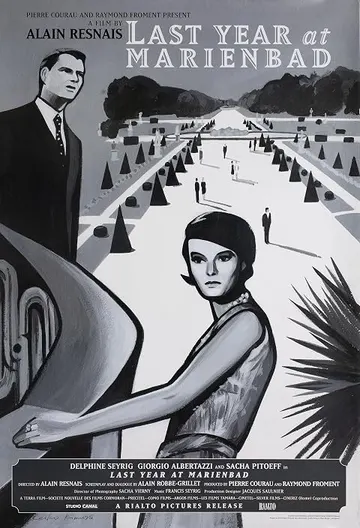
Alain Resnais / 阿伦·雷乃 · 1961
Last Year at Marienbad
L’Année dernière à Marienbad
Bifocal structure: Robbe-Grillet organizes incompatible peaks of the present, while Resnais places characters in coexisting sheets of the past.
Film details
- Original title
- L’Année dernière à Marienbad
- Director
- Alain Resnais / 阿伦·雷乃
- Year
- 1961
- Region
- France
Film analysis: how shots organize concepts
Repetition does not recover one determinate encounter; it gives 'already happened,' 'never happened,' and 'happening now' presents of their own.
- 01Architecture speaks before the event
A voice repeatedly describes corridors, mirrors, ceilings, and silent guests as the camera glides through symmetrical space.
Place no longer locates a past event; it becomes a machine that continually produces déjà vu. - 02The encounter forks into versions
When the same conversation returns in garden, bedroom, and bar, dress, posture, refusal, and consent keep changing.
The differences cannot be assigned to one missing true timeline; versions coexist as incompossible presents. - 03Departure cannot close the circuit
Shooting, the hotel game, and the final departure appear as fact, hypothesis, or replay, with no level appointed as judge.
Actual and virtual continue to exchange positions; the ending only extends the crystalline circuit.
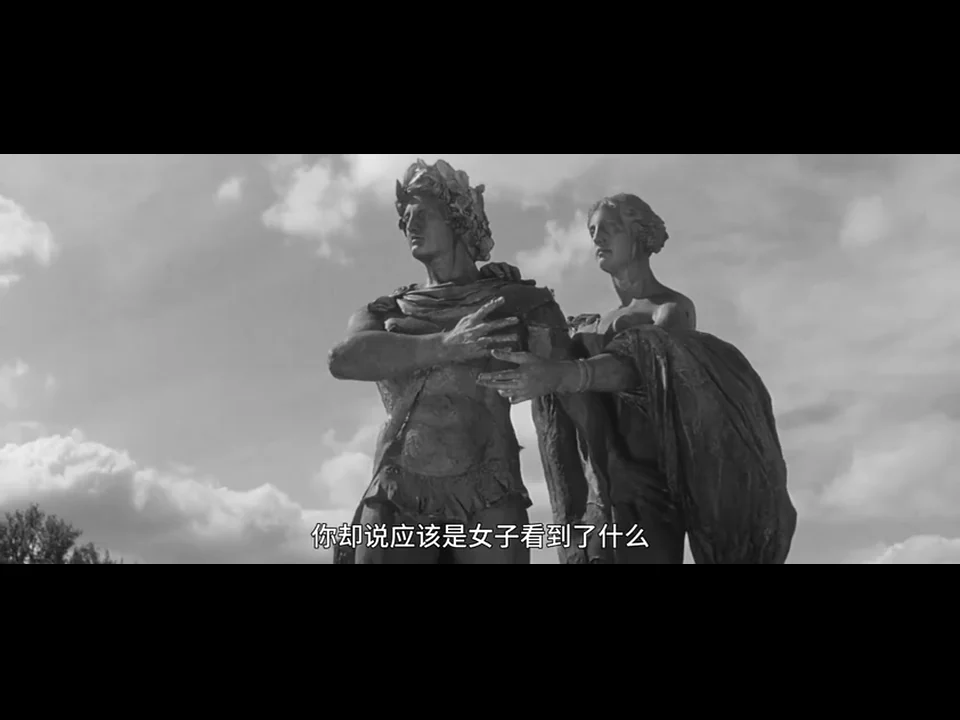 00:01:45
The same statues carry two accounts: he says the man stops the woman; she says the woman is the one who first sees something.
The image cuts from the woman in the garden to paired statues and then circles behind them.
At the anchor, the burned-in subtitle states that she had offered the reading in which the woman saw something.
A male voice first offers the reading that the man stops the woman, then recalls the other reading in which the woman sees something.
SITE ANALYSISThe film does not resolve the two readings into one recoverable past. The same visible object sustains two present versions, leaving the past in an incompossible relation to the present.
Cinema 2, chapter 5, English translation pp. 101, 106, 108; atlas shot analysis.Bilibili at 00:01:45 Open original still ↗Excerpt-upload timeline, frame-verified to within one second.A continuous 2:57 original-film excerpt, not the complete feature; film identity, continuity, burned-in subtitles, and anonymous playback were frame-verified.
Bilibili continuous original-film excerpt · moimoichou · verified 2026-08-14Close-reading questions
- 01Movements through corridors, gardens, and rooms place one encounter in incompatible presents. Which shots connect space while refusing to confirm the year in which it happened?
- 02The matchstick game repeats one rule while its winner and promise shift. How does the rule's stability produce forks among virtual pasts?
- 03The narrator's assertion, the woman's denial, and the man's insistence are never adjudicated as true or false. How does the film let three narrations occupy the present at once?
Shots and scenes
Primary texts, scholarship, and locators
Theory coordinate: Cinema 2, Minnesota 1989, ch. 5, pp. 101, 103–105, 122, 124
- 01Cinema 2: The Time-Image
Authoritative source for the standard translation, translators, ISBN, and publication date.
Open the atlas source record →
This film in books and research
Photography, Cinema, Memory · Book case
Last Year at Marienbad
pp. 128–129
Film relation: Repeated poses, spaces, and conflicting memories bring viewpoint into an undecidable crystal.
Shot question: In the statue discussion, which present exchanges with which virtual past?
《缠绕的诗学:德勒兹思维方法研究》 · Atlas extension
Last Year at Marienbad
Film relation: Site extension: hotel space, repeated narration, and conflicting memories test whether one version can exhaust an event.
Shot question: In the statue discussion, which actual present exchanges with which virtual past?
The Neuro-Image · Book case
Last Year at Marienbad
pp. 127–146
Film relation: Conflicting narration, repeated poses, and architecture let analog cinema anticipate a database-like brain-screen.
Shot question: Are competing statue versions memory errors or several presents reorganizing the past?
Deleuze and Cinema: The Film Concepts · Book case
Last Year at Marienbad
pp. 144–146, 170–175
Film relation: Conflicting narratives, poses, and spaces keep actual and virtual exchanging places.
Shot question: Which shots cannot be assigned stably to present, memory, hypothesis, or lie?
Cinema After Deleuze · Book case
Last Year at Marienbad
pp. 97–100
Film relation: The versions of A, X, and M remain unassignable between peaks of present and sheets of past.
Shot question: Which real actions and affective consequences do unverifiable versions still produce?
Sheets of Past and Peaks of Present: How the Order of Time Enters the Image
The present as simultaneous divergence
Claim: Peaks of present allow several presents of one event to persist simultaneously; each works internally, while their conjunction is incompossible.
Conclusion: Mark each present of one event, its internal evidence, and conflicts among versions; simultaneity and incompossibility jointly establish peaks.
Cinema 2: The Time-Image · ch. 5, pp. 101, 103–105Gilles Deleuze's Time Machine · pp. 79–120
Sheets of Past and Peaks of Present: How the Order of Time Enters the Image
Temporal relation takes over image linkage
Claim: A chronosign appears when coexistence of sheets or simultaneity of peaks directly organizes shots.
Conclusion: Record version, temporal position, mode of evidence, and action-consequence; when temporal relation links shots directly, the order of time becomes an image principle.
Cinema 2: The Time-Image · ch. 5, pp. 116, 118, 120, 122–123Deleuze's Cinema Books · pp. 151–156
Sheets of Past and Peaks of Present: How the Order of Time Enters the Image
Several presents of one encounter
Film comparison: The same encounter appears as already happened, never happened, and happening for the first time, producing incompossible presents.
Time-image research chapters
How memory searches the past and the present forks
Bearing Time Chinese DOCX, paragraphs 274–448.
Claim: Sheets and peaks are two different chronosigns: recollection searches a virtually preserved past for a sheet, while peaks let incompossible presents each persist in its own right.
What to watch for: First ask whether recollection selects a sheet of the past. If no common past is available for search, ask which versions of the present each persist yet remain incompossible. Record the direction and failure of the search separately from the consequences of each version.
Viewing gateways and editions
- Official Bilibili feature page: 去年在马里昂巴德bilibili.comOpen film page ↗
- Page access
- Region restricted
- Version extent
- Recorded as a complete version
- Source type
- Distributor or streaming platform
Edition note: Official Bilibili feature · 1:33:35; the page carries regional access restrictions.
Link checked: 2026-08-25
- Criterion Collectioncriterion.comOpen film page ↗
- Source type
- Distributor or streaming platform