Concept definition
Peaks of the present make several mutually incompossible presents persist as present and thereby deactualize the single continuous and decidable 'real present.' This is not a set of viewpoints upon an already settled event. The image sustains mutually exclusive present worlds without an external master version that can reduce the others to errors.
What the concept explains
Peaks of the present let several presents insist while remaining mutually incompossible; no single current instant adjudicates which version is real. The issue is not succession or multiple viewpoints but presents that cannot be reconciled within the same event.
Sheets of Past and Peaks of Present: How the Order of Time Enters the ImageFilms and scenes
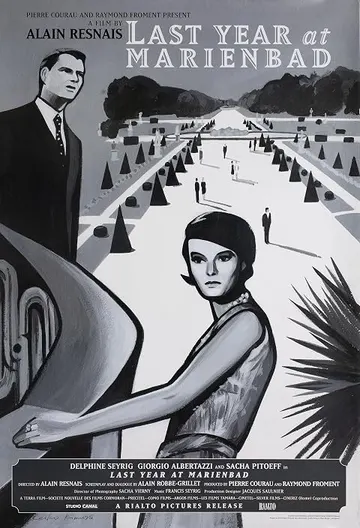
Presents in which the meeting happened, never happened, or is being produced all insist, while the film withholds a final point of calibration.
IMDb identification poster ↗Related film readings · 13 films
Last Year at Marienbad · 1961 · Candidate reading — Presents in which the meeting happened, never happened, or is being produced all insist, while the film withholds a final point of calibration.
All About Eve · 1950 — Multiple recollections return to conditional points where time might have taken another course, exposing its forks.
A Letter to Three Wives · 1949 — The absent woman’s voice hangs over three marriages at once. Its displaced source and three possible consequences make time fork around one threat.
L’Immortelle · 1963 — Differences among repeated scenes exceed a single true version. Each present holds in its own right, forming inexplicable peaks of the present.
The Discreet Charm of the Bourgeoisie · 1972 — The meal repeatedly restarts through dream, performance, or interruption. Present versions replace one another with no final hierarchy. Deleuze mentions the film only briefly in Cinema 2, so this atlas keeps the claim correspondingly narrow.
Uncle Boonmee Who Can Recall His Past Lives · 2010 — The dead, the living, animals, and former lives unfold incompatible times on the same perceptual plane.
Kaili Blues · 2015 — Criterion: the Dangmai sequence lets search, past, future premonition, and spatial traversal coexist within one present.
Long Day’s Journey into Night · 2018 — Criterion: whether dream repairs action or opens an indiscernible actual/virtual circuit.
Readings in the same thematic group
Late Spring · 1949 — The vase still life intervenes between the daughter’s smile and tears, placing change within time’s unchanging form.
Citizen Kane · 1941 — Witnesses search different sheets of the past for Kane; a complete truth remains unactualized.
Hiroshima mon amour · 1959 — Private memory and historical catastrophe remain incommensurable; sound and image place both experiences within one interval, making forgetting temporal structure.
Je t’aime, je t’aime · 1968 — The time machine throws the protagonist among repeatedly contracting sheets of the past; the former present remains irretrievable.
Muriel · 1963 — The Algerian War past remains fragmentary as short montage, rooms, and speech continually transform it across different sheets.
Criteria
List the figures, events, and audiovisual relations altered by each present version, then ask whether the film finally restores one adjudicating master present. If every difference can be explained by missing information, deactualization has not occurred.
Distinctions and counterexamples
Successive presents, imagined alternatives, or erroneous versions eliminated by a final solution do not qualify. If one authoritative present reduces the others to hypotheses, the peaks disappear.
Common confusion: Multiple viewpoints, cross-cutting, conflicting testimony, loops, or repeated scenes are insufficient. They may instead belong to sheets of past, falsifying narration, or ordinary suspense. Peaks require incompossible presents to remain operative.
Texts and sources
Cinema 2, ch. 5, pp. 98–125 (Minnesota 1989)
- 01Cinema 2: The Time-Image
Authoritative source for the standard translation, translators, ISBN, and publication date.
View source and edition →
Research disagreements
Replacement or coexistence?
The time-image reverses the subordination of time to movement; both regimes persist and can shift locally within one film.
Taxonomy or generator?
Fixed labels invite mere example-hunting; an open taxonomy requires new concepts to transform existing relations and explain across cases.
How do we use Deleuze precisely?
Test four layers: sensory-motor relation, actual/virtual circuit, audio-visual connection, and regime of truth.
Concepts to distinguish
Compare them
- Sheets of the pastnappes de passé
Sheets of the past are not former presents stacked in chronological order but virtual regions in which the pure past exists at different degrees of contraction; the whole past coexists virtually with every present. Recollection does not retrieve a ready-made copy from storage. Starting from a present problem, it leaps into a region, searches along a sheet, and actualizes a recollection-image; the search may also change sheets, misrecognize, or fail.
→ - Chronosignchronosigne
Chronosign is the superordinate classification used when temporal relations directly organize the connection of images rather than merely measuring or resulting from action. Chapter 5 distinguishes two branches that are distinct and non-interchangeable: sheets of past make the virtual past coexisting with the present into regions of recollection-search, while peaks of present sustain incompossible presents and deactualize the single present. Both are signs of direct time, but they answer different problems.
→ - Powers of the falsepuissances du faux
Narration abandons a recoverable model of truth and lets characters, testimonies, memories, and worlds mutate through a series of falsifiers. The false gains creative power by freeing itself from a model of truth.
→ - Falsifying narrationnarration falsifiante
Characters and narrative positions escape calibration by an omniscient centre. Each falsifier refers to another, while identity and past mutate according to degrees of power.
→