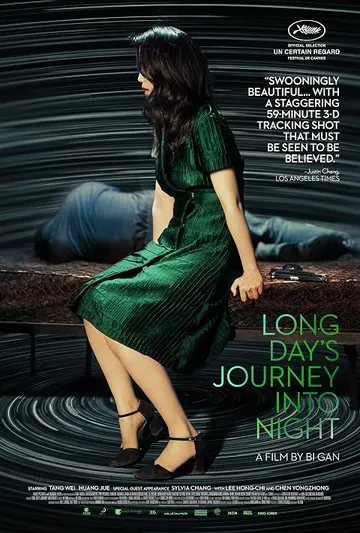
Bi Gan / 毕赣 · 2018
Long Day’s Journey into Night
地球最后的夜晚
Criterion: whether dream repairs action or opens an indiscernible actual/virtual circuit.
Film details
- Original title
- 地球最后的夜晚
- Director
- Bi Gan / 毕赣
- Year
- 2018
- Region
- China
Film analysis: how shots organize concepts
How does Long Day’s Journey into Night let a lost relation continue to act, rather than dividing its halves into reality and dream?
The film first lets voice, photographs, clocks, and resembling faces carry the past into Luo Hongwu’s present, then changes the viewing regime through the concrete act of putting on 3D glasses: a densely edited search becomes a continuous descent, walk, ride, flight, and rotation. The virtual past does not retreat into psychology; it acquires actual force through new bodies, routes, and choices.
Before bodies are clearly assigned, defocused coloured lights, a dark room, and the statement ‘I dreamed of her again’ place an absent person inside the current image.
The male voice-over takes position before a visible body. Rather than explaining background, it lets the past occupy the soundtrack in a sonic present tense.
The virtual is not a fictional other world but a real relation not yet actualized as a present object and already redirecting perception. The search is organized by this absence from its first minute.

Luo puts on glasses in a cinema and only then does the title appear; the camera subsequently descends through a tunnel into a continuous space linking mine, pool hall, motorcycle, and cable ride.
Narrative dialogue yields to footsteps, engine, billiard impacts, song, and spatial reverberation. Sound begins to measure a route instead of dating a recollection.
Continuous movement does not prove ‘real time.’ It compresses incompatible ages, identities, and places into one present and makes the spectator’s body part of the temporal circuit.
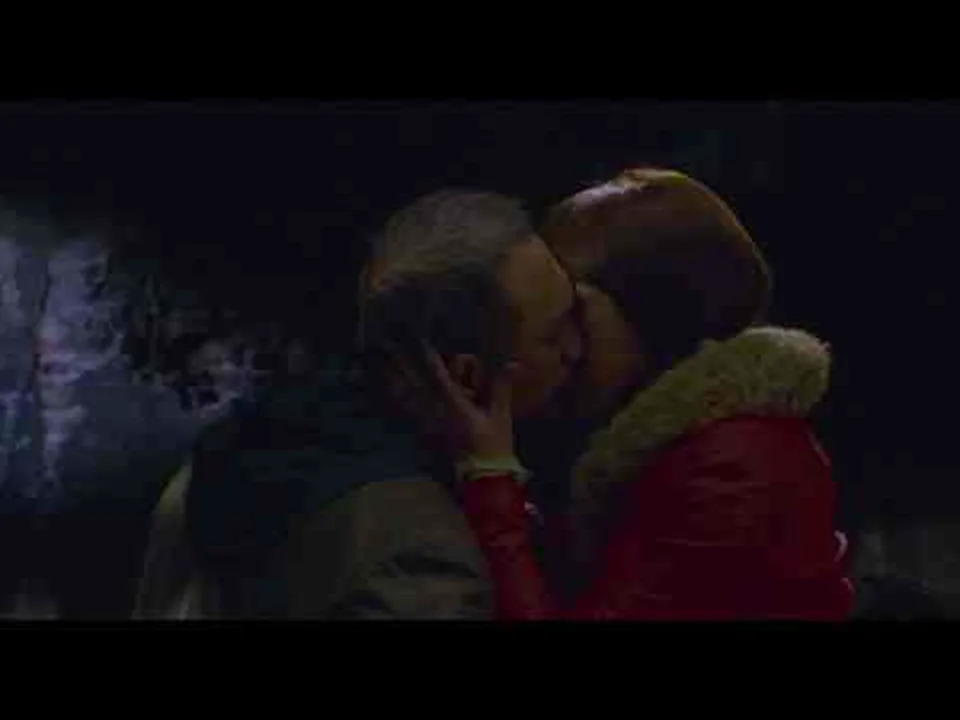
The room rotates as the figures kiss and brief sparks and fireworks light the encounter; the scene offers no reconciled space that could be inhabited for long.
Close breathing, mechanical rotation, and distant reports obey no common scale: intimate contact and the outside world approach together and begin receding together.
The crystal is not mere confusion between true and false. Actual encounter and virtual loss must exchange while producing consequences. The kiss actualizes the relation and preserves its impossibility at once.
EDITION NOTE The user-supplied carrier runs 02:46:55. Unrelated nature/travel padding occupies its first 00:30:08; the target feature is approximately 00:30:08–02:46:55 on the carrier. Carrier time equals feature time plus 00:30:08, and all three jumps are checked on the carrier axis.
Bi Gan first turns memory into a set of narratives that cannot be closed, then presses those versions into one present through a continuous 3D journey; the long take matters not because it is long, but because it lets past, dream, and present rewrite one another.
- 01Memory first creates a gap
In the first half, voice-over, photographs, songs, clocks, and recurring names call back Wan Qiwen without restoring her as an object the protagonist can finally investigate; Kaili becomes a memory-terrain made of lost things, debts, and unfulfilled promises.
The past is no longer background explaining the present; it is a virtual layer that continually changes how the present can be seen, spoken, and searched. - 02The transition makes the dream spatial
After the transition into the 3D long take, the figure moves through a billiard hall, stairs, rooftops, a bridge, streets, and a karaoke room; space stays continuous while relations and temporal positions drift, with the young position, the resemblance between Kaizhen and Wan Qiwen, and the present Luo Hongwu rewriting one another.
Continuous space does not guarantee one reality; it becomes a passage through the crystal, where each turn can send the actual face into another sheet of the past. - 03Return leaves an unfinished present
The long take returns to a field of singing, fireworks, and farewell without sealing the dream as false or memory as true; the protagonist receives an approach that still echoes, not compensation for what was lost.
The time-image is not an escape from reality; it makes reality bear a relation that cannot be solved. The dream is measured by its capacity to change the present.
Close-reading questions
- 01How do the first half’s voice-over, photographs, and names make memory a virtual layer changing the present rather than a flashback that merely fills plot gaps?
- 02Once the film enters its 3D long take, why does spatial continuity accommodate ruptures in relations and temporal positions rather than eliminate them?
- 03Should the dream be judged by whether it restores the lost person, or by how it lets an unfinished relation continue to act on the present?
Shots and scenes
Primary texts, scholarship, and locators
Theory coordinate: Editorial research proposition outside Cinema 2’s named cases
Consult the primary-text locator above.This film in books and research
Sheets of Past and Peaks of Present: How the Order of Time Enters the Image
Can database operations reorder the visible past?
Claim: The atlas proposes a hypothesis that still requires version-bound evidence: retrieval, refresh, and predictive interfaces may reorder how recorded material enters a present decision. An actual database is not the virtual past, and content juxtaposition is not a peak of present. The bridge gains evidence only when a versioned operation changes an actual relation among body, memory, or choice.
Conclusion: Keep two ledgers: one for recollection-search or forking presents in the film, another for database version, retrieval, and feedback. Then draw the three-step chain—visible present, retrieved material, next choice. The two relations can be compared but not identified.
Gilles Deleuze's Time Machine · ‘Time and Memory: Orders and Powers,’ pp. 79–120The Neuro-Image · Chapters on brain-screen and database time
Time-image research chapters
When heterogeneous times rewrite one another rather than merely coexist on screen
Bearing Time Chinese DOCX, paragraphs 1088–1160.
Claim: The final chapter turns the time-image into a testable relation: at least two heterogeneous times rewrite one another, shot, sound, editing, or apparatus carries the change, and a replayable consequence remains.
What to watch for: Find the exchange first, then its consequence; if times are merely displayed side by side, the work remains at the level of subject matter.
Time-image research dossier · Manuscript-proposed extension
Long Day’s Journey into Night
Image operation: Spatial crystal: search, dream, and return exchange actual and virtual within one extended passage.
Film question: Does the dream repair action with an ending, or deprive the present of a single centre?
Viewing gateways and editions
- Verified Bilibili feature interval: 地球最后的夜晚bilibili.comOpen film page ↗
- Page access
- Accessible when checked
- Version extent
- Recorded as a complete version
- Source type
- User-uploaded page
Edition note: The video runs 2:46:55; its first 00:30:08 is unrelated nature/travel padding. The feature begins at 00:30:08 and runs to the end, approximately 2:16:47. The feature occupies seconds 1808–10015 of the carrier; the URL is positioned at the feature start. The video runs 2:46:55; its first 00:30:08 is unrelated nature/travel padding. The feature begins at 00:30:08 and runs to the end, approximately 2:16:47.
Link checked: 2026-08-25