
Yasujirō Ozu / 小津安二郎 · 1949
Late Spring
晩春
The vase still life intervenes between the daughter’s smile and tears, placing change within time’s unchanging form.
Film details
- Original title
- 晩春
- Director
- Yasujirō Ozu / 小津安二郎
- Year
- 1949
- Region
- Japan
Film analysis: how shots organize concepts
Close-reading questions
When the vase still life enters between Noriko's smile and tears, how does the image make personal change and an unchanging form of time perceptible together without reducing the vase to a symbolic answer?
- 01When the vase enters between Noriko's smile and tears, which change belongs to the character and which duration belongs to time itself?
- 02How does the marriage arrangement retain action-causality while empty rooms, still life, and pauses open it to direct time?
Shots, relations, and concepts
- 1Record
In the sequence Deleuze singles out, Noriko's face first sustains a smile or composure; the cut moves to the vase in the dim room, then returns to her tearful face. The record should separate the face–vase–face cuts, shot duration, and continuing sound field before assigning the vase a symbolic meaning.
- 2Judge the relation
The vase neither completes an action for the character nor explains the tears psychologically. As an almost invariant still life occupying the interval, it places the change between the two faces within a continuing temporal relation: the character changes without time becoming the result of an action.
- 3Name the concept last
This supports the limited claim that time assumes an organizing role—a direct time-image. It does not prove that every still life, empty room, or slow shot is inherently a time-image.
- 4Countertest
Countertest: if the vase shot merely supplies an ellipsis, spatial orientation, or conventional emotional symbol, while the change is fully explained by action-causality, the name ‘direct time’ should be withdrawn.
Shots and scenes
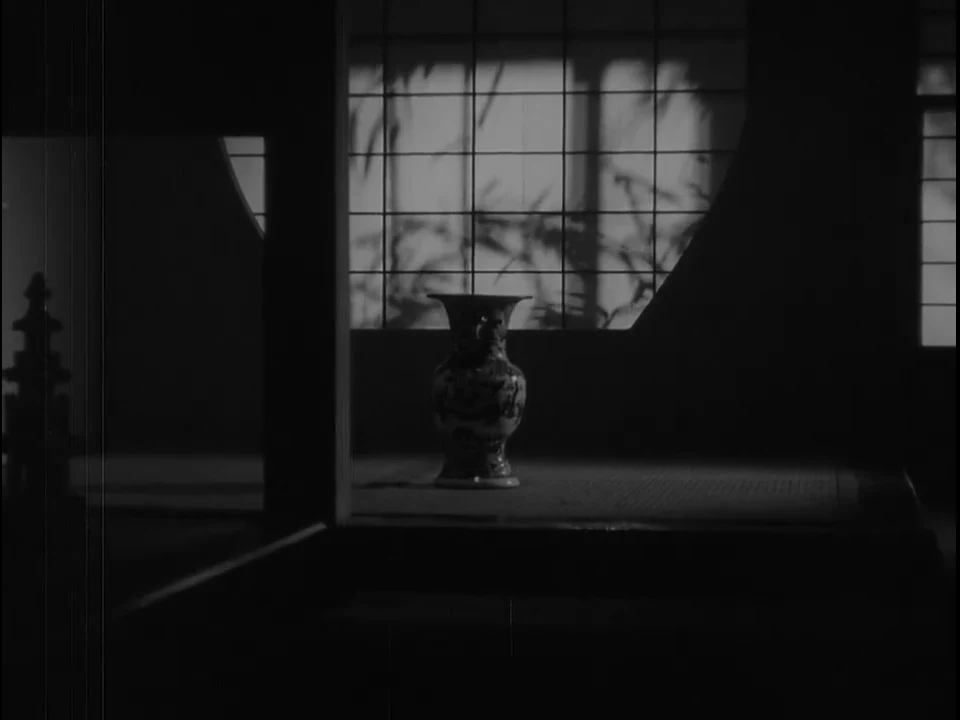
The atlas reviews the passage in four steps: locate both vase shots, compare the facial shots, check the snoring and music, and trace the transition from the second vase to the rock garden. The first two directly test the face–vase–face relation discussed by Deleuze; the latter two examine Parks's extension to the longer sequence. Any fixed symbolic answer requires separate support from shot relations and cannot be inferred from the unestablished premise that Noriko sees the vase or from mistaking the vase shot for her point-of-view shot.
Open viewing position ↗Primary texts, scholarship, and locators
Theory coordinate: Cinema 2, ch. 1, pp. 16–17
- 01Cinema 2: The Time-Image
Authoritative source for the standard translation, translators, ISBN, and publication date.
Open the atlas source record →
Scholarship cited by the scene records: Each study is listed once, with its locators and supported scenes retained together.
- 01The Riddle of the Vase: Ozu Yasujirō’s Late Spring (1949)
Locator(s): Japanese Cinema: Texts and Contexts (2007), pp. 78–89; point-of-view debate on p. 86
Cited by scene(s): The vase does not explain Noriko's tears; the cuts give change a temporal form
Nornes surveys conflicting interpretations and notes that Bordwell and Thompson correct Richie's and Schrader's loose descriptions of point of view. His emphasis on p. 86, however, is that this formal correction still does not explain why the vase is ‘oddly powerful.’ Rejecting the shortcut from ‘she sees the vase’ to a fixed emotional symbol is the atlas's methodological boundary, not Nornes's single conclusion.
Open the atlas source record → - 02Change, Horizon, and Event in Ozu’s Late Spring (1949)
Locator(s): Film-Philosophy 20.2–3 (2016), pp. 292–298, DOI 10.3366/film.2016.0016
Cited by scene(s): The vase does not explain Noriko's tears; the cuts give change a temporal form
Parks places Deleuze's temporal reading alongside shot legibility, sound continuity, and shot length. He reports four seconds for the first vase shot and nine for the second, whereas this carrier yields 6.089 and 10.260 seconds. Because the article does not identify its transfer or timing method here, the discrepancy is recorded without attributing it conclusively to an edition difference.
Open the atlas source record →
This film in books and research
Time-image research chapters
When time stops hiding behind movement
Bearing Time Chinese DOCX, paragraphs 44–133.
Claim: The threshold of the time-image is not slowness but the failure of perception to lead automatically to action that can close the situation.
What to watch for: Record image, sound, body, space, and editing: where does action fail, and which duration cannot be reclaimed as narrative information?
Viewing gateways and editions
- Verified complete Bilibili carrier: 晚春 Late Spring _ Banshun (Yasujiro Ozu, 1949)bilibili.comOpen film page ↗
- Page access
- Accessible when checked
- Version extent
- Recorded as a complete version
- Source type
- User-uploaded page
Edition note: Complete single-part film · 1:47:59.
Link checked: 2026-08-13
- Criterion Collectioncriterion.comOpen film page ↗
- Source type
- Distributor or streaming platform