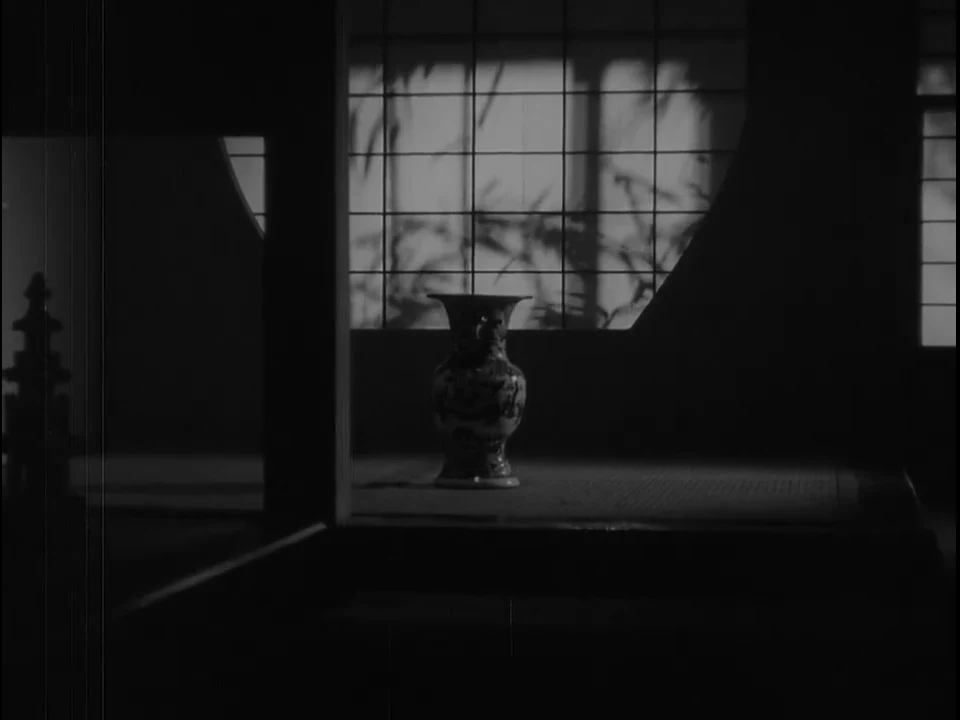
 01:28:42
Action rupture · SHOT EVIDENCE
The vase does not explain Noriko's tears; the cuts give change a temporal form
Noriko's half-smile gives way to incipient tears across the first vase shot. How does the film omit the visible transition in her expression, then use the snoring, the second vase shot, and the subsequent rock garden to extend the sequence's temporal effect?
Film and viewing version
Late Spring · 晩春 · Yasujirō Ozu / 小津安二郎 · 1949
Within a continuous 01:28:15–01:28:55 window on the complete single-part Bilibili carrier BV1dN4y1B7tF, the atlas used cut detection and then frame-by-frame review to verify four cut points: first vase at 01:28:20.380, back to Noriko at 01:28:26.469, second vase at 01:28:37.397, and cut to the Ryōan-ji rock garden at 01:28:47.657. These coordinates bind only this 01:47:59 carrier; other restorations, releases, and leader lengths require fresh location.
Version boundary: The timecodes on this page apply only to the named viewing carrier. Restorations, differing leaders, or platform transcodes may shift them.
Passage and still timecodes
01:28:20.380 to 01:28:47.657
Passage bounds checked on the named carrier
The passage bounds and Bilibili still at 01:28:42 were checked separately on their named carriers. They remain distinct coordinates and do not establish identical timecodes for other versions.
Visible facts
- 01
In the shot immediately preceding the stored interval, Noriko lies down smiling. The stored bounds begin with the first vase shot, return to Noriko as tears gather in her eyes, cut to the same vase a second time, and end at the instant of cutting into the Ryōan-ji rock garden. Viewed with the adjacent shot, the order is Noriko's face–vase–Noriko's face–vase–rock garden.
- 02
On this carrier, the first vase shot lasts about 6.089 seconds and the second about 10.260 seconds. During the second, the vase remains nearly motionless while bamboo shadows continue moving on the shoji.
Audible facts
- 01
On p. 297, Parks uses continuing snoring to establish temporal contiguity across the shots; on p. 298, he reports that a musical theme enters about four seconds into the second vase shot and bridges to the rock-garden scene. This is Parks's written account of his material; treating it as an audible fact of this carrier still requires a separate check of its soundtrack.
Action relation
The vase supplies no cue for what Noriko should do next and does not turn the marriage conflict into a solvable act. The cuts suspend the natural extension from facial expression into action: change has occurred, yet the film does not reduce it to an immediately executable response.
Temporal relation
In chapter 1 of Cinema 2, Deleuze places the vase shot between Noriko's half-smile and the beginning of her tears and describes it as giving what changes the ‘unchanging form’ in which change occurs; his argument also stresses the duration given to cinematic still life. Moving bamboo shadows, continuing snoring, the second vase shot, and the transition to the rock garden come from inspection of the film and Parks's extended analysis and should not be presented as criteria stated by Deleuze.
Conceptual reading
The atlas reviews the passage in four steps: locate both vase shots, compare the facial shots, check the snoring and music, and trace the transition from the second vase to the rock garden. The first two directly test the face–vase–face relation discussed by Deleuze; the latter two examine Parks's extension to the longer sequence. Any fixed symbolic answer requires separate support from shot relations and cannot be inferred from the unestablished premise that Noriko sees the vase or from mistaking the vase shot for her point-of-view shot.
Concepts used in the judgement
- Pure optical / sound situationopsigne / sonsigne · SCENE SUPPORT
The vase shots do not translate into cues for action. Verified shot duration and moving bamboo shadows support the pure optical situation. The snoring and music reported by Parks still require verification against this carrier's soundtrack and cannot independently establish a sonsign here.
→ - Sensory-motor schemaschème sensori-moteur · COUNTERTEST
The countertest asks whether the cuts merely delay Noriko's next action. If plot-use fully explains the vase, the sensory-motor chain has not genuinely loosened.
→ - Lectosignlectosigne · ADJACENT
The viewer must recompose shot length, facial difference, moving shadows, snoring, and music to explain how the transition is organized. Yet this remains chapter 1's still-life problem and must not be prematurely identified with the chapter 9 lectosign.
→
Primary and scholarly coordinates
- 01Cinema 2: The Time-Image
Minnesota 1989 translation, ch. 1, pp. 16–17
Deleuze distinguishes still life from empty space and uses the vase to explain change occurring in an unchanging form. The primary text gives no seconds for this Bilibili carrier; the atlas separately verifies the four cuts.
- 02The Riddle of the Vase: Ozu Yasujirō’s Late Spring (1949)
Japanese Cinema: Texts and Contexts (2007), pp. 78–89; point-of-view debate on p. 86
Nornes surveys conflicting interpretations and notes that Bordwell and Thompson correct Richie's and Schrader's loose descriptions of point of view. His emphasis on p. 86, however, is that this formal correction still does not explain why the vase is ‘oddly powerful.’ Rejecting the shortcut from ‘she sees the vase’ to a fixed emotional symbol is the atlas's methodological boundary, not Nornes's single conclusion.
- 03Change, Horizon, and Event in Ozu’s Late Spring (1949)
Film-Philosophy 20.2–3 (2016), pp. 292–298, DOI 10.3366/film.2016.0016
Parks places Deleuze's temporal reading alongside shot legibility, sound continuity, and shot length. He reports four seconds for the first vase shot and nine for the second, whereas this carrier yields 6.089 and 10.260 seconds. Because the article does not identify its transfer or timing method here, the discrepancy is recorded without attributing it conclusively to an edition difference.
Terminological coordinates
- cinematic still lifenature morte
The vase is not an eventless static insert; it holds the object's relative immobility together with changes in shadow, sound, and cuts within one duration.
→ - direct time-image / direct presentation of timeimage-temps directe / présentation directe du temps
Change is no longer measured indirectly by action continuity but organized by the difference between facial shots, two appearances of the same still-life composition, and sound-field connection.
→ - pure optical and sound situationsituation optique et sonore pure
Vase and sound no longer operate merely as cues for action; they require the viewer to compare duration and difference outside action.
→
Chapter relations
Viewing and still sources
Direct scene · Watch continuously from 01:28:15 to 01:28:50. First record visible differences between Noriko's two facial shots, then time both vase shots, and separately note snoring, music, and the cut to the rock garden. Do not begin by asking what the vase symbolizes. The coordinate binds only BV1dN4y1B7tF. Public reachability and the uploader's authorization to redistribute the feature are separate questions.