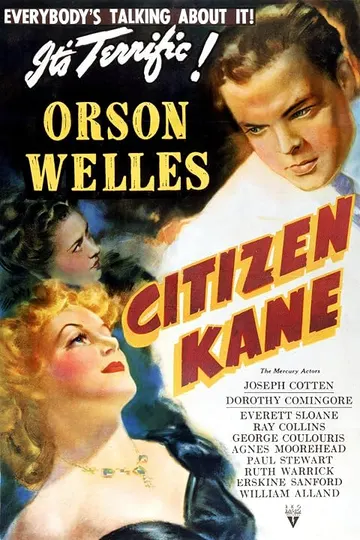
Orson Welles / 奥逊·威尔斯 · 1941
Citizen Kane
Citizen Kane
Witnesses search different sheets of the past for Kane; a complete truth remains unactualized.
Film details
- Original title
- Citizen Kane
- Director
- Orson Welles / 奥逊·威尔斯
- Year
- 1941
- Region
- United States
Film analysis: how shots organize concepts
A reporter searches a whole life through one word, but testimony, deep-focus space, and the final unseen sled distribute Kane across several coexisting sheets of past.
- 01A last word starts the search
Kane says 'Rosebud' before dying and drops a snow globe; the reporter then consults Thatcher's unpublished memoir and interviews Bernstein, Leland, Susan, and the butler Raymond.
A word is installed as a solvable clue, as if the past could be recalled sheet by sheet through testimony. - 02One life divides among different sheets
Each testimony enters a different age, space, and affective position; the deep-focus guardianship scene holds the indoor contract together with the child playing in snow outside.
The past does not queue along one causal line but coexists in planes that cannot totalize one another. - 03The answer leaves the investigator behind
The reporter concludes that no single possession can explain a man; workers then throw the childhood sled marked 'Rosebud' into the furnace, unseen by the investigators.
The disclosure does not synthesize the sheets into a truth; it shows the image preserving a past neither character nor inquiry can actualize.
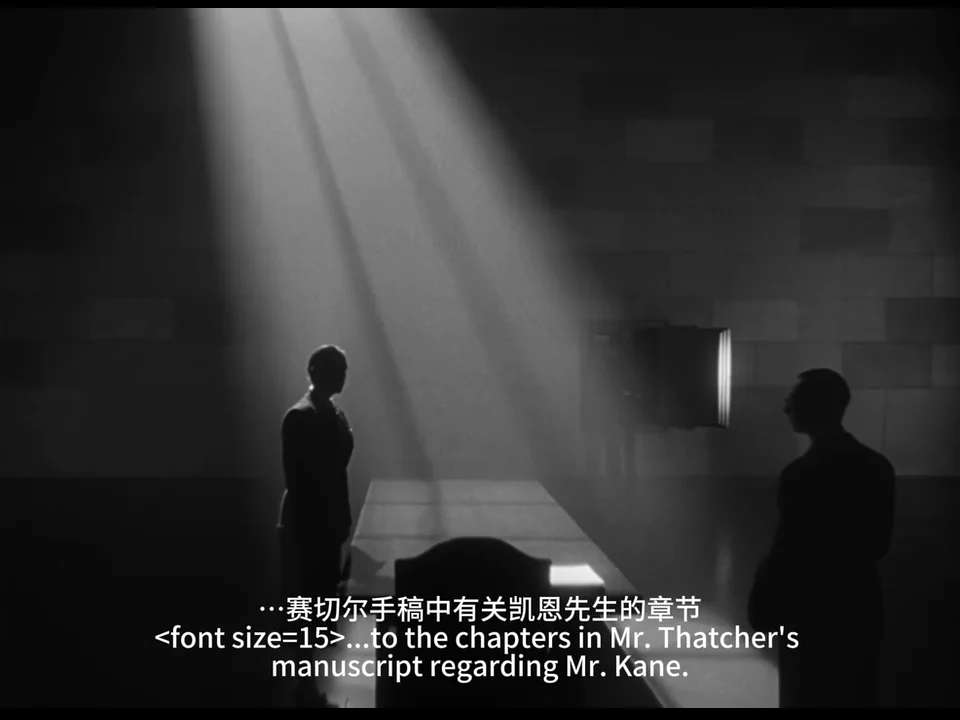 第3分段 00:00:15 / Part 3 00:00:15
The investigation does not return to one past; it enters one sheet through a witness document.
A single overhead beam cuts out the large reading table and manuscript while the figures recede into silhouettes.
The archive material lies between the two figures as a material entrance into Kane's past.
The attendant directs Thompson to the chapters of Thatcher's manuscript concerning Kane.
SITE ANALYSISThe manuscript is not a key that solves a life but one sheet opened by witness, document, and image; later testimonies enter other sheets.
Cinema 2, chapter 5, pp. 105, 110–111, 115–119.Bilibili at 第3分段 00:00:15 / Part 3 00:00:15 Open original still ↗Part 3 was frame-checked; the anchor is the entrance into Thatcher's manuscript.Complete Bilibili carrier; the shot at 第3分段 00:00:15 was checked frame by frame, and the still and timestamp come from the same public upload.
Bilibili · Citizen Kane, part 3 · verified 2026-08-14Close-reading questions
- 01Which sheet of past does each witness enter, and where do the testimonies fail to compose a complete life?
- 02Does the Rosebud disclosure complete causality, or let a past unavailable to every character continue to exist?
Analysis and scene sources
Shots and scenes
Primary texts, scholarship, and locators
Theory coordinate: Cinema 2, ch. 5, pp. 105–113
- 01Cinema 2: The Time-Image
Authoritative source for the standard translation, translators, ISBN, and publication date.
Open the atlas source record →
This film in books and research
Deleuze and Cinema: The Film Concepts · Book case
Citizen Kane
pp. 141–146, 170–174
Film relation: Testimony and archive enter different sheets of past, replacing a single character truth with topology.
Shot question: Which Kane does each testimony produce rather than which puzzle piece does it add?
Cinema After Deleuze · Book case
Citizen Kane
pp. 90–92
Film relation: Testimony and archive enter different sheets of past, with Rosebud only one sheet among them.
Shot question: How does each narrator produce a different Kane rather than complete the same Kane?
Gilles Deleuze : cinéma et philosophie · Atlas analysis
Citizen Kane
Marrati pp. 100–101 · site test
Film relation: On pp. 100–101, Marrati uses depth of field to show how a character moves within a sheet of the past; this site extends that criterion to the film's investigative structure: as the reporter consults archives and witnesses, he does not approach one definitive Kane but moves among non-coincident sheets of the past.
Shot question: What Kane is preserved by the Thatcher archive, Bernstein, Leland, Susan, and Raymond respectively, and why can 'Rosebud' not gather those sheets into a single truth?
Conclusion: The past is not a container awaiting restoration but a set of sheets selected, entered, and redistributed by different questions.
La Fable cinématographique
Citizen Kane
Reading relation: Testing periodization against formal coexistence
Sheets of Past and Peaks of Present: How the Order of Time Enters the Image
The past as a structure of coexistence
Claim: Recollection is not stored content in a mind but selection and actualization from coexisting sheets of the pure past.
Conclusion: Mark each past sheet's entrance, tone, object, witness, and actualized result; the sheets coexist without being totalized.
Cinema 2: The Time-Image · pp. 98–99, 105–110Matter and Memory · pp. 152, 162, 168–169Cinema 2: The Time-Image · pp. 105–113Gilles Deleuze's Time Machine · pp. 79–120
Sheets of Past and Peaks of Present: How the Order of Time Enters the Image
Witnesses enter different sheets
Film comparison: Each witness supplies evidence from one sheet of the past, but no sheet exhausts Kane's life.
Viewing gateways and editions
- Verified complete Bilibili multipart carrier: 「公民凯恩 中文字幕」 Citizen Kane (1941) 1080P.bilibili.comOpen film page ↗
- Page access
- Accessible when checked
- Version extent
- Recorded as a complete version
- Source type
- User-uploaded page
Edition note: Complete Chinese-subtitled 14-part film · 1:59:45.
Link checked: 2026-08-13
- Library of Congress essayloc.govOpen film page ↗
- Source type
- Institutional source