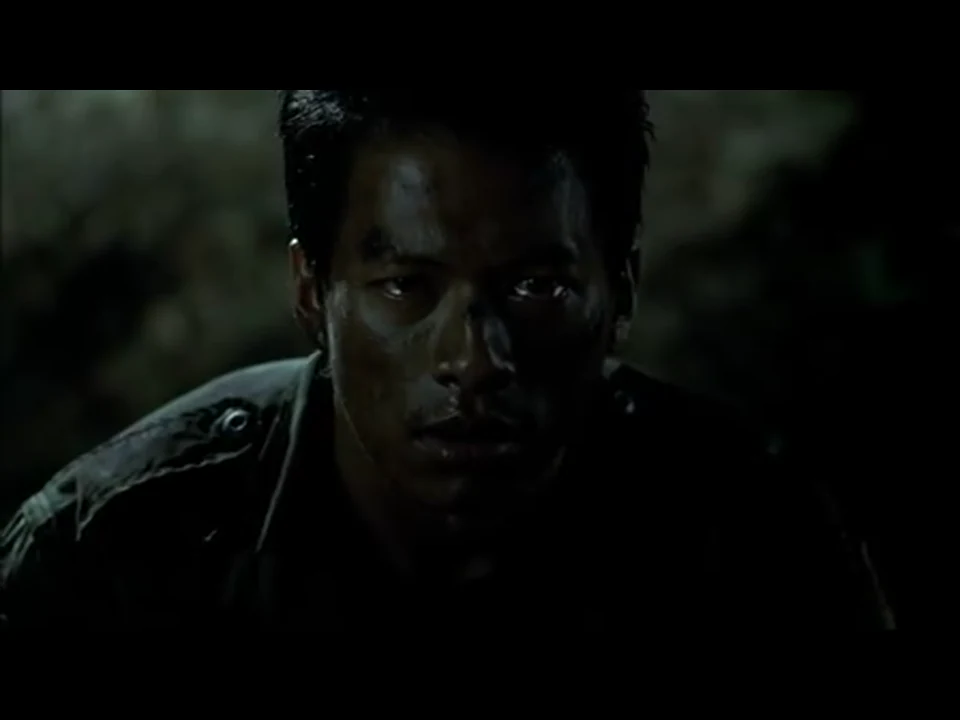
 01:48:40
Audio-visual relation · SHOT EVIDENCE
Giving over body and memory
How does 'Do you hear it?' entrust the film's final relation to sound rather than a visible victory or defeat?
Film and viewing version
Tropical Malady · สัตว์ประหลาด! · Apichatpong Weerasethakul / 阿彼察邦·韦拉斯哈古 · 2004
Frame-checked against the single-part Bilibili repost stream BV12QcAzME5g: the page API reports 6,867 seconds and the retrieved qn16 media runs 6,866.48 seconds. Bilibili supplies no subtitle track; dialogue sense was cross-checked against a third-party English SRT bearing the same DVDRip release name.
Version boundary: The timecodes on this page apply only to the named viewing carrier. Restorations, differing leaders, or platform transcodes may shift them.
Passage and still timecodes
01:47:52 to 01:49:17
Passage bounds checked on the named carrier
The passage bounds and Bilibili still at 01:48:40 were checked separately on their named carriers. They remain distinct coordinates and do not establish identical timecodes for other versions.
Visible facts
- 01
The film alternates between the soldier's frontal close-up and an image of a tiger extending a long tongue toward a kneeling human figure; the soldier keeps staring.
- 02
At the segment's end, the film leaves the face for the dark canopy.
Audible facts
- 01
A voice addresses the 'monster' and gives over spirit, flesh, and memories.
- 02
The speech says that every drop of blood sings 'our song' and ends by asking, 'Do you hear it?' Forest sound continues.
Action relation
The hunt concludes not with a kill but by changing the relation through an offering of body and memory.
Temporal relation
'Our song' renders individual memory as a shared time persisting in blood, sound, and forest.
Conceptual reading
Voice, painting, and gaze must jointly make predation more than one-way; if the ending merely confirmed victor and victim, this reciprocal relation would not hold.
Concepts used in the judgement
- Pure optical / sound situationopsigne / sonsigne · Support tag · evidence chain incomplete
The final question asks for a sound-relation that cannot be exhausted by the action of the hunt.
→ - Body / braincorps / cerveau · ADJACENT · BODY AXIS
Adjacent to the body axis: body, blood, and memory cross the human-animal boundary, but this first supports a relation of becoming. Without attitude and ceremony directly bearing time before story, the scene does not independently establish cinema of the body.
→
Primary and scholarly coordinates
Viewing and still sources
Direct scene · Single-part user repost on Bilibili; the page and anonymous Player API were verified as playable. No platform subtitle track is present.