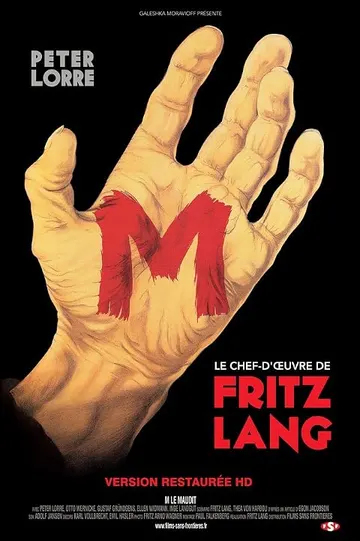
Fritz Lang / 弗里茨·朗 · 1931
M
M – Eine Stadt sucht einen Mörder
Police and underworld tighten the city through raids, maps, and divided labour, yet the real duel is not between them. The underworld tribunal presents crime as manageable habit, while M pleads an uncontrollable impulse. The clash between organized action and affective compulsion marks Lang's passage from expressionist shadow to austere realism.
Film details
- Original title
- M – Eine Stadt sucht einen Mörder
- Director
- Fritz Lang / 弗里茨·朗
- Year
- 1931
- Region
- Germany
Film analysis: how shots organize concepts
Police and underworld share one organizational reason, while M's uncontrollable impulse relocates the true duel between action and affect.
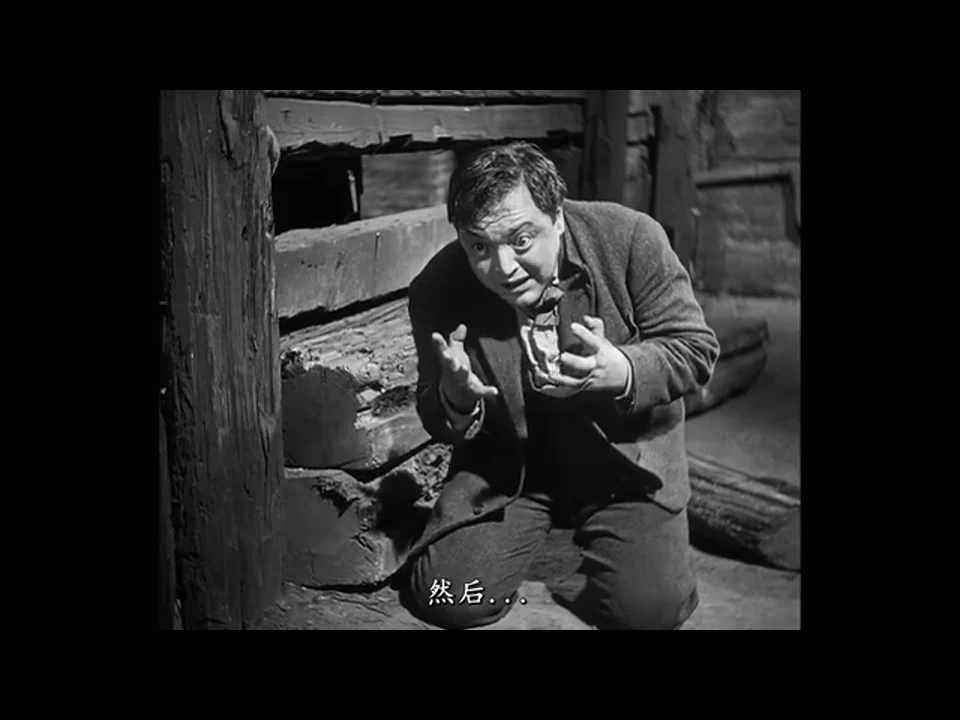 01:44:10
- 01Sound produces the unseen
The whistle comes first, followed by the waiting mother, empty stair, rolling ball, and balloon caught on a wire.
Offscreen sound turns an absent body into the perceptual object of a citywide hunt. - 02Opponents share a machine
Police and underworld meetings crosscut through similar tables, smoke, maps, and divisions of labour.
Law and crime mirror one another in organized action, weakening the explanatory power of binary opposition. - 03Tribunal exposes the gap
The underworld tribunal judges M by professional rules, while he cries that he cannot stop his murderous compulsion.
The real duel shifts between manageable conduct and uncontrollable affect, cracking the action-image from within.
Close-reading questions
- 01The whistled “Hall of the Mountain King” precedes the killer's body: sound → mother's waiting → empty stair and balloon. How does offscreen sound organize the unseen man as the city's perceptual object?
- 02Police and underworld meetings are crosscut through similar tables and gestures; why do opposed institutions form one machine at the level of organized action?
- 03In the underworld tribunal, professional criminals judge M by rules while he pleads uncontrollable compulsion; how does this duel shift law from police-versus-criminal conflict to a gap between action and affect?
Analysis and scene sources
Shots and scenes
Primary texts, scholarship, and locators
Theory coordinate: Cinema 1, Minnesota 1986, ch. 9, pp. 152–153
- 01Cinema 1: The Movement-Image
Standard Minnesota English translation and a principal citation edition in Anglophone scholarship.
Open the atlas source record →
This film in books and research
Gilles Deleuze : cinéma et philosophie · Atlas analysis
M
Marrati pp. 30–35, 46–48, 68–71 · site test
Film relation: This site joins Marrati's out-of-field, stimulus-response interval, and large action form within one pursuit: a whistle first makes the murderer present as unseen sound, after which police and underworld organize the whole city through the same rationality.
Shot question: When police and underworld both turn cues into efficient action while M says in the underground court that he cannot stop, is the decisive conflict still merely pursuers versus murderer?
Conclusion: The action-machine can operate perfectly yet encounter a body the same stimulus-response model cannot explain; the rupture emerges inside the regime of action.
Viewing gateways and editions
- Verified complete Bilibili carrier: M就是凶手.1931.BD1080p.国德双语中字bilibili.comOpen film page ↗
- Page access
- Accessible when checked
- Version extent
- Recorded as a complete version
- Source type
- User-uploaded page
Edition note: Mandarin/German bilingual, Chinese-subtitled complete single-part film · 1:49:46.
Link checked: 2026-08-14