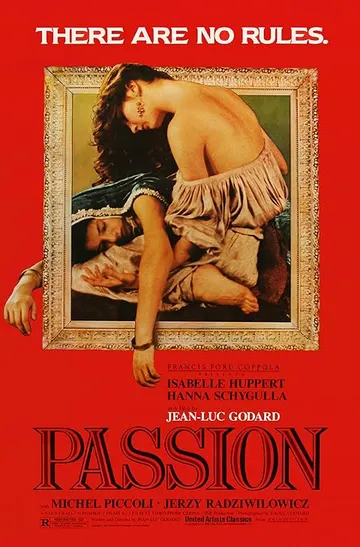
Jean-Luc Godard / 让-吕克·戈达尔 · 1982
Passion
Passion
Tableaux vivants, factory labour, and failed production remain unresolved. The film turns theorem into problem and relinks bodies, images, and sounds across intervals.
Film details
- Original title
- Passion
- Director
- Jean-Luc Godard / 让-吕克·戈达尔
- Year
- 1982
- Region
- France / Switzerland
Film analysis: how shots organize concepts
Why does Godard’s Passion refuse to turn paintings, factory, and love into one story, and instead make them question one another through light, bodies, command, and labour?
The Night Watch, the Goya constellation, and Delacroix’s Crusaders do not become plot illustrations; they are penetrated by camera, track, lamps, factory machinery, strike, and repeated commands to ‘work.’ The apparent failure to find a story is a refusal to govern heterogeneous production with one horizontal causal chain: painting, cinema, components, and love must all be materially made by bodies under different conditions of power.
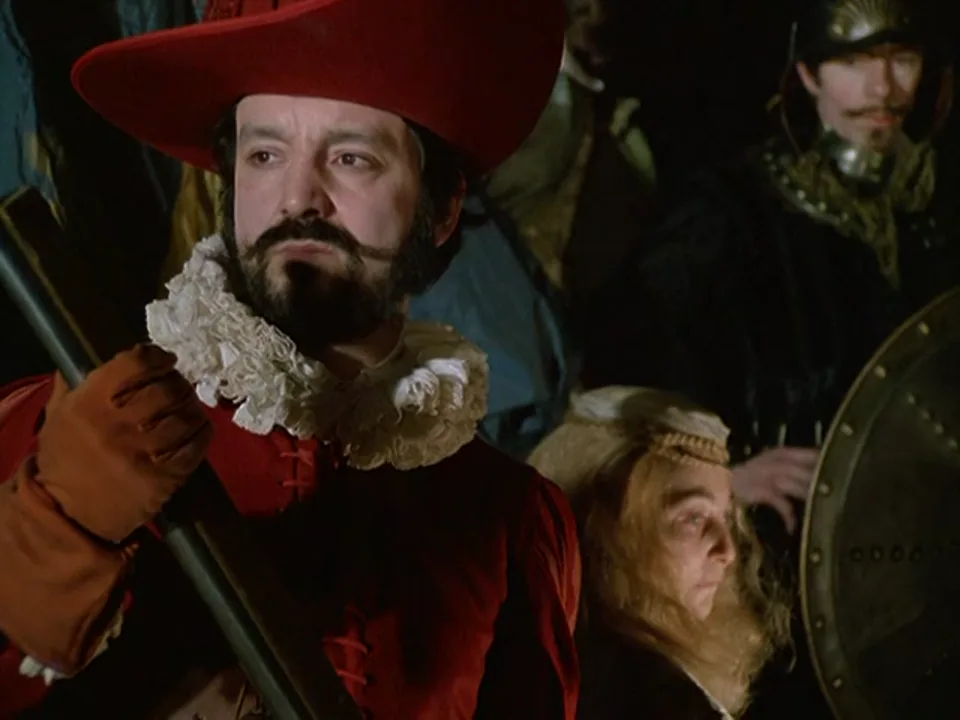
The film alternates factory drill press and a living tableau of Rembrandt’s Night Watch. Captain, group arrangement, lamps, machinery, and Isabelle’s posture form correspondences without being translated into one-to-one allegory.
Voices ask ‘what is this story?’ as cinematographic discussion turns to mouths, eyes, and light; commands requiring Jerzy and Isabelle to work enter from different places.
Cinema of the body produces thought through posture: bodies waiting and adjusting for composition face bodies timed by machinery. Painting does not explain labour; it makes two forms of labour expose one another.
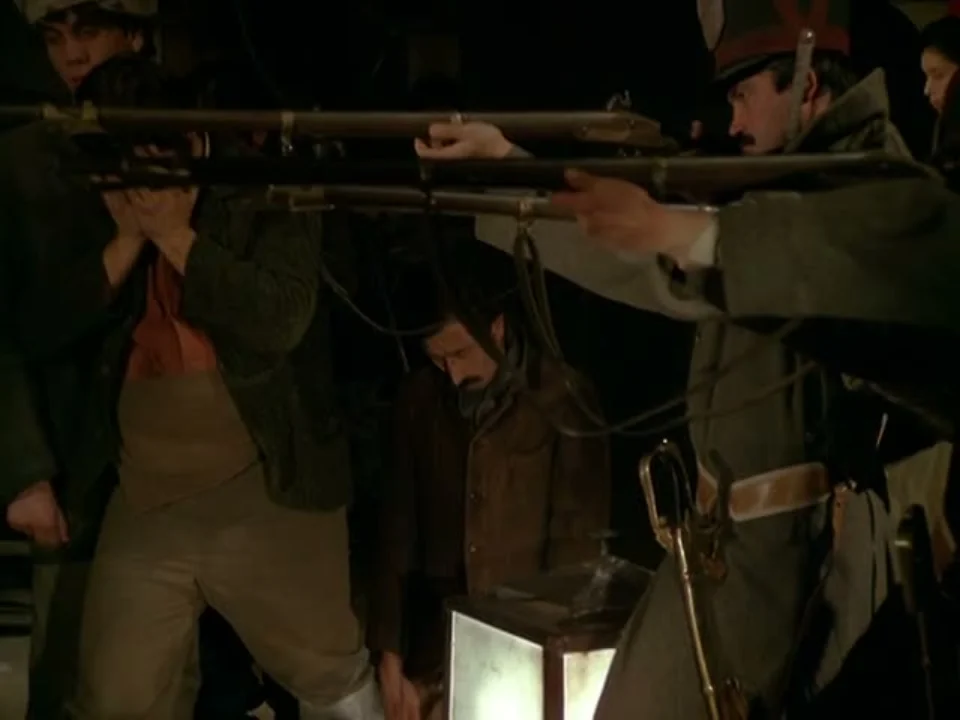
Actors playing the firing squad level rifles while a light box remains visible inside the composition; this tableau then alternates with royal portraiture, exposed bodies, cinematographic machinery, and Isabelle’s factory body in a continually reorganized series.
Mozart’s Requiem runs alongside production phrases such as ‘the light doesn’t work’ and ‘follow the story.’ Historical mourning, studio judgment, and labour dispute do not merge into one authoritative voice.
Category does not apply one theme to heterogeneous material; it lets execution, nude, royalty, factory, and strike rewrite one another’s visibility. The lectosign must preserve differences among layers for their relation to be legible.
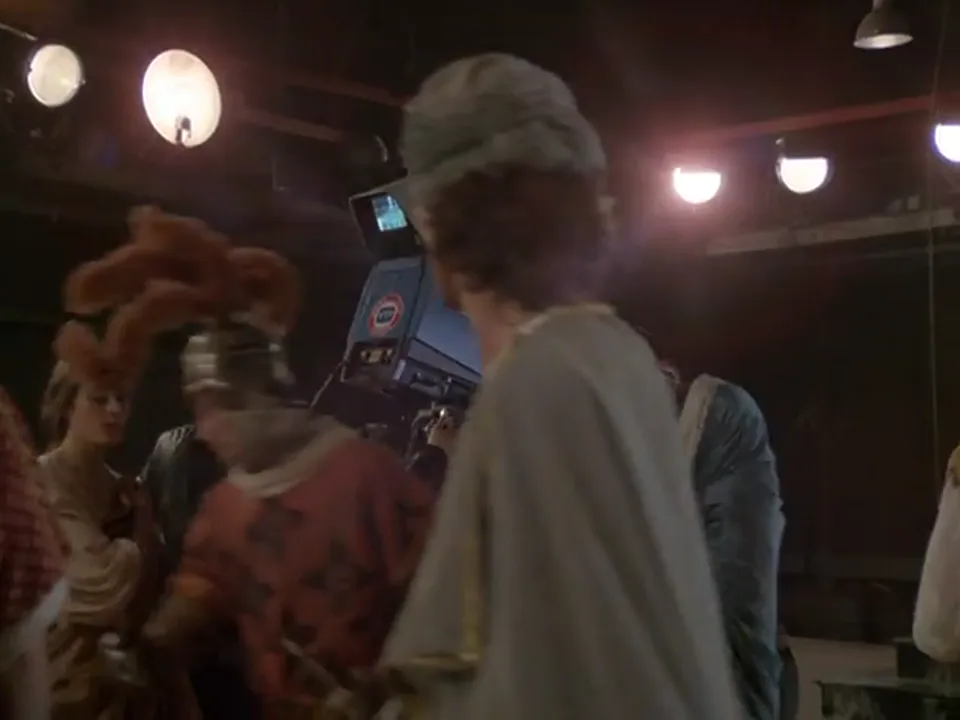
Camera, track, crew, horses, armoured figures, and crowd remain together within the Delacroix-like scene; the history of conquest continually shows itself as rehearsal, direction, and rework.
An off-screen account of Delacroix gives way to increasingly dense commands: ‘back to work,’ ‘positions,’ ‘why aren’t you working,’ ‘Work!’ Commands move bodies but do not produce a final completed picture.
The irrational interval keeps imperial image and modern studio labour incommensurable yet mutually pressuring. Incompletion is not production anecdote but a force making thought ask who labours, commands, and bears risk for spectacle.
EDITION NOTE Frame research uses the public Internet Archive reference copy (01:24:18, 25fps PAL speed-up). Its three images are checked frames, while watch links are marked as edition locators rather than direct Bilibili shots. In 87–88-minute editions these events usually occur about 4% later; align by visual and spoken checkpoints. User-supplied BV1gPKPzZEfZ is Ryusuke Hamaguchi’s 2008 namesake and remains excluded from Godard’s record.
Unfinished restagings of paintings, factory conflict, and broken speech refuse to form one story, making thought arise in intervals among bodies and sites.
- 01Restaging stalls in light
The studio repeatedly stages tableaux after Rembrandt, Goya, and Delacroix, while the director insists the light is wrong and the story cannot be found.
Image production ceases to obey the goal of a finished work; bodily attitude becomes an autonomous problem. - 02Factory speech refuses subplot status
Isabelle's stammer, pauses, machine noise, and labour dispute cross studio and hotel without being absorbed by the director's art story.
Body and sound establish their own line of thought; labour cannot be reduced to background for the paintings. - 03Sites connect only through 'and'
Studio, factory, hotel, and road are repeatedly juxtaposed; when figures depart, film, love, and strike all remain unresolved.
The irrational cut replaces hierarchy, forcing thought between heterogeneous series.
Close-reading questions
- 01Why do the Rembrandt, Goya, and Delacroix tableaux keep stalling over light, pose, or framing? After each declaration that it is still wrong, log whether bodies, lamps, or frame continue to change, testing when image production detaches from the goal of a finished work.
- 02How do Isabelle's stammer, breathing, factory noise, and labour dispute enter studio and hotel without being absorbed as social background to Jerzy's artistic crisis? Across which cuts does sound retain its own rhythm and pressure?
- 03Is there a retellable causal hierarchy among studio, factory, hotel, and road, or does editing only place film and labour and love beside one another? If one shot could subordinate all three to a single aim, how would it falsify the atlas's claim about the interstice?
Analysis and scene sources
Shots and scenes
Primary texts, scholarship, and locators
Theory coordinate: Cinema 2, ch. 1, p. 10; ch. 4, pp. 79, 81; ch. 7, p. 178; ch. 8, p. 199; notes, p. 283
- 01Cinema 2: The Time-Image
Authoritative source for the standard translation, translators, ISBN, and publication date.
Open the atlas source record →
Viewing gateways and editions
- Same-title negative audit lead: 激情(2008,日本,滨口龙介)bilibili.comOpen film page ↗
- Source type
- Search lead
Edition note: This page contains Ryusuke Hamaguchi’s 2008 film, not Jean-Luc Godard’s 1982 Passion. Its 2:51:01 runtime exceeds the usual Hamaguchi edition.
Link checked: 2026-08-25