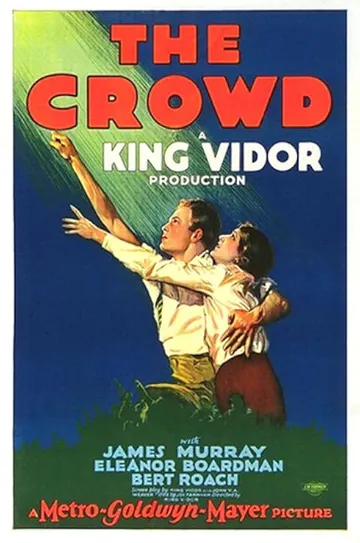
King Vidor / 金·维多 · 1928
The Crowd
The Crowd
The camera travels against the street crowd, enters a skyscraper, and finds one desk among countless windows, embedding the individual in an exchangeable mass. John repeatedly answers the city with effort only to return to the same situation. The large form S–A–S′ fails, turning upward mobility into an S–A–S loop.
Film details
- Original title
- The Crowd
- Director
- King Vidor / 金·维多
- Year
- 1928
- Region
- United States
Film analysis: how shots organize concepts
The city first locates the individual as a point in the crowd, then returns every effort to its origin, closing the large form's ascending spiral into a loop.
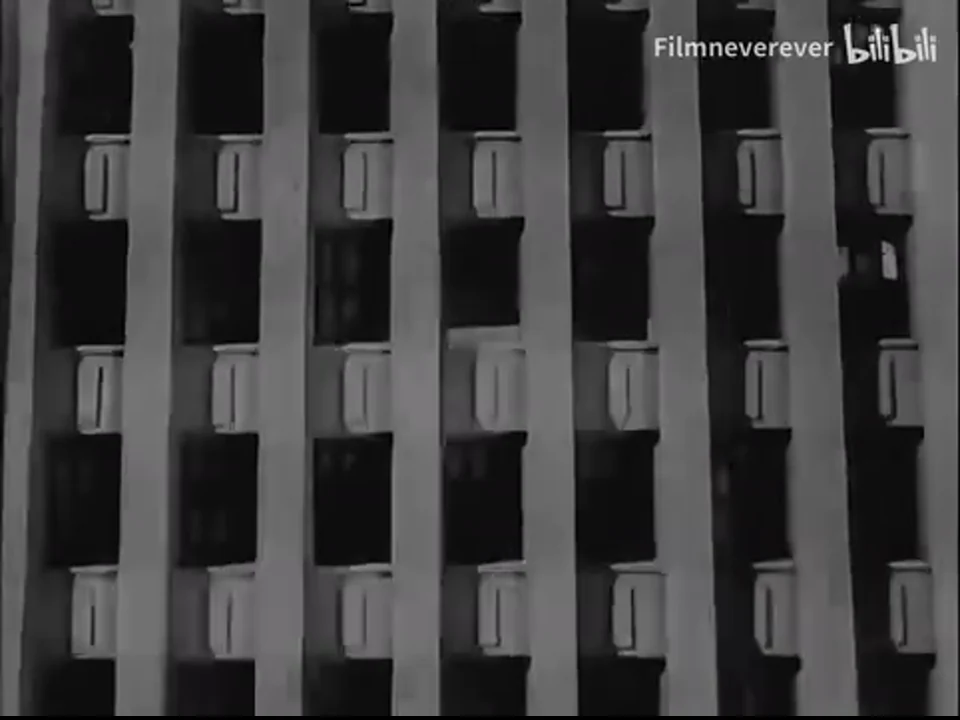 00:07:30
- 01The individual is located by the crowd
The camera moves against street flow into a skyscraper, passing countless windows and desks before finding John.
Continuous perception embeds the protagonist in an exchangeable social set rather than singling him out. - 02Milieu refuses response
After his daughter's accident, John's running, work, and appeals are repeatedly delayed by crowds and institutions.
Action cannot transform the milieu into an adequate new situation; the large form S–A–S′ fails. - 03Laughter closes the loop
At the end, the family laughs in a theatre as the camera pulls back and makes them small points in the crowd again.
The situation eases without changing and returns to its start; S–A–S becomes the American nightmare.
Close-reading questions
- 01The camera moves against the crowd, enters the skyscraper, passes rows of windows, and stops at John's desk; how does movement locate the “unique individual” as one exchangeable point in the mass?
- 02After his daughter's accident, John struggles through onlookers to reach home; as crowd changes from community into obstacle, why does the urban milieu no longer support adequate action?
- 03At the end, the family laughs with the theatre crowd; the situation appears restored without materially changing. How does this S–A–S circuit turn the American dream into an American nightmare?
Analysis and scene sources
Shots and scenes
Primary texts, scholarship, and locators
Theory coordinate: Cinema 1, Minnesota 1986, ch. 2, p. 22; ch. 9, p. 144
- 01Cinema 1: The Movement-Image
Standard Minnesota English translation and a principal citation edition in Anglophone scholarship.
Open the atlas source record →
This film in books and research
Deleuze and Cinema: The Film Concepts · Book case
The Crowd
pp. 2–3
Film relation: The individual and mass flow contest the image centre, establishing the problem of cinematographic consciousness.
Shot question: When does framing turn a person into a unit of the crowd, and when does it restore an individual centre?
Gilles Deleuze : cinéma et philosophie · Atlas analysis
The Crowd
Marrati pp. 68–71, 102–104 · site test
Film relation: This site tests the large action form and American cinema's belief in the world through the opening and ending: the camera finds John among countless office windows, then returns his laughter to an indistinguishable audience.
Shot question: The individual is located by the city, acts and strives, then is absorbed again by the crowd. Why does this route fold S–A–S′ back into S–A–S?
Conclusion: The film frustrates, from within its form, the belief that action transforms situation: actions accumulate experience without changing the individual's replaceable place in the whole.
Viewing gateways and editions
- Verified complete Bilibili carrier: 群众 1928(2k修复版)bilibili.comOpen film page ↗
- Page access
- Accessible when checked
- Version extent
- Restored version
- Source type
- User-uploaded page
Edition note: 2K-restored complete single-part film · 1:33:39.
Link checked: 2026-08-14