
Buster Keaton / 巴斯特·基顿 · 1928
Steamboat Bill, Jr.
Steamboat Bill, Jr.
The cyclone turns the town into a continuously transforming milieu: façades fall, buildings slide, and wind transports bodies. Keaton's small body does not overpower disaster but passes through it by exact position and improvised trajectory. Burlesque small form thereby carries a sublime scale usually reserved for epic large form.
Film details
- Original title
- Steamboat Bill, Jr.
- Director
- Buster Keaton / 巴斯特·基顿
- Year
- 1928
- Region
- United States
Film analysis: how shots organize concepts
The cyclone converts a stable town into transformation-space, and a small body bears epic scale through exact position rather than force.
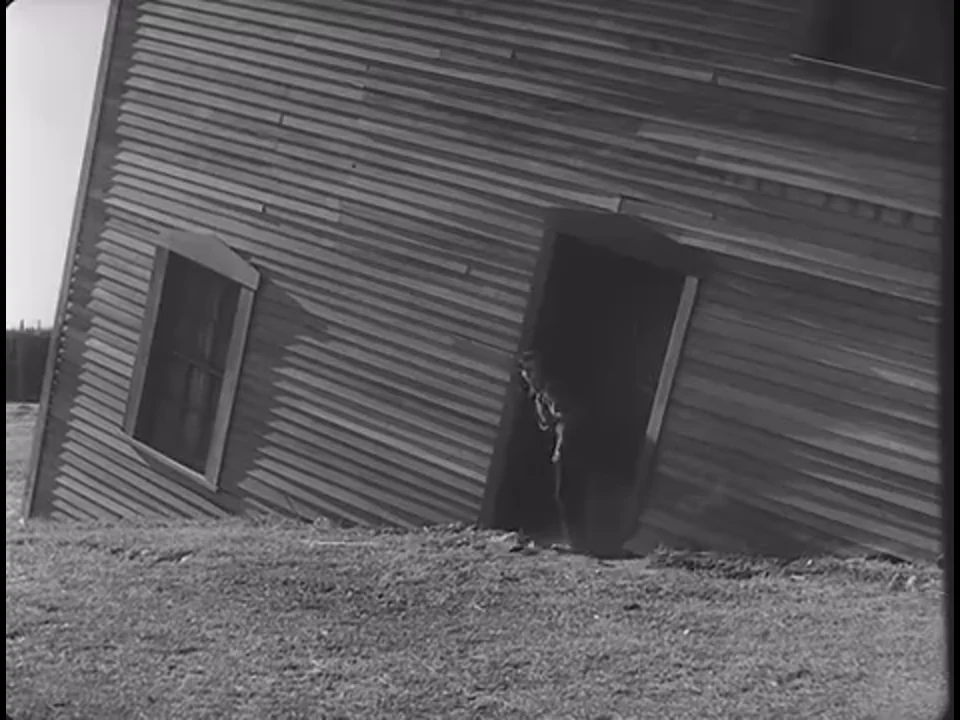 01:02:41
- 01The milieu moves as a whole
Wind moves bed, walls, trees, signs, and bodies together; architecture no longer provides fixed coordinates.
The milieu changes from backdrop into the agent governing every local movement. - 02Position answers scale
An entire façade falls, its window landing exactly around the stationary Keaton.
Minimal displacement answers maximal catastrophe, joining small form and sublime large form in one gag. - 03Disaster redistributes relations
Keaton successively rescues father, lover, and rival captain, crossing flood and wind with improvised devices.
Environmental pressure temporarily assembles rivals into cooperation, and action produces a new relation.
Close-reading questions
- 01The cyclone moves bed, walls, trees, and people together: fixed town → transformation-space → improvised routes. How does the milieu become the real agent?
- 02An entire façade falls while its window lands exactly around Keaton: catastrophic scale → precise position → survival. Why does the gag display burlesque small form and sublime large form at once?
- 03As he rescues father, lover, and rival captain in the wind, disaster redistributes their conflict; how does action temporarily connect heterogeneous people into a machine?
Shots and scenes
Primary texts, scholarship, and locators
Theory coordinate: Cinema 1, Minnesota 1986, ch. 10, p. 173
- 01Cinema 1: The Movement-Image
Standard Minnesota English translation and a principal citation edition in Anglophone scholarship.
Open the atlas source record →
Viewing gateways and editions
- Verified complete Bilibili carrier: 【1080P/BDrip/无声电影】 船长二世(巴斯特·基顿)1928【官方画面修复版】bilibili.comOpen film page ↗
- Page access
- Accessible when checked
- Version extent
- Restored version
- Source type
- User-uploaded page
Edition note: Visually restored complete single-part film · 1:10:33.
Link checked: 2026-08-14