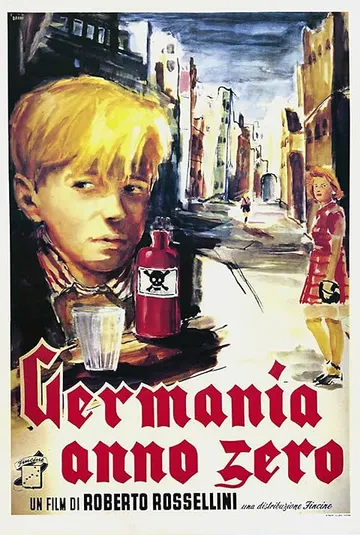
Roberto Rossellini / 罗伯托·罗西里尼 · 1948
Germany Year Zero
Germania anno zero
Ruins exceed the reach of reparative action. The child becomes a seer before the intolerable, and the action-chain collapses from within.
Film details
- Original title
- Germania anno zero
- Director
- Roberto Rossellini / 罗伯托·罗西里尼
- Year
- 1948
- Region
- Italy / Germany
Film analysis: how shots organize concepts
The long wandering turns streets, church, ruined buildings, traffic, and children's play from usable action-space into a city layer that must be watched. Bilibili timecode 01:12:18.
Edmund crosses streets and broken walls alone, pauses outside a church, and enters a building without intact walls.
He watches children playing, vehicles, and the street below, repeatedly touches debris and architectural fragments; after climbing upward, he falls from the building, and a woman in the street approaches his body.
The long passage is formed mainly by sustained orchestral music, traffic, distant children's voices, and urban ambience; Edmund speaks almost no dialogue.
SITE ANALYSISWandering must let space and sound endure beyond route-finding and turn the child's motor helplessness into intensified seeing; the finale satisfies both conditions.
Bilibili at 01:12:18 Open original still ↗Frame-checked against the single-part Bilibili repost stream BV1hP4y1k78i: the page API reports 4,388 seconds and the retrieved qn16 media runs 4,387.37 seconds. Bilibili supplies no subtitle track; audible facts record only clearly discernible German speech, music, and ambient sound in the image sequence.Complete single-part Bilibili film; the page and anonymous Player API were verified as playable. Bilibili submission label: repost.
Bilibili · La-Jeunesse- · public repost page · verified 2026-08-13Close reading and primary texts
Germania anno zero · 1948 · Roberto Rossellini / 罗伯托·罗西里尼
Germany Year Zero: After Action Succeeds, the World Still Fails
Ruins, historical sound, sensory-motor rupture, and the child seer
The threshold of the time-image is not the disappearance of action but the loss of adequacy between action and situation: local acts remain effective yet cannot grasp consequences, repair the world, or open a future, turning the child from agent into a seer compelled by the situation to look.
Deleuze directly names the film and its child in chapter 1 of Cinema 2, establishing a direct relation between primary text and film. This site's scene readings of the cemetery, teacher, recording, poisoned glass, rebuke, and final wandering are cross-checked against film-historical and formal scholarship.
Primary passages and argumentative function
DELEUZE PRIMARY TEXTet qui meurt de ce qu’il voit.
DELEUZE PRIMARY TEXTCe n’est pas la situation qu’ils voient. C’est la situation qui les fait voir.
DELEUZE PRIMARY TEXTa cinema of the seer and no longer of the agent.
SITE FILM ARGUMENT
Local labour cannot restore the scale of the city
The opening overlays cemetery, worksite, dwelling, and passage: people still dig and carry, yet space no longer offers a whole that such acts could repair.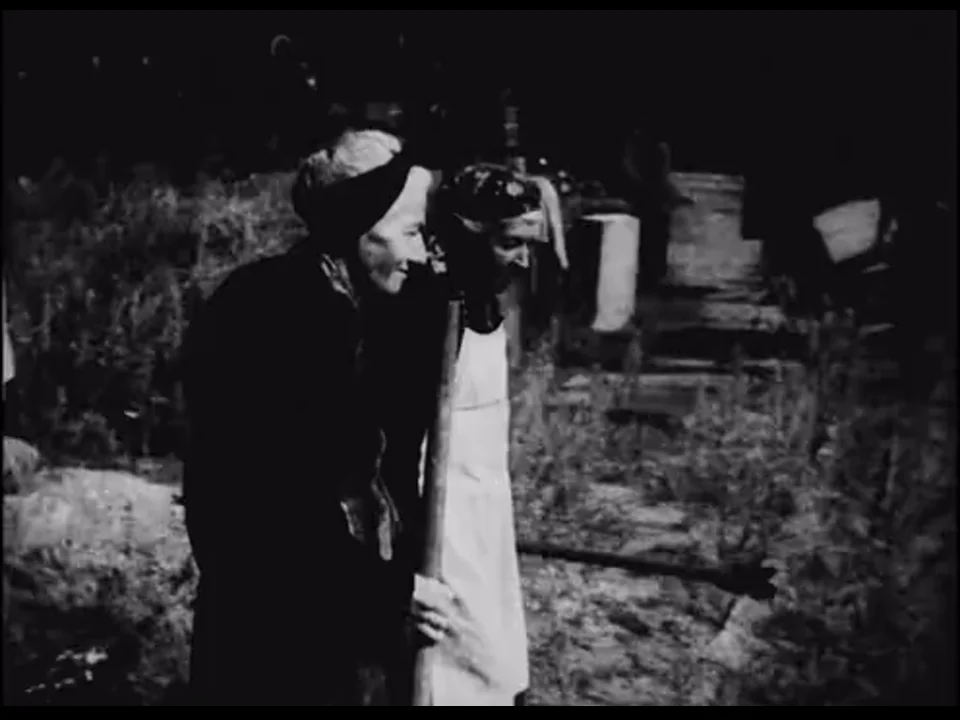
After the title, the city appears not as a coherent background for action but as cemetery, rubble, and survival labour layered together. Bilibili timecode 00:02:35.
Open video positionBetween 00:02:05 and 00:02:54 the camera moves from a damaged skyline into an overgrown cemetery. Two women cross graves and rubble while figures dig and carry behind them and a pale board traverses the foreground. The acts are clear and locally effective: earth is opened, material moved. Yet the cemetery is also worksite and passage, and labour cannot restore the boundaries among death, dwelling, and production. The ruin is not empty scenery but a space where action continues after losing a total scale.[5][7]
Cadel places panorama, cemetery, and child within a progressively narrowing visual route; Morrison cautions that the ruin’s stylistic disarticulation cannot be reduced to Edmund’s psychology. Together, the two studies make the opening a test for the any-space-whatever: cemetery, worksite, and passage begin to overlap while local acts continue; whether the space becomes ‘disconnected or emptied’ in Deleuze’s sense must be established through later routes and shot relations. War returns not in flashback but as damaged buildings, mixed uses, and disproportion still occupying the present.[5][7][2]
SITE FILM ARGUMENT
Old discourse continues arranging action after defeat
The teacher converts household scarcity into the black-market sale of a Hitler record; its playback in the ruined Chancellery lets the fascist past enter the present as portable, reproducible, and saleable sound.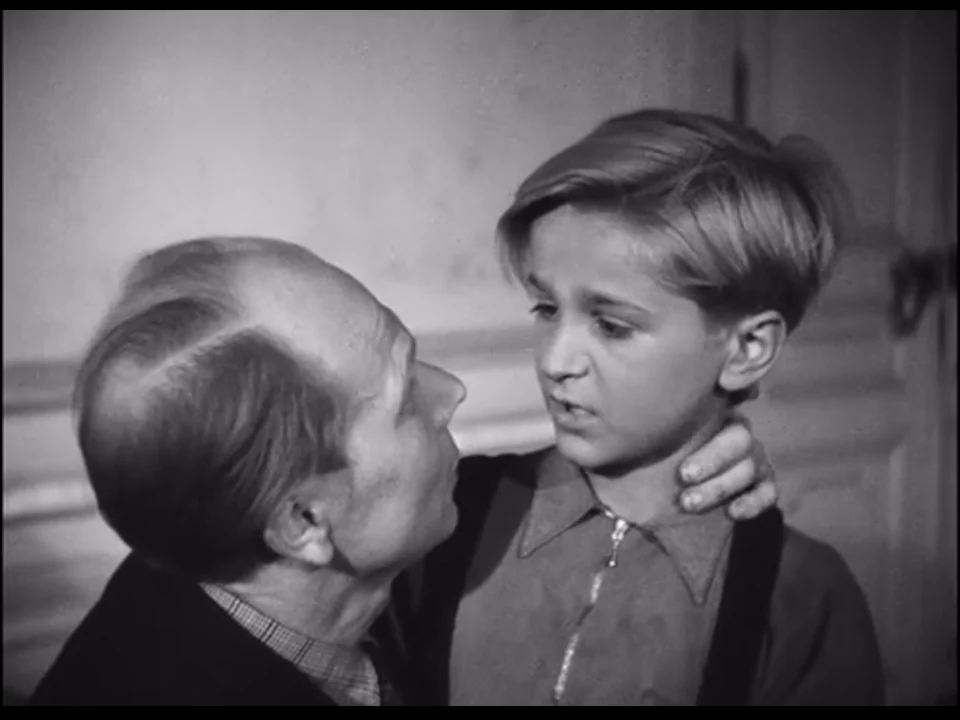
The former teacher gives Edmund a record of a Hitler speech and a player to sell at the ruined Chancellery. Bilibili timecode 00:24:40.
Open video position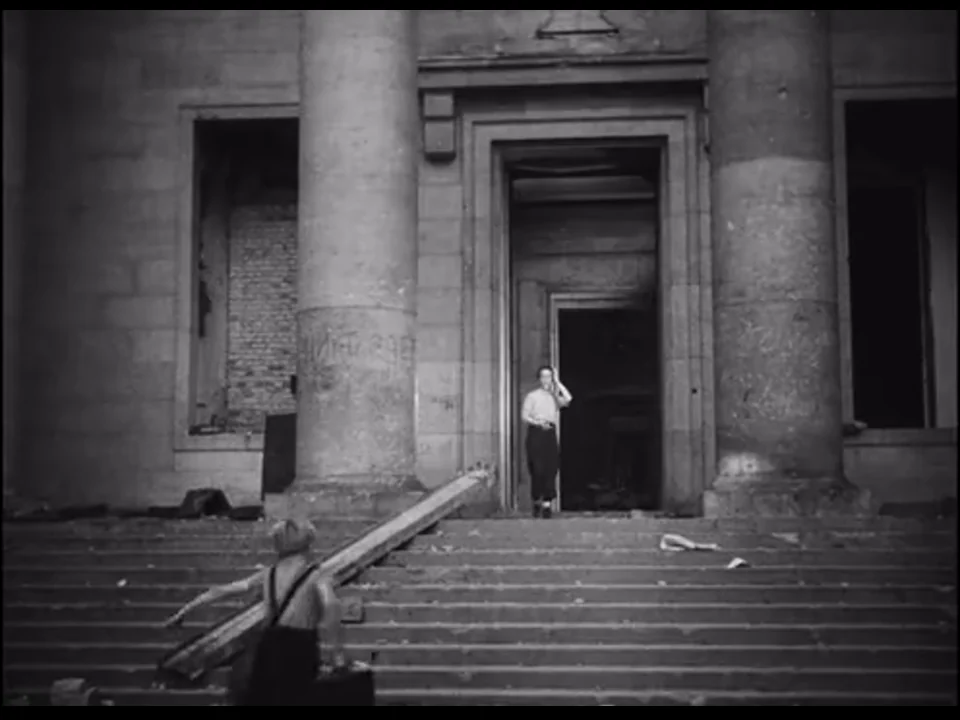
A recorded political voice meets the ruined Chancellery; the source of the voice and visible history are separated. Bilibili timecode 00:27:50.
Open video positionFrom 00:23:58 to 00:26:11 the teacher asks why Edmund is out of school and why the family lacks food, then gives him a record of a Hitler speech and a player to sell at the Chancellery, instructing him to claim the record as his own if questioned. Household scarcity becomes a concrete black-market task; ideology becomes portable, reproducible, and saleable. From 00:27:41 to 00:28:24 Edmund carries the record case through the ruined Chancellery as the amplified political speech plays.[5][6]
The recording does not explain the building. Its assertion of intact power conflicts with empty doorways, broken walls, and tiny bodies in the image. Sound belongs to a fascist past still reproducible, architecture to a present in which destruction remains unfinished, and record-selling to the child’s immediate survival task. No single causal line unifies the three times. Cadel’s analysis of the recorded leader against the Chancellery’s visual ruin supports this audio-visual split and shows a sensory-motor program continuing automatically after its political world has collapsed.[5][2][7]
SITE FILM ARGUMENT
The more exact the act, the less reparable its consequence
The poisoned-glass scene completes taking, mixing, serving, and drinking; the teacher’s later denial severs the source of explanation. The sensory-motor schema reaches failure through successful execution.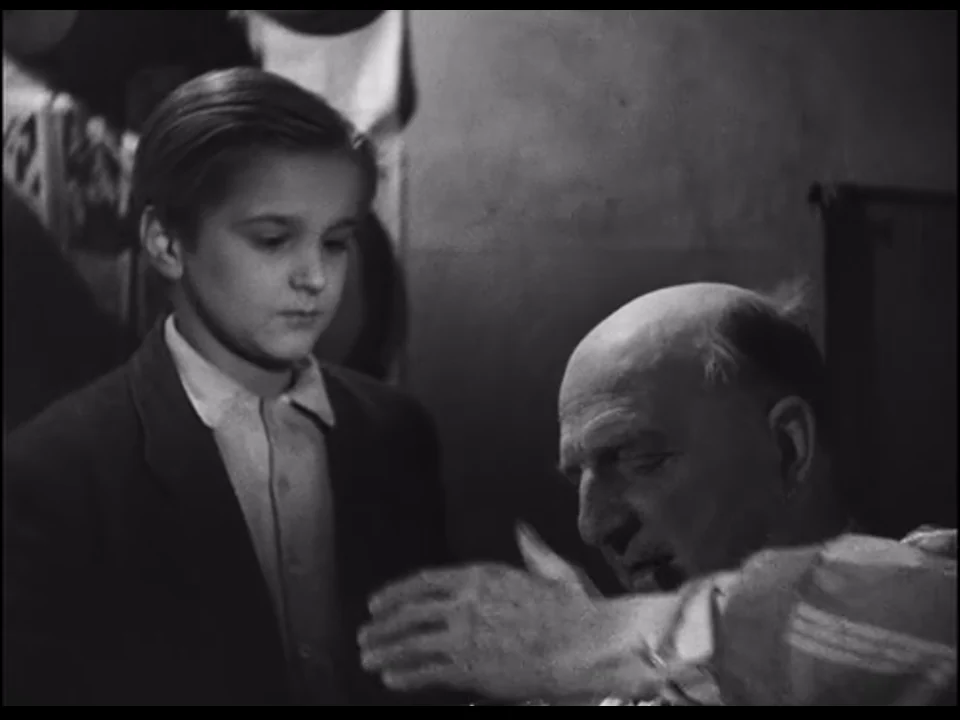
After an act mistaken for a solution to the family's hardship, the child can only watch his father drink from the glass. Bilibili timecode 00:52:15.
Open video position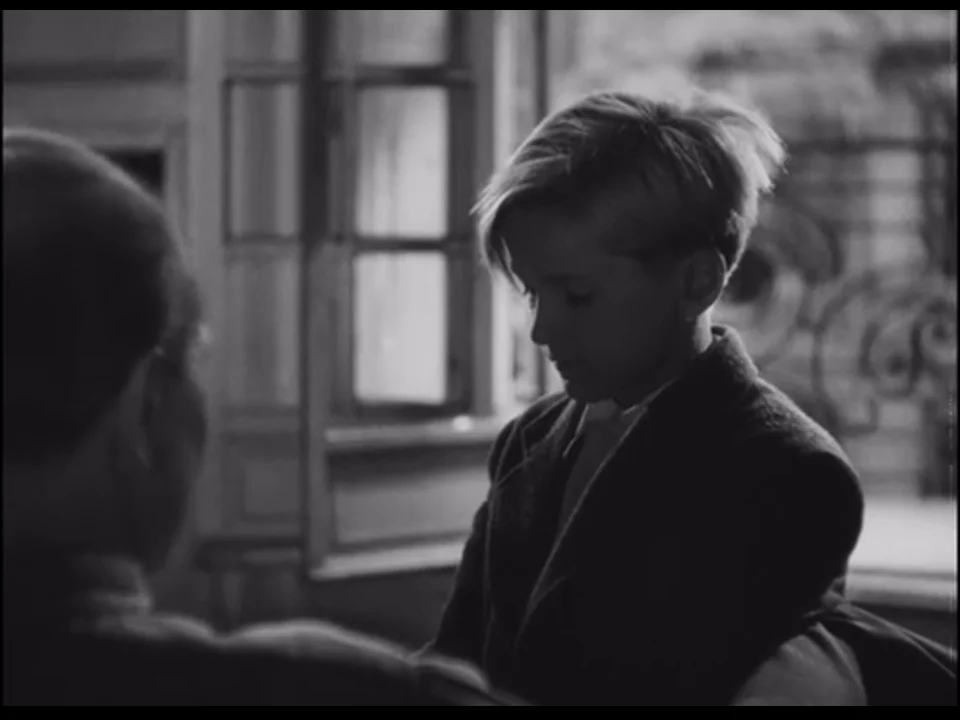
The child brings the completed act back to its source in speech but receives no explanation capable of bearing its consequence. Bilibili timecode 01:03:18.
Open video positionBetween 00:50:11 and 00:52:42 Edmund moves between table and bed, places powder in a drink, and watches his father lift and empty the glass. Every step receives its purpose from the previous one; the physical chain does not fail. At completion, however, the family situation becomes irreversible. The film leaves the child watching beside glass and father after the act has occurred and no act of the same order can recall it. The threshold of the time-image is therefore not immobility but action’s inability to comprehend the time it has produced.[6][8][2]
From 00:45:08 to 00:45:32, in a second meeting, the teacher turns the death of the weak into a rule of action; the poisoning at 00:50:11–00:52:42 gives that rule an irreversible result. From 01:02:58 to 01:04:11 Edmund returns the consequence to the teacher, who rebukes him and withdraws the explanatory chain without establishing a new rule. Fisher resists naturalizing the neorealist child as mere weakness. The correction is crucial: Edmund can act; adult instruction, material consequence, and responsibility have come apart.[6][5][8]
SITE FILM ARGUMENT
Final wandering turns the child into a seer
Walking, stopping, picking up, looking, and climbing continue without composing a route; children’s play, traffic, church, and ruin force Edmund to endure times that cannot be unified.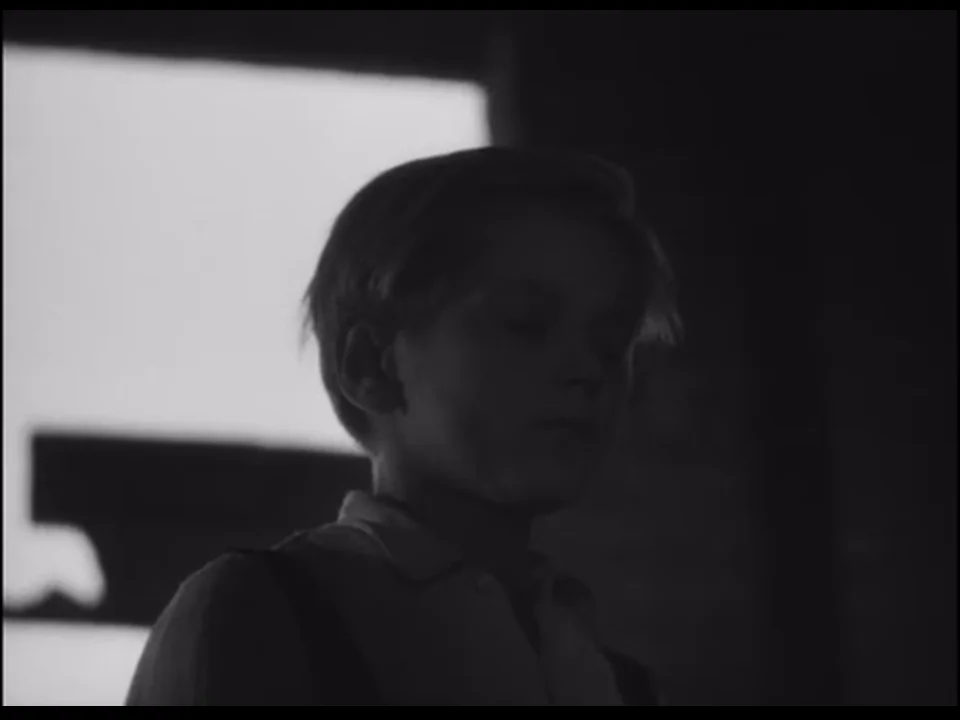
The long wandering turns streets, church, ruined buildings, traffic, and children's play from usable action-space into a city layer that must be watched. Bilibili timecode 01:12:18.
Open video positionBetween 01:05:01 and 01:12:44 Edmund crosses streets, church walls, and fractured buildings alone. He stops to watch children’s play, vehicles, and the street below, picks up rubble, touches architectural fragments, and climbs. Each gesture has a motor form but no common goal. Every part of the city can be crossed, yet no place can receive a next step toward repairing his father’s death or restoring the family. Orchestral music, traffic, and distant children endure beyond route guidance.[5][8][4]
Deleuze’s seminar formula states the relation precisely: the child does not elect to view a situation; the situation makes him see. Children’s play presents a social time that can continue, recordings and walls retain an uncleared wartime past, and the father’s death forms an irreversible immediate past. Sánchez treats the suicide as the point where the movement-image can no longer comprehend a fractured world; Martin-Jones cautions that making World War II the universal global periodization of cinema creates a Eurocentric account. The film's direct relation to Deleuze rests on these concrete image-relations, not on a universal historical divide.[4][9][10][1][2]
How scholarship advances the film
Francesca Cadel
Cadel closely analyzes the opening ruins, Chancellery recording, the teacher’s ideological education, and final wandering.
- Use for this film
- Directly supports the opening, the Chancellery recording, the teacher’s ideological function, and the final wandering; supplies narrative-political context for the poisoning without directly analyzing the later rebuke.
- Critical pressure
- Postwar politics must appear in concrete audio-visual relations rather than as an abstract trauma label.
Jaimey Fisher
Fisher resists equating the neorealist child with natural weakness and studies the child’s body, ruined masculinity, and tension of action.
- Use for this film
- Explain how Edmund can be an intensely active figure and still become a seer marked by motor helplessness.
- Critical pressure
- The passive/active binary must give way to consequences and adequacy between act and situation.
Benedict Morrison
Morrison shows that the film’s formal disarticulation and complex style cannot be reduced to Edmund’s psychology.
- Use for this film
- Preserve the historical and formal force of ruin, composition, and audio-visual relation.
- Critical pressure
- Psychological explanation must be tested against shot organization.
David Martin-Jones
Martin-Jones affirms the time-image’s power for thinking World War II modernity while criticizing a world film history periodized by European experience.
- Use for this film
- Bound the scope of the film as a case of postwar transformation.
- Critical pressure
- The film analysis can hold while a universal global periodization requires separate proof.
Limits of the argument
- 01
Action rupture is judged by lost adequacy between act and situation; neither number nor precision of acts alone proves agency retains power.
- 02
The seer turns motor helplessness into intensified audio-visual reception; childhood, silence, or wandering provide clues rather than proof.
- 03
Ruins enter the any-space-whatever when they alter use, scale, and coordinates of action.
- 04
Historical recording gains temporal pressure beyond locational explanation when it enters a different tense from visible ruin.
- 05
World War II is the film’s concrete historical condition; it does not automatically become a universal periodization of world cinema.
References
- 01Open source
DIRECT FILM PAGE Gilles Deleuze, Cinema 2: The Time-Image, trans. Hugh Tomlinson and Robert Galeta (University of Minnesota Press, 1989), p. 2.
Chapter 1, p. 2Publisher record - 02Open source
CONCEPTUAL CONTEXT Gilles Deleuze, Cinema 2: The Time-Image, trans. Hugh Tomlinson and Robert Galeta (University of Minnesota Press, 1989), pp. 3–5.
Chapter 1, pp. 3–5; p. 5 defines the any-space-whatever criterionPublisher record; used for chapter-level conceptual context, not as a shot-by-shot discussion of this film - 03Edition collation record
PRIMARY THEORY Gilles Deleuze, Cinema 2: The Time-Image, trans. Xie Qiang, Cai Ruoming, and Ma Yue (Hunan Fine Arts Publishing House, 2004), ch. 1, print pp. 3–8.
Chapter 1, print pp. 3–8; any-space-whatever criterion at print p. 8Simplified Chinese edition: Hunan Fine Arts Publishing House, 2004 - 04Open source
PRIMARY THEORY Gilles Deleuze, “Cinema, Truth and Time: The Falsifier, Lecture 17,” 24 April 1984, The Deleuze Seminars, Purdue University.
Approx. 132–133 minutes, the situation makes characters seeOpen Purdue audio, transcript, and translation · DOI 10.4231/58SA-BD74 - 05Open source
SCHOLARSHIP Francesca Cadel, “Mutations and Mutants in Europe after World War II: ‘Germany, Year Zero’ by Roberto Rossellini,” Italica 93.2 (2016): 274–285.
pp. 274–285Peer-reviewed; JSTOR record / institutional access - 06Open source
SCHOLARSHIP Jaimey Fisher, “On the Ruins of Masculinity: The Figure of the Child in Italian Neorealism and the German Rubble-Film,” in Italian Neorealism and Global Cinema (Wayne State University Press, 2007), pp. 25–53.
pp. 25–53University press record - 07Open source
SCHOLARSHIP Benedict Morrison, “Articulation in Ruins: Complicating Style in Germania anno zero,” in Complicating Articulation in Art Cinema (Oxford University Press, 2021), pp. 31–55.
pp. 31–55Oxford Academic chapter · DOI 10.1093/oso/9780192894069.003.0002 - 08Open source
SCHOLARSHIP Timothy C. Campbell, “Playful Falls in a Milieu of Contagion,” in The Techne of Giving: Cinema and the Generous Form of Life (Fordham University Press, 2017), pp. 91–116.
pp. 91–116University press chapter · DOI 10.5422/fordham/9780823273256.003.0004 - 09Open source
SCHOLARSHIP Sergi Sánchez, “Towards a Non-Time Image: Notes on Deleuze in the Digital Era,” in Post-Cinema: Theorizing 21st-Century Film, ed. Shane Denson and Julia Leyda (Falmer: REFRAME Books, 2016), pp. 171–194.
pp. 171–194, especially the opening discussion of Edmund’s finaleOpen university-hosted text, CC BY-NC-ND - 10Open source
SCHOLARSHIP David Martin-Jones, “The Cinematic Temporalities of Modernity: Deleuze, Quijano and ‘How Tasty Was My Little Frenchman’,” Institute of Advanced Study Insights 6.1 (2013).
Open full text from Durham IAS
Close-reading questions
Edmund can still walk, trade, obey, poison, and climb. Why can these movements no longer compose an intelligible and reparable world?
- 01How do the ruins turn the child from agent into seer?
- 02How does urban space collapse the action-chain from within?
Shots, relations, and concepts
- 1Record
The camera first pans across damaged buildings and the city skyline, then cuts into an overgrown cemetery. The opening orchestral music continues over the city views and the first images of labour in the cemetery.
Open the scene currently used to ground this chain: The cemetery emerges from rubble - 2Judge the relation
Digging and carrying are concrete labours, yet they cannot restore stable distinctions among cemetery, dwelling, and ruin. The wartime past does not return through flashback; it remains in the present as a layer of damage still used, cleared, and crossed.
- 3Name the concept last
Sensory-motor schema、Any-space-whatever. Only concepts whose scene relation resolves to “supports” under the current record are named here; candidates, adjacent terms, and countertests are not merged into the conclusion.
- 4Countertest
The ruin must remove the space's single practical use while retaining local human actions; only their coexistence makes it more than a war backdrop.
Shots and scenes
The ruin must remove the space's single practical use while retaining local human actions; only their coexistence makes it more than a war backdrop.
Open viewing position ↗The record is then played in the ruined Chancellery, showing political speech converted into a portable, reproducible, and saleable object.
Open viewing position ↗If the speech merely explains the place, sound and image remain illustrative; sound gains autonomous temporal pressure when recorded authority conflicts with architectural destruction.
Open viewing position ↗Rupture does not mean an absence of action; the criterion is that the more exactly the act is completed, the less its situation can be mastered or repaired by the agent.
Open viewing position ↗If rebuke supplied a new task, the action-chain would continue; rupture holds when speech withdraws the old rule without establishing another.
Open viewing position ↗Wandering must let space and sound endure beyond route-finding and turn the child's motor helplessness into intensified seeing; the finale satisfies both conditions.
Open viewing position ↗Primary texts, scholarship, and locators
Theory coordinate: Cinema 2, Minnesota 1989, Preface p. xi; ch. 1, p. 2
- 01Cinema 2: The Time-Image
Authoritative source for the standard translation, translators, ISBN, and publication date.
Open the atlas source record →
- 01Gilles Deleuze, Cinema 2: The Time-Image, trans. Hugh Tomlinson and Robert Galeta (University of Minnesota Press, 1989), p. 2.
Chapter 1, p. 2
Open source ↗ - 02Gilles Deleuze, Cinema 2: The Time-Image, trans. Hugh Tomlinson and Robert Galeta (University of Minnesota Press, 1989), pp. 3–5.
Chapter 1, pp. 3–5; p. 5 defines the any-space-whatever criterion
Open source ↗ - 03Gilles Deleuze, Cinema 2: The Time-Image, trans. Xie Qiang, Cai Ruoming, and Ma Yue (Hunan Fine Arts Publishing House, 2004), ch. 1, print pp. 3–8.
Chapter 1, print pp. 3–8; any-space-whatever criterion at print p. 8
- 04Gilles Deleuze, “Cinema, Truth and Time: The Falsifier, Lecture 17,” 24 April 1984, The Deleuze Seminars, Purdue University.
Approx. 132–133 minutes, the situation makes characters see
Open source ↗ - 05Francesca Cadel, “Mutations and Mutants in Europe after World War II: ‘Germany, Year Zero’ by Roberto Rossellini,” Italica 93.2 (2016): 274–285.
pp. 274–285
Open source ↗ - 06Jaimey Fisher, “On the Ruins of Masculinity: The Figure of the Child in Italian Neorealism and the German Rubble-Film,” in Italian Neorealism and Global Cinema (Wayne State University Press, 2007), pp. 25–53.
pp. 25–53
Open source ↗ - 07Benedict Morrison, “Articulation in Ruins: Complicating Style in Germania anno zero,” in Complicating Articulation in Art Cinema (Oxford University Press, 2021), pp. 31–55.
pp. 31–55
Open source ↗ - 08Timothy C. Campbell, “Playful Falls in a Milieu of Contagion,” in The Techne of Giving: Cinema and the Generous Form of Life (Fordham University Press, 2017), pp. 91–116.
pp. 91–116
Open source ↗ - 09Sergi Sánchez, “Towards a Non-Time Image: Notes on Deleuze in the Digital Era,” in Post-Cinema: Theorizing 21st-Century Film, ed. Shane Denson and Julia Leyda (Falmer: REFRAME Books, 2016), pp. 171–194.
pp. 171–194, especially the opening discussion of Edmund’s finale
Open source ↗ - 10David Martin-Jones, “The Cinematic Temporalities of Modernity: Deleuze, Quijano and ‘How Tasty Was My Little Frenchman’,” Institute of Advanced Study Insights 6.1 (2013).Open source ↗
This film in books and research
Gilles Deleuze : cinéma et philosophie · Scholarly reading
Germany Year Zero
Marrati pp. 74–76
Film relation: Marrati opens the postwar chapter through Bazin's analysis of Edmund's unreadable face and prolonged wandering: the viewer cannot decide in advance whether the face expresses indifference, pain, or cruelty, and can only reinterpret the preceding time after his fall.
Shot question: In the final sequence, walking, stopping, picking up, looking, and climbing all remain possible. Why can none of them repair the father's death, restore the family, or open a next step?
Conclusion: Sensory-motor rupture occurs when action ceases to be adequate to the situation, not when movement stops.
Gilles Deleuze : cinéma et philosophie · Atlas analysis
If movements still finish, why has action already failed?
Marrati pp. 74–85
Claim: The postwar break must be demonstrated as a relation: characters can complete local movements from what they see and hear, yet those acts cannot treat the situation, assume its consequences, or open a next step.
Film relation: The poisoning is physically completed, the teacher then refuses responsibility for his instruction, and final walking, looking, and climbing continue without composing a plan of repair.
Conclusion: The rupture lies not in an absence of movement but in movement's failure to remain adequate to a transformed situation.
Cinema 1: The Movement-Image, French primary edition · Cinema 1, chapter 12Cinema 2: The Time-Image, French primary edition · Cinema 2, chapter 1
Cinema After Deleuze
Germany Year Zero dossier
Reading relation: Test action and seeing within one film
Sensory-Motor Rupture: How a Character Becomes a Seer
The act is completed; the situation remains unmastered
Claim: Rupture occurs between local motor success and the failure of the action-chain as a whole.
Conclusion: Record perception, ensuing movement, and alteration of the situation. Rupture is established when movement is completed but the situation remains untreated.
Cinema 2: The Time-Image · ch. 1, p. 2Cinema 2: The Time-Image · p. 2Gilles Deleuze: Cinema and Philosophy · pp. 56–57
Sensory-Motor Rupture: How a Character Becomes a Seer
The image unexhausted by action carries time
Claim: When the shot no longer submits to route and task, pressures of past, present, and future can coexist within one passage.
Conclusion: Action-images and time-images may alternate in one film; the analytical unit is the concrete passage.
Cinema 2: The Time-Image · ch. 1, pp. 2–3Cinema 2: The Time-Image · ch. 1, pp. 2–5Deleuze on Cinema · pp. 107–113
Sensory-Motor Rupture: How a Character Becomes a Seer
Movement persists / future closes
Film comparison: Walking and climbing are completed but no longer generate a continuable world.
Viewing gateways and editions
- Verified complete Bilibili carrier: 德意志零年 Germania anno zero 1948bilibili.comOpen film page ↗
- Page access
- Accessible when checked
- Version extent
- Recorded as a complete version
- Source type
- User-uploaded page
Edition note: Complete single-part film, accompanied by six still-led scene analyses.
Link checked: 2026-08-13