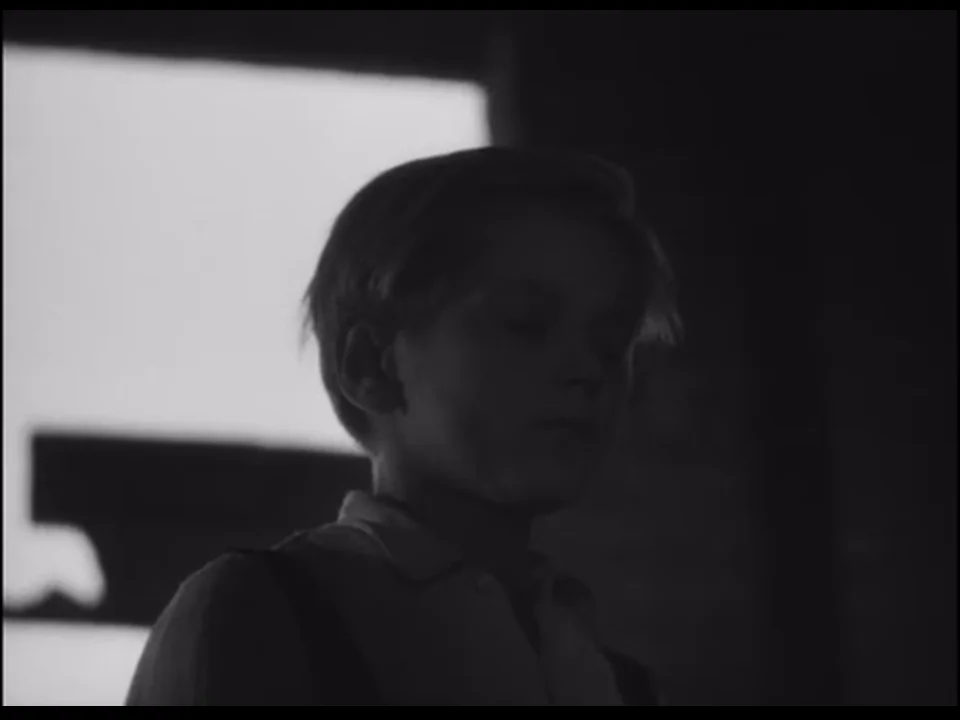
 01:12:18
Action rupture · SHOT EVIDENCE
Final wandering and the sight too much to bear
When every part of the city can be crossed but no place can receive a next action, what does the child see?
Film and viewing version
Germany Year Zero · Germania anno zero · Roberto Rossellini / 罗伯托·罗西里尼 · 1948
Frame-checked against the single-part Bilibili repost stream BV1hP4y1k78i: the page API reports 4,388 seconds and the retrieved qn16 media runs 4,387.37 seconds. Bilibili supplies no subtitle track; audible facts record only clearly discernible German speech, music, and ambient sound in the image sequence.
Version boundary: The timecodes on this page apply only to the named viewing carrier. Restorations, differing leaders, or platform transcodes may shift them.
Passage and still timecodes
01:05:01 to 01:12:44
Passage bounds checked on the named carrier
The passage bounds and Bilibili still at 01:12:18 were checked separately on their named carriers. They remain distinct coordinates and do not establish identical timecodes for other versions.
Visible facts
- 01
Edmund crosses streets and broken walls alone, pauses outside a church, and enters a building without intact walls.
- 02
He watches children playing, vehicles, and the street below, repeatedly touches debris and architectural fragments; after climbing upward, he falls from the building, and a woman in the street approaches his body.
Audible facts
- 01
The long passage is formed mainly by sustained orchestral music, traffic, distant children's voices, and urban ambience; Edmund speaks almost no dialogue.
Action relation
Walking, stopping, looking, picking up, and climbing no longer compose a plan capable of repairing the father's death or restoring family relations; the fall brings this rupture in action to its endpoint.
Temporal relation
Once action-goals recede, each pause prolongs the city's present; wartime destruction and the immediate consequence of his act press together upon what is seen.
Conceptual reading
Wandering must let space and sound endure beyond route-finding and turn the child's motor helplessness into intensified seeing; the finale satisfies both conditions.
Concepts used in the judgement
- Sensory-motor schemaschème sensori-moteur · SCENE SUPPORT
Test whether perception still extends naturally into action adequate to transform the situation.
→ - The seervoyant · SCENE SUPPORT
Place motor helplessness and the compelled capacity to see more within the same relation.
→ - Pure optical / sound situationopsigne / sonsigne · SCENE SUPPORT
Urban sound and ruined images cease to be action cues and become durations that must be endured.
→ - Any-space-whateverespace quelconque · SCENE SUPPORT
The ruined building and streets retain only fractured routes, openings, walls, and relations of height.
→
Primary and scholarly coordinates
- 01Cinema 2: The Time-Image
Minnesota 1989 translation: Preface, p. xi; ch. 1, p. 2. 2004 Simplified Chinese edition: ch. 1, p. 3.
Brief primary-text mention: Deleuze uses the child in Germany Year Zero to connect motor helplessness with a greater capacity to see and hear. Preface p. x and the chapter's following passages are adjacent conceptual context, not direct pages on the film; the scene windows, facts, and criteria are this atlas's shot analysis.
Terminological coordinates
- sensory-motor schemaschème sensori-moteur
Action persists but can no longer repair the situation.
→ - seervoyant
The child's powerlessness becomes seeing and witnessing.
→ - opsign / optical signopsigne
What is seen no longer leads to an adequate response.
→ - sonsign / sound signsonsigne
Music and city sound endure beyond action cues.
→ - any-space-whateverespace quelconque
Ruins dissolve the total coordinates required by action.
→
Chapter relations
Viewing and still sources
Direct scene · Complete single-part Bilibili film; the page and anonymous Player API were verified as playable. Bilibili submission label: repost.