
Marguerite Duras / 玛格丽特·杜拉斯 · 1974
The Ganges Woman
La Femme du Gange
Two atemporal voices and the visible image each form autonomous series. The irrational cut preserves their boundaries so sound and image meet only at their limits.
Film details
- Original title
- La Femme du Gange
- Director
- Marguerite Duras / 玛格丽特·杜拉斯
- Year
- 1974
- Region
- France
Film analysis: how shots organize concepts
The Ganges Woman pushes sound and visible space to their limits: sound preserves an atemporal relational history, image preserves empty places and attitudes, and they touch only at the irrational cut.
- 01Sound detaches from bodies
Women's voices recur offscreen while the camera stays with corridors, beaches, and empty rooms, offering no lip movement or psychological reaction.
This is the autonomous audio-visual series discussed directly in Cinema 2, ch. 9, pp. 251, 257, 260–61, not ordinary explanatory offscreen sound. - 02Places preserve absence
The camera lingers on ballroom, shore, and veranda; after figures leave, the spaces retain their light, echo, and orientation.
The visual series does not wait for sound to complete a plot; the persistence of absence forces a stratigraphic relation. - 03The cut has its own duration
Sound suddenly turns toward another memory while the image does not change; the following encounter can connect only through difference, not causality.
Read beside India Song, the two voices and absent event show how the lectosign requires the spectator to relink heterogeneous strata.
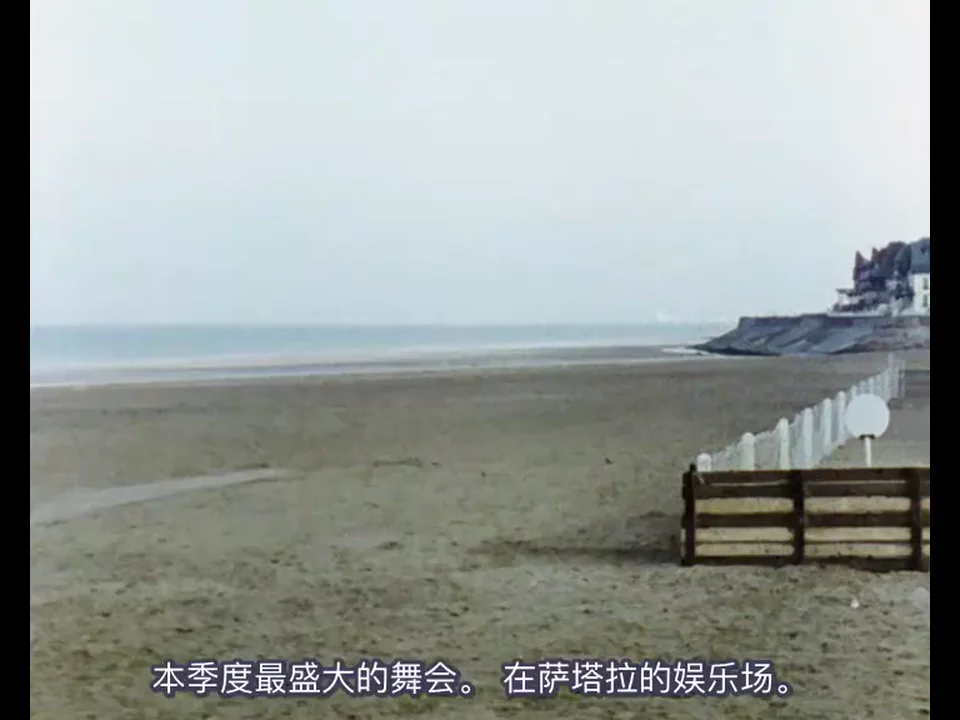 第1分段 00:08:20 / Part 1 00:08:20
The voice points toward a ball and its figures while the image holds on a place with no speaker.
Beach, bench, fence, and distant buildings remain empty; neither the ball nor a speaker appears.
An off-screen voice speaks of a grand ball without receiving a synchronized source in the empty view.
SITE ANALYSISSound and image unfold independently rather than through synchronized explanation; the viewer must read the interval among empty place, absent figures, and off-screen narration.
Cinema 2, chapter 7, pp. 173–180; chapter 9, pp. 245–261.Bilibili at 第1分段 00:08:20 / Part 1 00:08:20 Open original still ↗Part 1's empty-beach and off-screen voice passage was frame-checked.Complete Bilibili carrier; the shot at 第1分段 00:08:20 was checked frame by frame, and the still and timestamp come from the same public upload.
Bilibili · La Femme du Gange, part 1 · verified 2026-08-14Close-reading questions
- 01How do two voices and empty places form atemporal series of their own and refuse psychological explanation of the image?
- 02At which boundaries do sound and image remain incommensurable, and where do they touch at their respective limits?
- 03When sound turns toward another memory without a visual scene change, how does the cut acquire a duration of its own?
Analysis and scene sources
Shots and scenes
Primary texts, scholarship, and locators
Theory coordinate: Cinema 2, Minnesota 1989, ch. 9, pp. 251, 257, 260–61
- 01Cinema 2: The Time-Image
Authoritative source for the standard translation, translators, ISBN, and publication date.
Open the atlas source record →
This film in books and research
The Irrational Cut: How the Interstice Becomes a Lectosign
Audio-visual disjunction establishes an incommensurable common limit
Claim: Sound-image and visual image unfold autonomously and touch through distance rather than restored synchronization.
Conclusion: List the internal organization of sound and image separately, then locate each limit; relation is produced by the distance between limits.
Cinema 2: The Time-Image · pp. 251, 257, 260–261Cinema 2: The Time-Image · pp. 250, 256–258Deleuze's Cinema Books · pp. 162–171
The Irrational Cut: How the Interstice Becomes a Lectosign
Two timeless voices
Film comparison: Sound and image unfold separately and touch only at their limits and a point at infinity.
Viewing gateways and editions
- Verified complete Bilibili multipart carrier: 恒河女 La Femme du Gange (1974/玛格丽特·杜拉斯)bilibili.comOpen film page ↗
- Page access
- Accessible when checked
- Version extent
- Recorded as a complete version
- Source type
- User-uploaded page
Edition note: Complete 9-part film · 1:23:36.
Link checked: 2026-08-13