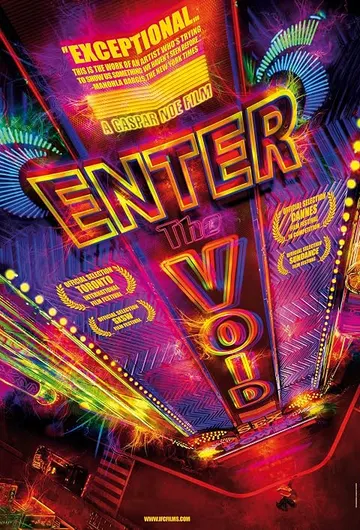
Gaspar Noé / 加斯帕·诺 · 2009
Enter the Void
Enter the Void
City, memory, body, and possible futures interweave; viewing proceeds by reading relations among image strata.
Film details
- Original title
- Enter the Void
- Director
- Gaspar Noé / 加斯帕·诺
- Year
- 2009
- Region
- France
Analysis and scene sources
Shots and scenes
Primary texts, scholarship, and locators
Theory coordinate: Deamer, 2016, pp. 337–344
- 01Deleuze’s Cinema Books: Three Introductions to the Taxonomy of Images
Detailed reconstruction with a film index; the nine-cell grid and eleven film cases carry the evidence status of Deamer’s later interpretation.
Open the atlas source record →
This film in books and research
The Cinematic Body · Further discussion
When does a work become a variable screen event?
pp. 263–264
Claim: Post-cinema does not mean merely shot digitally. Version, device, network, and political economy must jointly change how images reach bodies.
Extension: Shaviro's 2010 work moves the problem into digital technology, globalization, and financialization; Denson's discorrelated image addresses image operations beyond human perceptual scales.
Tension: The 1993 book did not predict streaming, smartphones, or generative images. Keeping the body as the sole center also cannot describe computation that first occurs among machines.
Deleuze, Altered States and Film
Enter the Void
Reading relation: Compare subjective viewpoint, drug state, and drifting temporality.
The Crystal-Image: How Actual and Virtual Exchange
The neuro-image: how the crystalline circuit connects to the brain-screen
Claim: The neuro-image carries the actual–virtual problem into networks, interfaces, and prediction systems, but it does not make every digital image crystalline; a distributed circuit must rewrite a body, memory, or choice in return.
Conclusion: Map nodes, feedback, and the body or memory being rewritten before deciding whether the neuro-image advances the crystal's two-sided exchange into networked actualization.
The Neuro-Image · Introduction and chapters on brain-screen and database narration
Viewing gateways and editions
- Festival de Cannesfestival-cannes.comOpen film page ↗
- Source type
- Institutional source