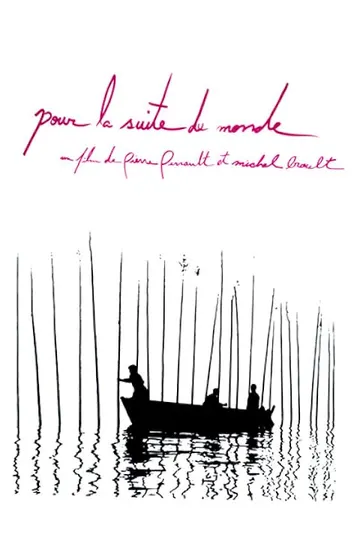
Pierre Perrault & Michel Brault / 皮埃尔·佩罗、米歇尔·布罗 · 1963
Pour la suite du monde
Pour la suite du monde
Reviving the beluga hunt is both action and storytelling. Filming reorganizes communal memory and produces collective utterances that prefigure a people to come.
Film details
- Original title
- Pour la suite du monde
- Director
- Pierre Perrault & Michel Brault / 皮埃尔·佩罗、米歇尔·布罗
- Year
- 1963
- Region
- Canada
Film analysis: how shots organize concepts
The group delegates one member to speak for them inside an institutional setting.
Three men converse in an outdoor area of the aquarium; one occupies the position between the other two.
The exchange explicitly delegates one participant to speak for the group.
SITE ANALYSISDelegation is spoken by group members and changes who can speak in what capacity.
Bilibili at 01:40:00 Open original still ↗Official NFB English-version stream; anchor 01:40:00 verified. The displayed window locates that anchor; narrative boundaries await shot-level review.Official NFB full film; the 01:40:00 anchor is verified and the displayed window locates it.
Bilibili · 牛仔C麦 · user-provided public repost page · verified 2026-08-13Close reading and primary texts
Pour la suite du monde · 1963 · Pierre Perrault & Michel Brault / 皮埃尔·佩罗、米歇尔·布罗
Pour la suite du monde: How a ‘We’ Is Filmed into Existence
Oral memory, the beluga hunt, fabulation, and a people to come
The film places community inside a process of becoming: memory becomes speech; speech enters budgets, tides, posts, the result of the hunt, and delegation; a collective position capable of saying ‘we’ takes form.
Cinema 2 directly treats Perrault under fabulation in chapter 6 and analyzes this film’s storytelling speech-act in chapter 8. The ten scene windows and visible and audible facts were verified scene by scene; the theoretical links are established through this site's shot-by-shot analysis.
Primary passages and argumentative function
DELEUZE PRIMARY TEXTBoth communicate in the invention of a people.
DELEUZE PRIMARY TEXTa speech-act
DELEUZE PRIMARY TEXTLa fabulation, c’est quoi ? C’est l’appel à son peuple.
SITE FILM ARGUMENT
Oral memory first restores the conditions of action
Preparation, the low-tide rule, and public mobilization form one chain: memory acquires a present tense in speech, and speech convenes those who will enact it.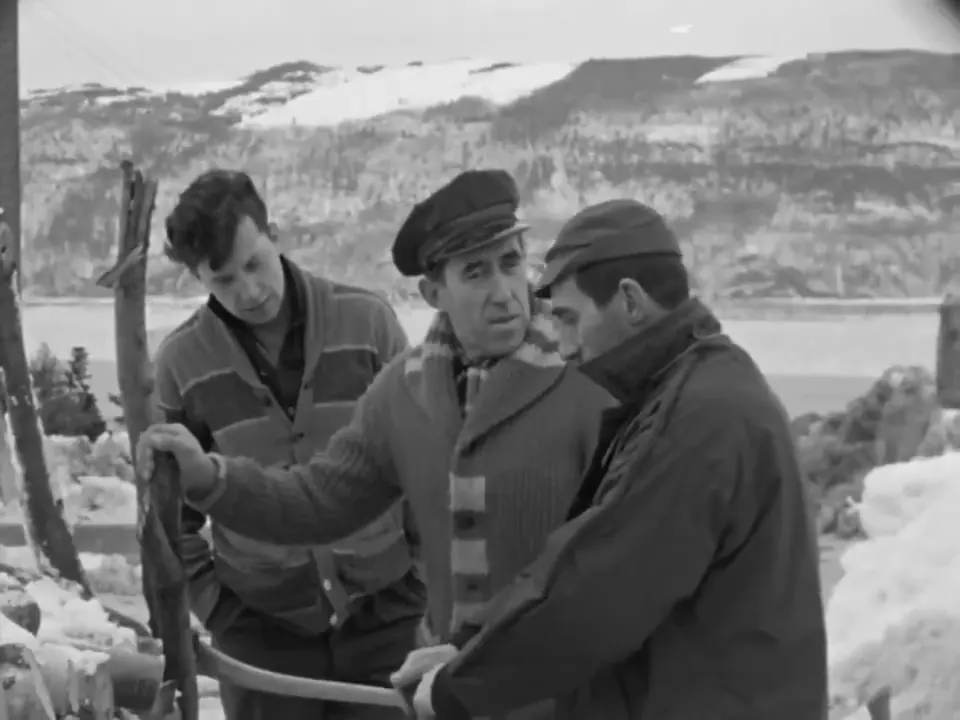
Preparations for the beluga hunt begin with a riverside discussion.
Open video position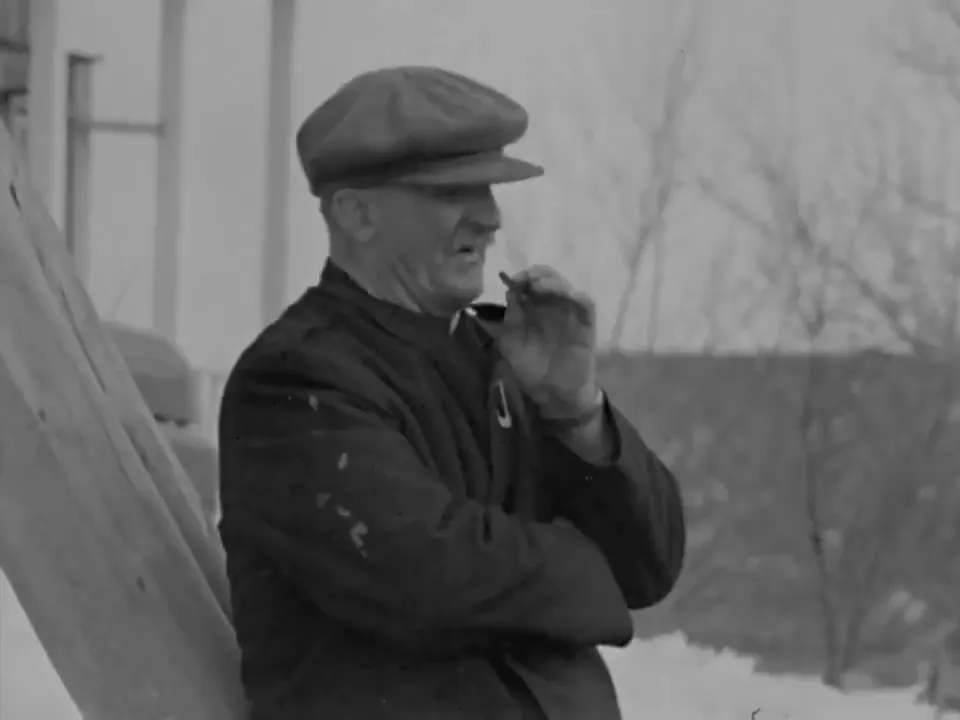
The elders restate the rule that the work must follow low tide.
Open video position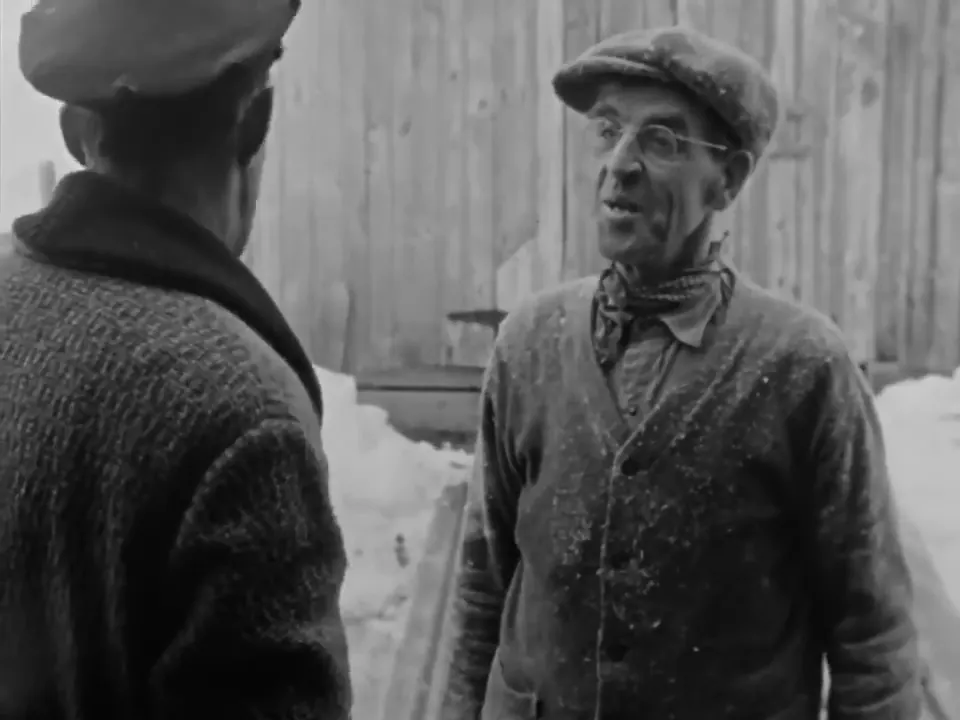
The shared project reaches islanders through face-to-face explanation.
Open video positionThe riverside discussion at 00:10:00 does not display a ready-made technique. The hunt has been suspended for years; posts, tides, and divisions of labour remain dispersed across elders’ bodily memory and speech. At 00:15:00 the rule of working at low tide is spoken again, reconnecting natural rhythm to human action. By 00:20:00 the addressee expands from a few knowledgeable men to the island, and recollection becomes a public proposition that can receive a response.[8][11]
Deleuze calls this relation a word in act. Its force lies not in supplying background information but in changing the positions of speaker and addressee: those who remember become transmitters, those who hear become potential participants, and the filmmakers enter the event as intercessors rather than detached observers. Froger’s account of community adds that cinema does not simply represent an existing bond; the bond is tested and produced through filming, response, and shared obligation.[1][6][4]
SITE FILM ARGUMENT
Fabulation passes through budgets, equipment, and bodily labour
Budget calculations, the transmission of a hunter’s role, and setting posts in the tide show that story becomes a generator of action only by entering material organization.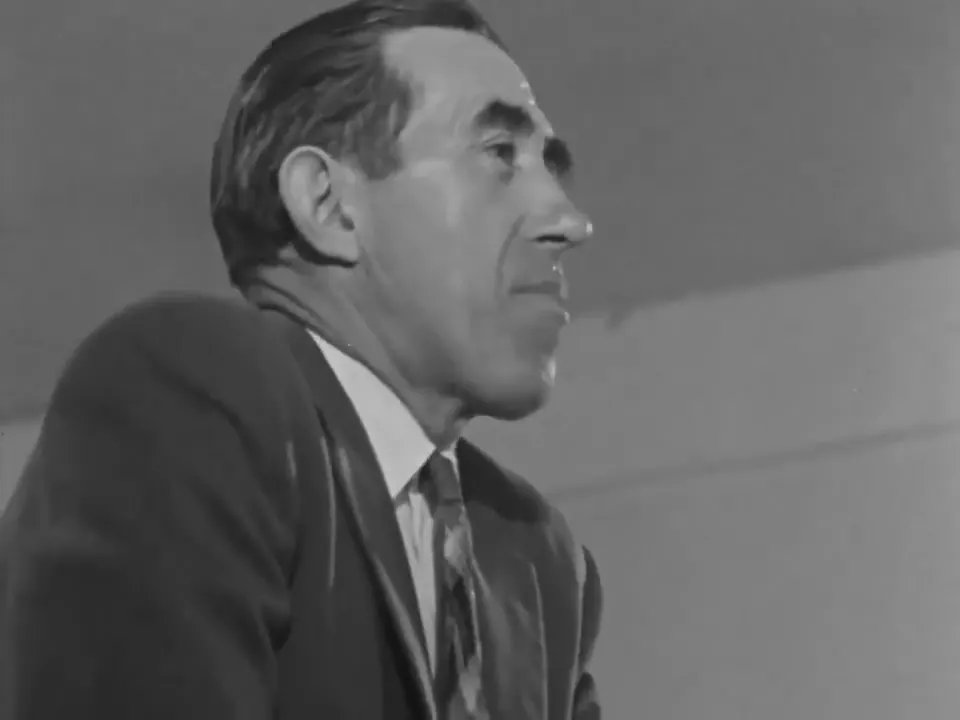
The meeting translates the hunt into financing and equipment.
Open video position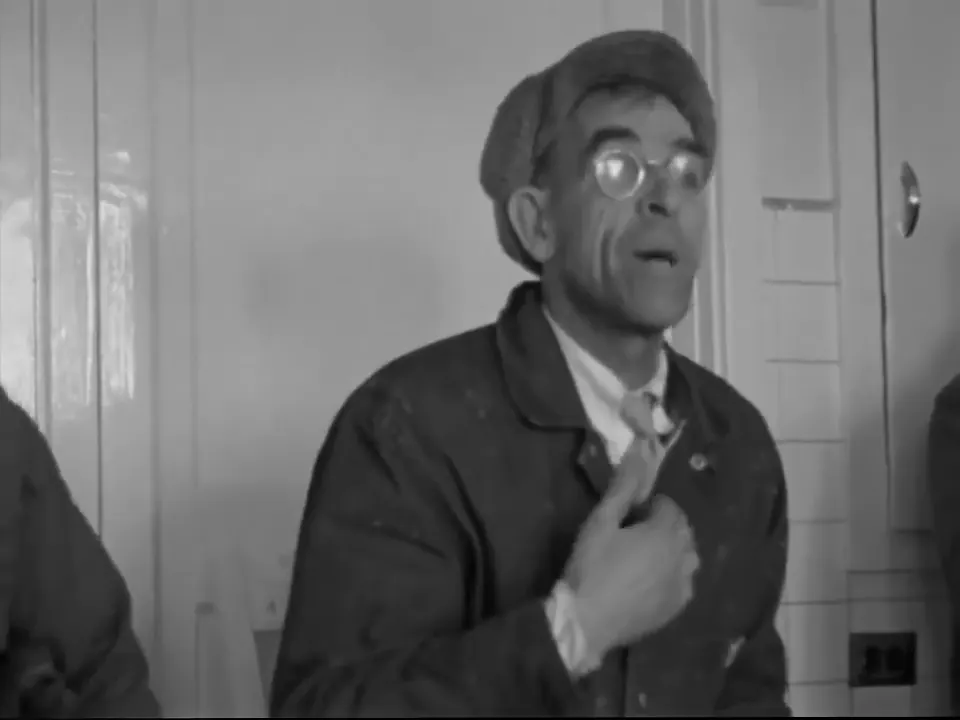
An elder explains how a hunter must outwit the whale.
Open video position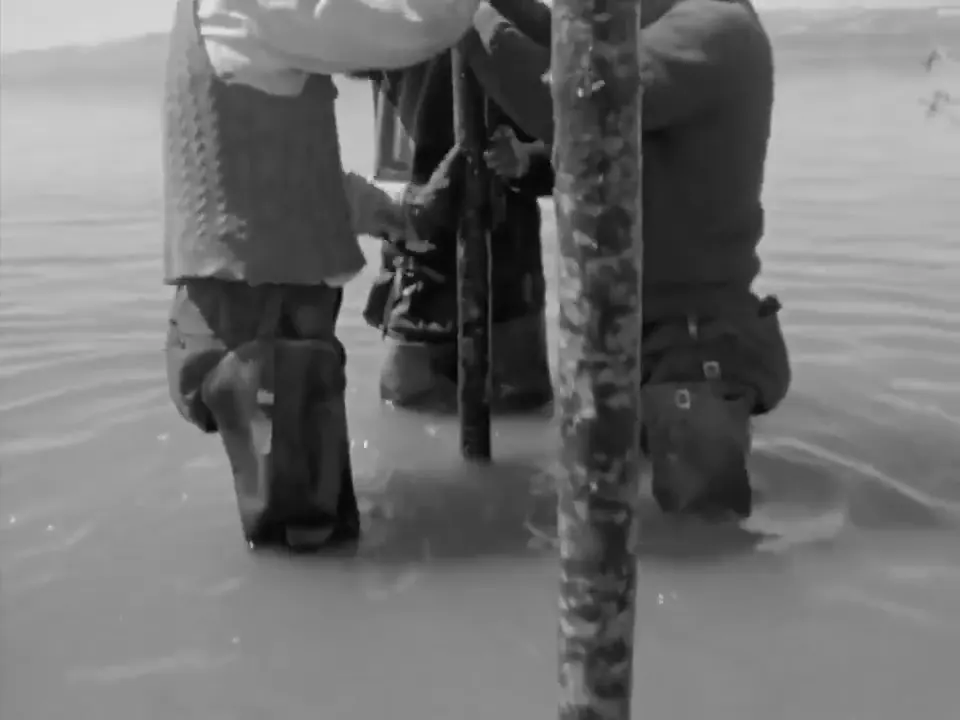
Deliberation, roles, and materials become shared construction in the water.
Open video positionThe meeting at 00:25:00 presses the revival into unit prices, financing, and equipment. At 00:35:00 an elder uses gesture, exaggeration, and practical language to shape the role of the hunter. Between 00:43:35 and 00:44:13 islanders stand knee-deep in the tide adjusting post spacing. Together the scenes show fabulation not as an escape from reality but as the conversion of an unrealized project into relations that can be costed, taught, and coordinated.[1][11]
Cinema 2 calls the film’s storytelling speech-act a generator of action. Action has not vanished; rather, its causal chain must first be rebuilt by collective enunciation. Bogue describes Perrault and the islanders as reciprocal intercessors: Perrault needs their local knowledge and voices, while filming helps them organize memory into a present undertaking. Construction is therefore repetition with difference. An older practice returns but becomes something new within an environment composed of camera, finance, and public institutions.[1][4][8]
SITE FILM ARGUMENT
Attribution of origin remains contested and unresolved
The boat narrative and workshop debate preserve the community’s production of origin stories rather than deliver a historical answer adjudicated by the film.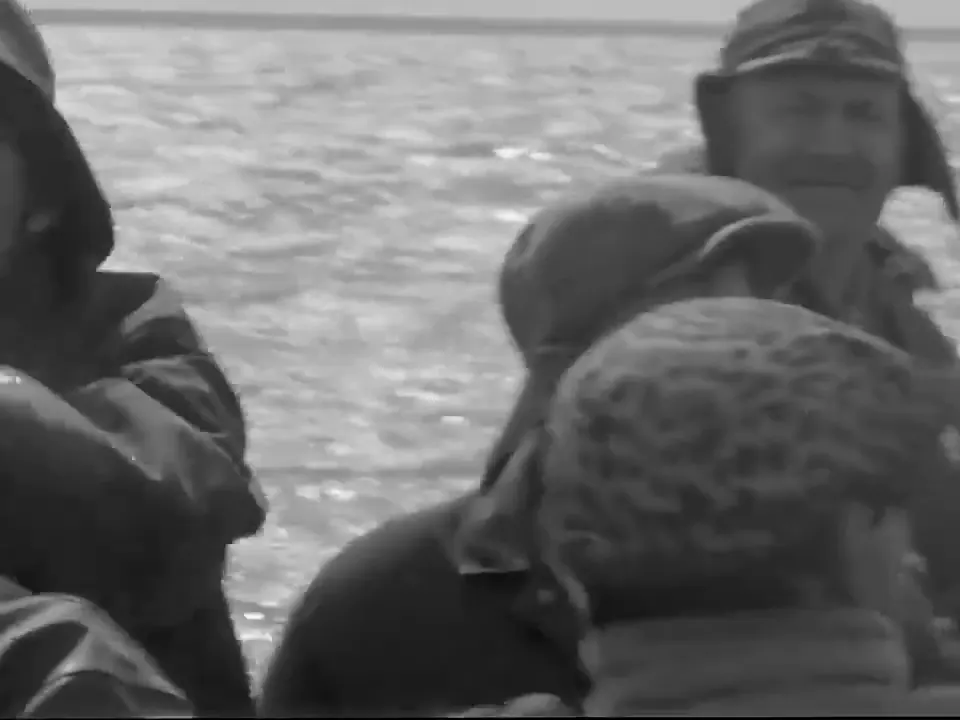
The river journey unfolds alongside a story about the hunt's origin.
Open video position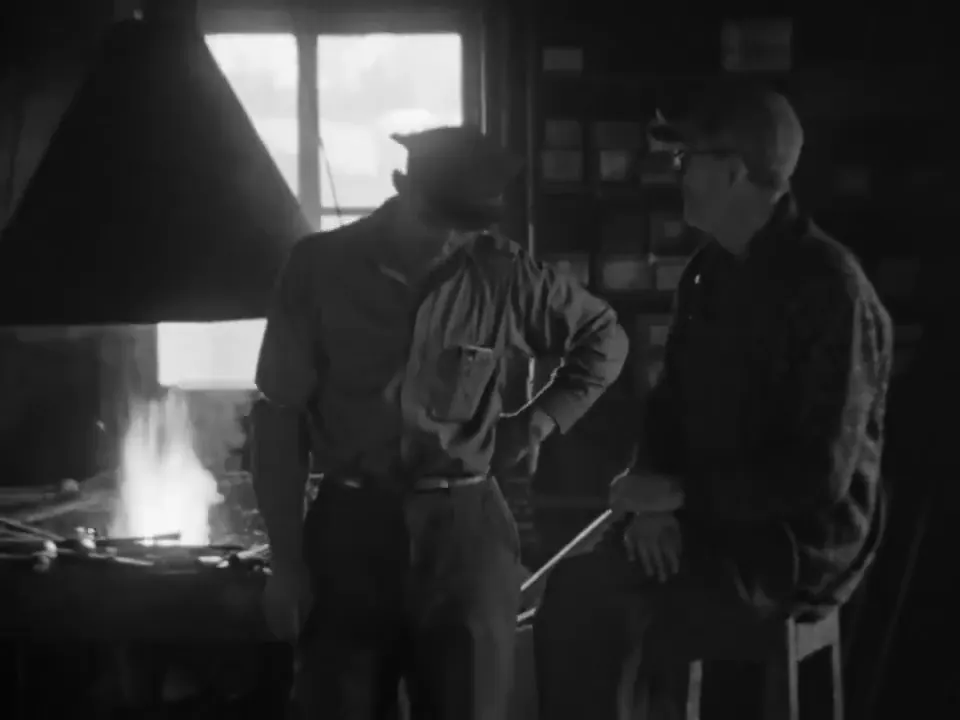
The origin of the post structure remains unsettled in a workshop exchange.
Open video positionAt 00:30:00 participants attribute the post-weir technique to Indigenous inhabitants before the settlers; at 01:10:00 the workshop exchange continues by asking how Indigenous people obtained the idea. Kinik records another account in the film linking the structure to settlers from Brittany and Normandy. Moussette, p. 93, places island oral tradition beside Casgrain’s objection and finds no surviving document that establishes the structure’s origin. The film establishes a conflict of attribution; it does not adjudicate the inventor.[11][7][9][10]
Freire situates Perrault within an anthropology of memory: gesture and speech are staged by the filming situation without making the participants unreal. Beaulieu adds that Perrault’s légender belongs to a specific Québécois politics and poetics that cannot be exhausted by an imported philosophical category. The film works in this tension: local speech produces community while retaining the factual boundary that speech alone cannot establish historical truth.[7][5][9]
SITE FILM ARGUMENT
Shared result and delegation establish a plural speaking position
The captured result gives shared labour a visible consequence, and delegation gives an individual voice plural standing; a people appears as a traceable relation rather than a homogeneous totality.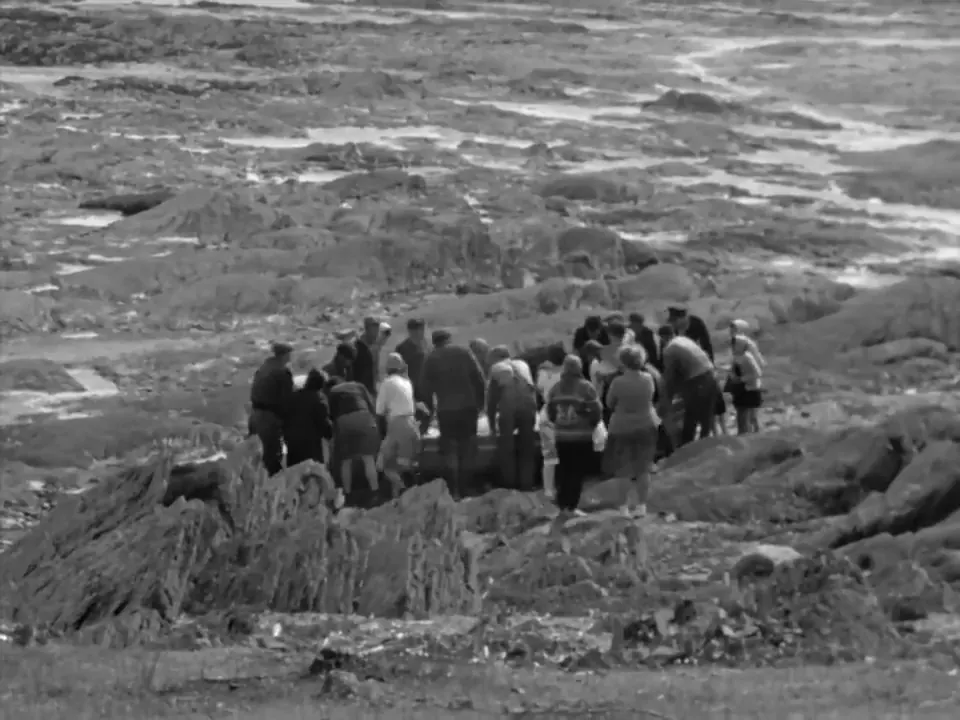
Islanders gather around the result of the hunt as collective labour gains a visible consequence.
Open video position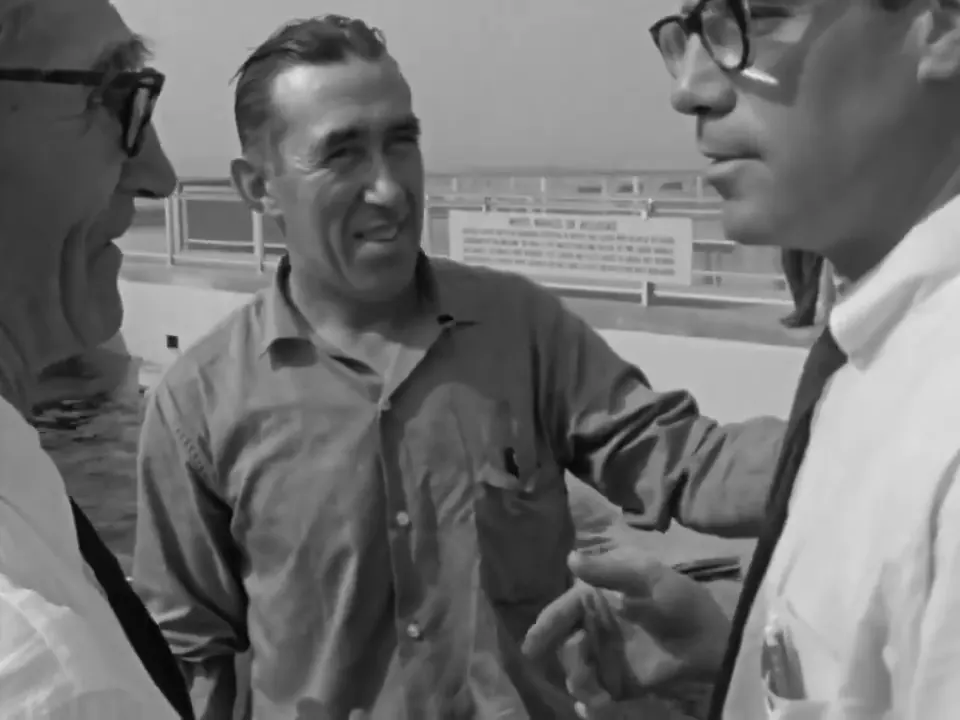
The group delegates one member to speak for them inside an institutional setting.
Open video positionAt 01:30:00 islanders gather around the captured beluga as it is prepared for transport; collective labour has produced a visible result. At 01:40:00, the aquarium request ‘you speak for us’ explicitly places one voice in the position of group representative. The first establishes a shared consequence; the second is the directly identifiable speech-act. Collective enunciation does not require everyone to speak at once; authorization, circulation, and consequence must remain traceable in the image.[1][11]
Deleuze’s invention of a people takes concrete form here. Kinship, local knowledge, collective labour, a national film institution, and the aquarium meet, while no single subject owns the event. Froger’s community-under-trial is equally visible: the collective gains visibility through external relations and continues to face representation, institutional dependence, and internal difference. The people to come is thus an unfinished temporal structure—already appearing in action and speech, never frozen as a final identity.[1][6][5]
How scholarship advances the film
Ronald Bogue
Bogue uses intercessors to explain the reciprocal dependence of Perrault and the islanders, situating the film within fabulation and the invention of social collectivity.
- Use for this film
- Connect filmmaker, participant, speech, and action, explaining why construction belongs to the fabulatory process.
- Critical pressure
- A people must be demonstrated through concrete reciprocal dependence rather than used as an abstract political noun.
Marion Froger
Froger understands cinema as a site where communal bonds are tested and produced, making incompletion a formal problem.
- Use for this film
- Explain why the film sustains deliberation, disagreement, institutions, and delegation rather than centring only the captured beluga.
- Critical pressure
- Failure, difference, and external dependence must enter analysis alongside moments of solidarity.
Alain Beaulieu
Beaulieu reconstructs the Québec encounter between Perrault and Deleuze and returns fabulation to the cultural politics following the Quiet Revolution.
- Use for this film
- Read the revived hunt as the differentiated actualization of tradition and the recovery of a suppressed capacity to imagine and speak.
- Critical pressure
- Perrault’s légender retains its own poetic genealogy; Deleuze’s concept enters a powerful dialogue rather than replacing it.
Marcius Freire
Freire compares Perrault and Rouch through an anthropology of memory, stressing how real participants, gesture, speech, and filming situation compose the event.
- Use for this film
- Support a joint reading of disputed origins and bodily labour.
- Critical pressure
- The staging of the filming situation must enter the factual account; participant speech is not an unmediated natural voice.
Anthony Kinik
Kinik directly analyzes the workshop origin dispute, absent Indigenous presence, and the circulation among Île-aux-Coudres, Montréal, and the New York aquarium.
- Use for this film
- Bound the origin narrative and place final delegation within a larger institutional geography.
- Critical pressure
- The formation of collective speech must be tracked together with positions excluded from it.
Limits of the argument
- 01
A speech-act is established by changes in who participates, how action proceeds, and who can represent the collective.
- 02
Fabulation is tested through material reality: tide, finance, posts, and bodily labour determine whether the project takes form.
- 03
A people to come appears as an unfinished collective position; disagreement, external institutions, and representation belong to its structure.
- 04
Origin claims in the film record acts of narration; their historical truth is established separately through Indigenous knowledge and archival research.
References
- 01Open source
PRIMARY THEORY Gilles Deleuze, Cinema 2: The Time-Image, trans. Hugh Tomlinson and Robert Galeta (University of Minnesota Press, 1989), ch. 6, pp. 150–153; ch. 8, pp. 221–224.
Chapter 6, pp. 150–153; chapter 8, pp. 221–224Publisher record - 02Edition collation record
PRIMARY THEORY Gilles Deleuze, Cinema 2: The Time-Image, trans. Xie Qiang, Cai Ruoming, and Ma Yue (Hunan Fine Arts Publishing House, 2004), ch. 6, pp. 237–240; ch. 8, pp. 350–354.
Chapter 6, print pp. 237–240; chapter 8, print pp. 350–354Simplified Chinese edition: Hunan Fine Arts Publishing House, 2004 - 03Open source
PRIMARY THEORY Gilles Deleuze, “Cinema and Thought 12,” 5 February 1985, The Deleuze Seminars, Purdue University.
Approx. 114:00, fabulation as a call to a peopleOpen audio, French transcript, and English translation - 04Open source
SCHOLARSHIP Ronald Bogue, “The Concept of Fabulation,” in Deleuzian Fabulation and the Scars of History (Edinburgh University Press, 2010), pp. 14–48.
Chapter 1, pp. 14–48, especially pp. 18–19Publisher chapter; preview available · DOI 10.1515/9780748641758-003 - 05Open source
SCHOLARSHIP Alain Beaulieu, “Gilles Deleuze au Québec,” Dialogue: Canadian Philosophical Review / Revue canadienne de philosophie 63.2 (2024): 375–396.
pp. 375–396Peer-reviewed; Cambridge Core full-text gateway · DOI 10.1017/S0012217324000313 - 06Open source
SCHOLARSHIP Marion Froger, Le cinéma à l’épreuve de la communauté (Presses de l’Université de Montréal, 2010).
Open full text on OpenEdition - 07Open source
SCHOLARSHIP Marcius Freire, “Perrault, Rouch: slippages between ‘direct cinema/cinéma-vérité’ and ‘lived cinema’,” Significação 39.38 (2012): 27–39.
pp. 27–39Open peer-reviewed article · DOI 10.11606/issn.2316-7114.sig.2012.71137 - 08Open source
SCHOLARSHIP Séverine Graff, “La construction en France du cinéma direct canadien,” in Le cinéma-vérité: films et controverses (Presses universitaires de Rennes, 2014).
Full text on OpenEdition - 09Open source
SCHOLARSHIP Anthony Kinik, “The Beluga Triangle: Pour la suite du monde (1962), New Quebec Cinema, and the urban/rural dialectic,” Shima 18.2 (2024): 21–32.
pp. 21–32Open peer-reviewed article · DOI 10.21463/shima.234 - 10Open source
SCHOLARSHIP Marcel Moussette, Fishing Methods Used in the St. Lawrence River and Gulf, Parks Canada History and Archaeology 22 (1979), p. 93.
p. 93, oral tradition and documentary limits concerning the origin of the post weirOpen Government of Canada PDF - 11Open source
FILM SOURCE Michel Brault, Marcel Carrière, and Pierre Perrault, Pour la suite du monde (National Film Board of Canada, 1963), official English-subtitled version.
Official NFB full-film stream
Close-reading questions
How does the camera turn a long-interrupted hunt from memory into a shared project and give a collective a position from which to speak?
- 01How does collective narration reactivate a long-interrupted hunt as common action?
- 02Who speaks, who is convened, and who becomes the people to come?
Shots, relations, and concepts
- 1Record
Three island men confer above the river; one handles a wooden post or tool. The hunt concerns the beluga, locally called marsouin blanc. French location dialogue discusses preparations still to be made; the official player supplies English subtitles.
Open the scene currently used to ground this chain: Preparing to revive the beluga hunt - 2Judge the relation
The hunt has long been discontinued, while elders retain its techniques in memory and speech; collective deliberation reorganizes them into an executable plan. The past enters the present as practical knowledge awaiting revival, and the group retakes that time through narration.
- 3Name the concept last
Speech act and a people to come. Only concepts whose scene relation resolves to “supports” under the current record are named here; candidates, adjacent terms, and countertests are not merged into the conclusion.
- 4Countertest
Subsequent images show deliberation becoming roles, equipment, and shared labour.
Shots and scenes
Subsequent images show deliberation becoming roles, equipment, and shared labour.
Open viewing position ↗Later judgements of tide, placement of posts, and collective labour take up this knowledge.
Open viewing position ↗The sequel shows recruits, delegated roles, financing, and collective construction.
Open viewing position ↗The calculation belongs to the film’s larger collective reconstruction and leads toward purchase and construction.
Open viewing position ↗The attribution records the islanders’ narrative position; Indigenous history requires separate independent evidence.
Open viewing position ↗Later collective construction and hunting give the utterance practical force.
Open viewing position ↗The labour itself is action; its temporal relation comes from the full genesis from oral account to construction.
Open viewing position ↗The scene establishes the speakers’ conjecture and memory; historical fact requires Indigenous sources and archival verification.
Open viewing position ↗This segment first establishes a shared result; the later explicit delegation establishes plural speaking authority.
Open viewing position ↗Delegation is spoken by group members and changes who can speak in what capacity.
Open viewing position ↗Primary texts, scholarship, and locators
Theory coordinate: Cinema 2, Minnesota 1989, ch. 6, p. 150; ch. 8, pp. 221, 223
- 01Cinema 2: The Time-Image
Authoritative source for the standard translation, translators, ISBN, and publication date.
Open the atlas source record →
- 01Gilles Deleuze, Cinema 2: The Time-Image, trans. Hugh Tomlinson and Robert Galeta (University of Minnesota Press, 1989), ch. 6, pp. 150–153; ch. 8, pp. 221–224.
Chapter 6, pp. 150–153; chapter 8, pp. 221–224
Open source ↗ - 02Gilles Deleuze, Cinema 2: The Time-Image, trans. Xie Qiang, Cai Ruoming, and Ma Yue (Hunan Fine Arts Publishing House, 2004), ch. 6, pp. 237–240; ch. 8, pp. 350–354.
Chapter 6, print pp. 237–240; chapter 8, print pp. 350–354
- 03Gilles Deleuze, “Cinema and Thought 12,” 5 February 1985, The Deleuze Seminars, Purdue University.
Approx. 114:00, fabulation as a call to a people
Open source ↗ - 04Ronald Bogue, “The Concept of Fabulation,” in Deleuzian Fabulation and the Scars of History (Edinburgh University Press, 2010), pp. 14–48.
Chapter 1, pp. 14–48, especially pp. 18–19
Open source ↗ - 05Alain Beaulieu, “Gilles Deleuze au Québec,” Dialogue: Canadian Philosophical Review / Revue canadienne de philosophie 63.2 (2024): 375–396.
pp. 375–396
Open source ↗ - 06Marion Froger, Le cinéma à l’épreuve de la communauté (Presses de l’Université de Montréal, 2010).Open source ↗
- 07Marcius Freire, “Perrault, Rouch: slippages between ‘direct cinema/cinéma-vérité’ and ‘lived cinema’,” Significação 39.38 (2012): 27–39.
pp. 27–39
Open source ↗ - 08Séverine Graff, “La construction en France du cinéma direct canadien,” in Le cinéma-vérité: films et controverses (Presses universitaires de Rennes, 2014).Open source ↗
- 09Anthony Kinik, “The Beluga Triangle: Pour la suite du monde (1962), New Quebec Cinema, and the urban/rural dialectic,” Shima 18.2 (2024): 21–32.
pp. 21–32
Open source ↗ - 10Marcel Moussette, Fishing Methods Used in the St. Lawrence River and Gulf, Parks Canada History and Archaeology 22 (1979), p. 93.
p. 93, oral tradition and documentary limits concerning the origin of the post weir
Open source ↗ - 11Michel Brault, Marcel Carrière, and Pierre Perrault, Pour la suite du monde (National Film Board of Canada, 1963), official English-subtitled version.Open source ↗
This film in books and research
Gilles Deleuze : cinéma et philosophie · Atlas analysis
Pour la suite du monde
Marrati pp. 102–118 · site test
Film relation: This site makes 'belief in the world' observable as collective production: a long-interrupted beluga hunt passes from oral memory into funding, equipment, tide, stakes, ritual, and delegated speech, forming a position capable of saying 'we.'
Shot question: Which utterance changes participants, resources, roles, or authority to speak, and which labour proves that speech has not remained a myth of community?
Conclusion: Belief is not an optimistic judgment but the fabrication of a new speech-action relation within a world that offers no guarantee.
Gilles Deleuze : cinéma et philosophie · Atlas analysis
How does an utterance pass through matter and become common action?
Marrati pp. 111–118
Claim: Belief in the world is not verbal hope. Speech remakes a broken world-relation only when it changes participants, resources, roles, labour, or authority to speak.
Film relation: Riverside discussion organizes memory as a plan, explanation to islanders recruits participants, driving posts subjects the plan to tide and labour, and final delegation specifies who may speak for the collective.
Conclusion: The position capable of saying 'we' is not a completed entity predating filming; it acquires actuality through a chain of speech, resources, labour, and delegation.
Cinema 2: The Time-Image, French primary edition · Cinema 2, chapter 6Cinema 2: The Time-Image, French primary edition · Cinema 2, chapter 8
Documentary Time: Film and Phenomenology
Pour la suite du monde
Reading relation: Test documentary time through ritual reenactment, oral memory, and communal action.
Fabulation: How the Speech Act Prefigures a People to Come
Fabulation is a double becoming
Claim: Real characters become other through storytelling, while their intervention changes the filmmaker's position.
Conclusion: A character's telling, performance, or reenactment must change both the character's position and the filmmaker's structure.
Cinema 2: The Time-Image · pp. 151, 223Deleuze on Cinema · pp. 135–164Cinema 2: The Time-Image · ch. 6, p. 150; ch. 8, pp. 221, 223Fabulation, Narration and the People to Come · pp. 202–226
Fabulation: How the Speech Act Prefigures a People to Come
The speech act is evidenced by real consequences
Claim: An utterance acquires efficacy when it changes participants, resources, tasks, labour, or authority within the film.
Conclusion: For each utterance record speaker, addressee, path of circulation, and visible consequence. Changes in role, resource, labour, or authority establish the speech act.
Cinema 2: The Time-Image · ch. 6, p. 150; ch. 8, pp. 221, 223Fabulation, Narration and the People to Come · pp. 202–226
Fabulation: How the Speech Act Prefigures a People to Come
Memory enters plan and labour
Film comparison: Storytelling, financing, setting posts, and delegation form a traceable speech-act chain.
Cinema 2: The Time-Image · ch. 6, p. 150; ch. 8, pp. 221, 223
Viewing gateways and editions
- Verified complete Bilibili carrier: 【纪录片】为了世界的继续 Pour la suite du monde(1963)bilibili.comOpen film page ↗
- Page access
- Accessible when checked
- Version extent
- Recorded as a complete version
- Source type
- User-uploaded page
Edition note: The image timeline matches the NFB English-language edition, accompanied by ten still-led scene analyses.
Link checked: 2026-08-13
- National Film Board of Canadanfb.caOpen film page ↗
- Source type
- Institutional source