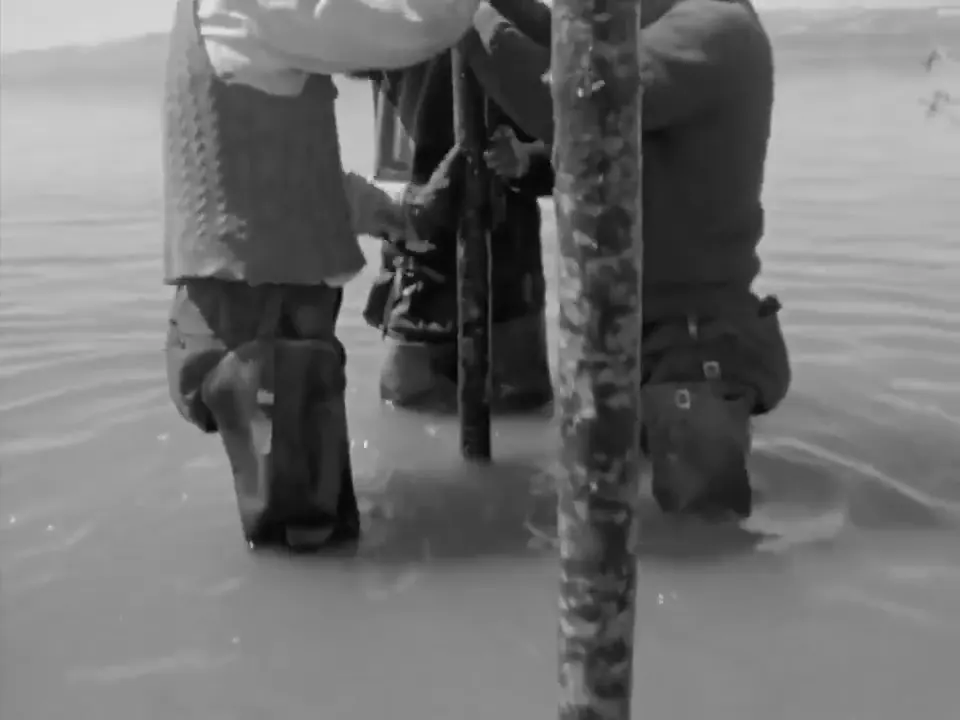
 00:43:56
People and fabulation · SHOT EVIDENCE
Setting posts in the tide
Where does speech become shared labour, and what historical difference does the labour retain?
Film and viewing version
Pour la suite du monde · Pour la suite du monde · Pierre Perrault & Michel Brault / 皮埃尔·佩罗、米歇尔·布罗 · 1963
Official NFB English-version stream; anchor 00:44:02 verified. The displayed window locates that anchor; narrative boundaries await shot-level review.
Version boundary: The timecodes on this page apply only to the named viewing carrier. Restorations, differing leaders, or platform transcodes may shift them.
Passage and still timecodes
approx. 00:43:35—00:44:13
The window locates the passage; its boundaries remain approximate
The passage window and still anchor are separate coordinates: the Bilibili still at 00:43:56 was checked on 2026-08-13; it does not turn an approximate passage on another carrier into exact bounds.
Visible facts
- 01
Several islanders stand knee-deep in the tide among rows of set posts, steadying and adjusting an upright post; the sequence turns to the water, post rows, and close views of hands.
Audible facts
- 01
The dialogue discusses spacing posts about one pace (roughly three feet) apart, how water entering the boat impedes the work, and earlier labour in the water wearing leather boots.
Action relation
Effective action is present here; it has been generated by prior remembrance, deliberation, and delegation.
Temporal relation
Past practice receives a differentiated re-enactment through new bodies and materials.
Conceptual reading
The labour itself is action; its temporal relation comes from the full genesis from oral account to construction.
Concepts used in the judgement
- Fabulationfabulation · ADJACENT
Setting posts is first of all effective labour and remains adjacent to fabulation as the action-end of earlier narration and reenactment. Detached from the chain running from oral account and deliberation to construction, the scene cannot establish fabulation on its own.
→ - Speech act and a people to comeacte de parole / peuple à venir · SCENE SUPPORT
Earlier speech acts acquire consequences in collective labour.
→
Primary and scholarly coordinates
- 01Cinema 2: The Time-Image
Minnesota 1989 translation: ch. 6, pp. 150–153; ch. 8, pp. 221–224
Perrault: the white whale and fabulation in chapter 6; storytelling speech-act, fishing action, memory, and a people to come in chapter 8.
Terminological coordinates
Chapter relations
Viewing and still sources
Film gateway · Official NFB full film; the 00:44:02 visual anchor and scene dialogue are verified.