 00:30:00
People and fabulation · SHOT EVIDENCE
On the river, the hunt becomes an origin story
How can documentary preserve communal memory and the historical gaps within that memory?
Film and viewing version
Pour la suite du monde · Pour la suite du monde · Pierre Perrault & Michel Brault / 皮埃尔·佩罗、米歇尔·布罗 · 1963
Official NFB English-version stream; anchor 00:30:00 verified. The displayed window locates that anchor; narrative boundaries await shot-level review.
Version boundary: The timecodes on this page apply only to the named viewing carrier. Restorations, differing leaders, or platform transcodes may shift them.
Passage and still timecodes
approx. 00:29:30—00:30:30
The window locates the passage; its boundaries remain approximate
The passage window and still anchor are separate coordinates: the Bilibili still at 00:30:00 was checked on 2026-08-13; it does not turn an approximate passage on another carrier into exact bounds.
Visible facts
- 01
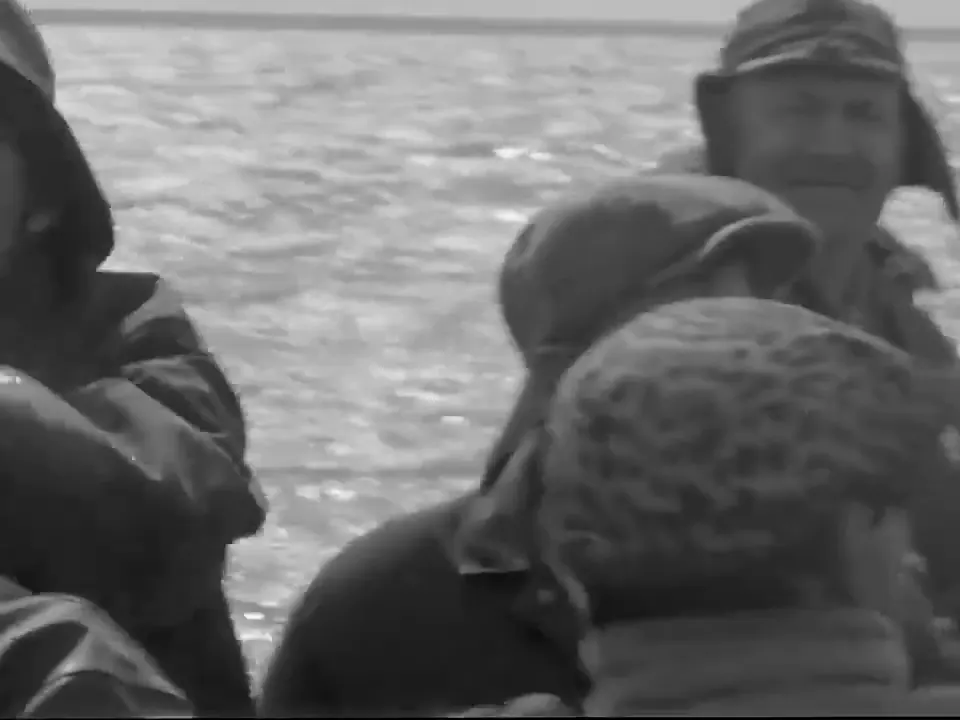
Men cluster on a working boat while the river continues moving behind them.
Audible facts
- 01
Conversation invokes earlier times and attributes the practice’s invention to Indigenous inhabitants before the settlers.
Action relation
The voyage supplies actual action, while origin is organized through situated storytelling.
Temporal relation
A communal past enters the present through several speakers’ memories and conjectures without closing into one archival conclusion.
Conceptual reading
The attribution records the islanders’ narrative position; Indigenous history requires separate independent evidence.
Concepts used in the judgement
- Fabulationfabulation · CANDIDATE
The origin story remains conjectural and plural, making it a fabulation candidate. If the film merely preserves it as unchanged testimony without co-transforming speaker, practice, and filmmaker, the candidate relation fails.
→ - Speech act and a people to comeacte de parole / peuple à venir · SCENE SUPPORT
Boat dialogue circulates origin through collective enunciation.
→
Primary and scholarly coordinates
- 01Cinema 2: The Time-Image
Minnesota 1989 translation: ch. 6, pp. 150–153; ch. 8, pp. 221–224
Perrault: the white whale and fabulation in chapter 6; storytelling speech-act, fishing action, memory, and a people to come in chapter 8.
Terminological coordinates
Chapter relations
Viewing and still sources
Film gateway · Official NFB full film; the atlas paraphrases rather than reproducing extended subtitles.