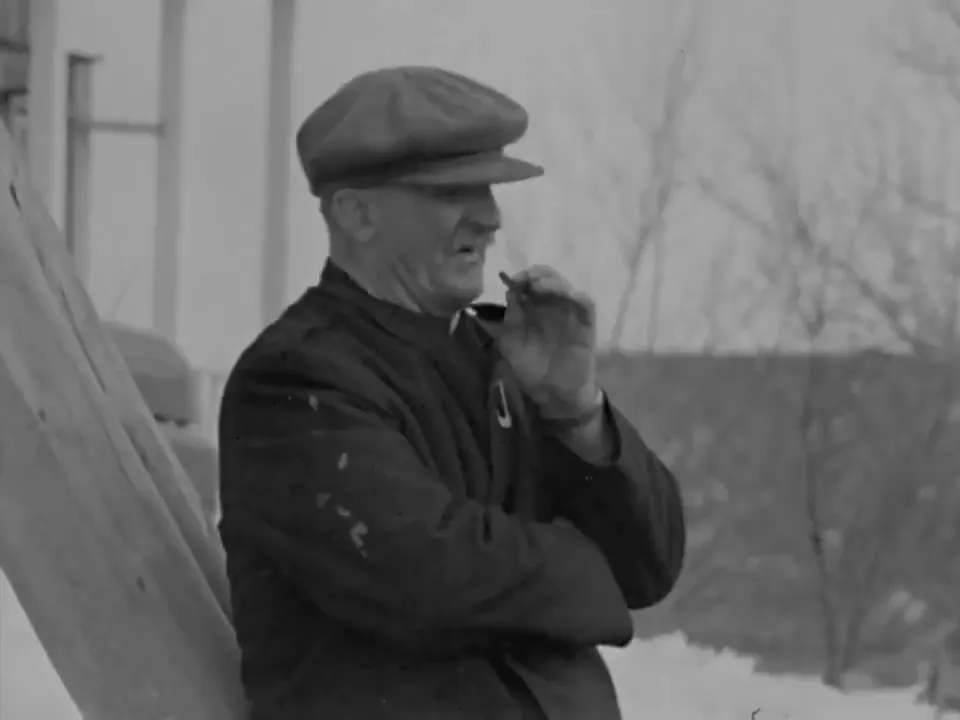
 00:15:00
People and fabulation · SHOT EVIDENCE
Low-tide knowledge is spoken back into use
How does oral knowledge move from memory into a usable condition of action?
Film and viewing version
Pour la suite du monde · Pour la suite du monde · Pierre Perrault & Michel Brault / 皮埃尔·佩罗、米歇尔·布罗 · 1963
Official NFB English-version stream; anchor 00:15:00 verified. The displayed window locates that anchor; narrative boundaries await shot-level review.
Version boundary: The timecodes on this page apply only to the named viewing carrier. Restorations, differing leaders, or platform transcodes may shift them.
Passage and still timecodes
approx. 00:14:30—00:15:30
The window locates the passage; its boundaries remain approximate
The passage window and still anchor are separate coordinates: the Bilibili still at 00:15:00 was checked on 2026-08-13; it does not turn an approximate passage on another carrier into exact bounds.
Visible facts
- 01
Older islanders converse face-to-face beside a building in winter.
Audible facts
- 01
The dialogue specifies that the work must take place at low tide.
Action relation
A remembered rule is first actualized in speech before it can guide labour.
Temporal relation
A technical past returns as present speech and awaits new bodies to enact it.
Conceptual reading
Later judgements of tide, placement of posts, and collective labour take up this knowledge.
Concepts used in the judgement
- Fabulationfabulation · CANDIDATE
Oral tidal knowledge enters the fabulation chain only when later judgement, post-setting, and collective labour take it up. If it merely supplies information about an old technique, the fabulation label should be withdrawn.
→ - Speech act and a people to comeacte de parole / peuple à venir · SCENE SUPPORT
Speech preserves and transmits a rule for action.
→
Primary and scholarly coordinates
- 01Cinema 2: The Time-Image
Minnesota 1989 translation: ch. 6, pp. 150–153; ch. 8, pp. 221–224
Perrault: the white whale and fabulation in chapter 6; storytelling speech-act, fishing action, memory, and a people to come in chapter 8.
Terminological coordinates
Chapter relations
Viewing and still sources
Film gateway · Official NFB full film; this window was checked against the official player.