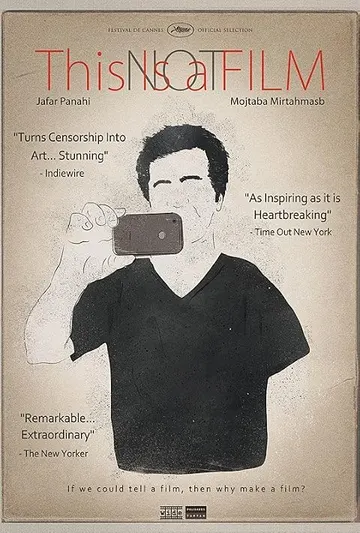
Jafar Panahi & Mojtaba Mirtahmasb / 贾法·帕纳西、莫塔巴·米尔塔马斯布 · 2011
This Is Not a Film
In film nist
A filmmaking ban confines the director to his apartment, yet phone, domestic camera, taped floor, and an unmade screenplay reassemble a cinematic machine. As Panahi speaks shots, blocking, and space, the absent film acquires form through voice and gesture.
Film details
- Original title
- In film nist
- Director
- Jafar Panahi & Mojtaba Mirtahmasb / 贾法·帕纳西、莫塔巴·米尔塔马斯布
- Year
- 2011
- Region
- Iran
Film analysis: how shots organize concepts
Law blocks filmmaking action, yet speech, tape, and domestic devices give the absent film visible form.
- 01The ban becomes space
The director is confined to his apartment; doors, windows, phone, and news sound press the political outside into the interior.
Law is not merely explained; it is filmed as a boundary on body and space. - 02Speech actualizes the unmade film
Tape outlines a set on the carpet as Panahi demonstrates screenplay, blocking, and shots through voice and gesture.
The speech-act gives the virtual film a temporary actual structure. - 03Devices open the political outside
Phone and camera first film one another; Panahi then switches to the video camera and follows an art student who is covering a shift and collecting rubbish floor by floor down the lift toward the street fires.
Private confinement connects to collective repression, and a new position of enunciation forms through filming.
Close-reading questions
- 01Panahi marks the room of an unmade screenplay on the carpet with tape, then stops to ask why make a film if it can be told; how does spatial demonstration encounter the irreplaceable boundary of images here?
- 02As fixed camera, phone, iguana, calls, and fireworks repeatedly interrupt the account, how does a home under restriction change from a closed backdrop into a site continually producing contingent images?
- 03As Panahi switches from phone to video camera and follows an art student covering the rubbish-collection shift into the lift and toward the fires outside, how does an everyday accompaniment cross the declaration of a non-film and produce a sequence that could not be scripted?
Analysis and scene sources
Shots and scenes
Primary texts, scholarship, and locators
Theory coordinate: Atlas analysis; theoretical basis: Cinema 2, Minnesota 1989, ch. 6, pp. 151–155; ch. 7, pp. 156–157; ch. 8, pp. 221–224; ch. 9, pp. 225–230, 231–239
- 01Cinema 2: The Time-Image
Authoritative source for the standard translation, translators, ISBN, and publication date.
Open the atlas source record →
Viewing gateways and editions
No direct viewing link is listed; film search gateways are available above.