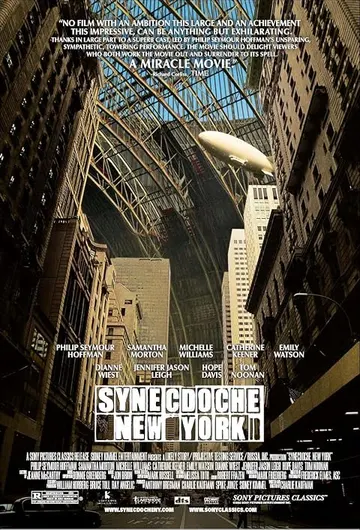
Charlie Kaufman / 查理·考夫曼 · 2008
Synecdoche, New York
Synecdoche, New York
Caden copies New York inside a warehouse and assigns actors to copy friends, strangers, and himself. Each double demands more rooms, rehearsals, and doubles of doubles. The stage no longer abbreviates life; it expands like a crystalline seed into an environment that reabsorbs marriage, ageing, and death. Sammy first makes a profession of watching Caden and later assumes his role, showing that a copy is not a static image: it changes how the original can next live until neither person nor set retains an outside to which it can return.
Film details
- Original title
- Synecdoche, New York
- Director
- Charlie Kaufman / 查理·考夫曼
- Year
- 2008
- Region
- United States
Film analysis: how shots organize concepts
When life is moved into a theatre and actors play other actors, which layer can still be called the original reality?
The film does not hide true life behind copies. Date shifts, Sammy's long surveillance, and Millicent's earpiece commands make so-called original life repeatedly actualized by doubles, rehearsal, and recollection. Reality persists but loses a single centre.
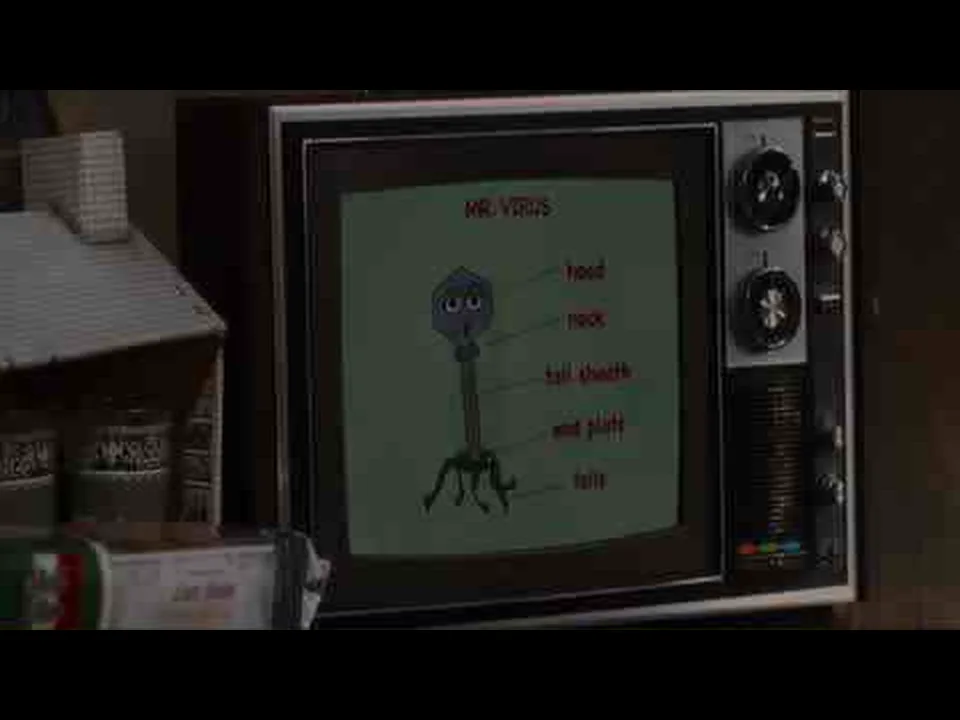
Broadcast dates, newspapers, seasonal programmes, food, and bodily symptoms traverse months inside one apparently continuous breakfast, while the characters treat change as ordinary noise.
Time is not a theme later added to life. Editing first deprives the present of a stable peak and forces viewers to read incompatible temporal markers.
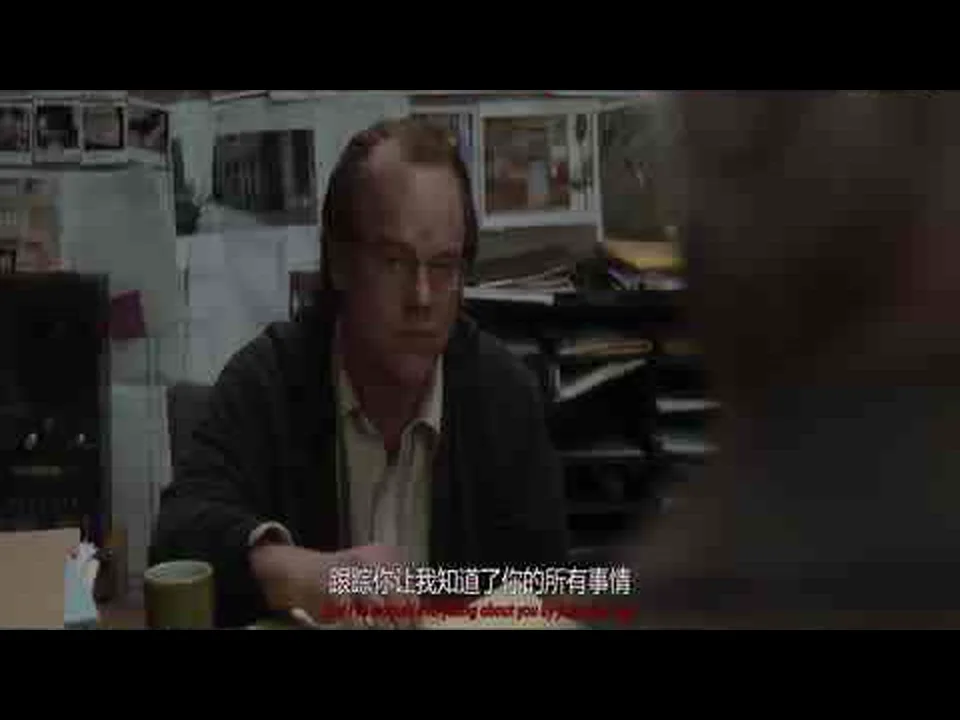
Sammy says he has followed Caden for twenty years and knows his unspoken conduct. ‘Hire me and you will see the real you’ turns observation itself into a qualification for the role.
Once the virtual ‘other Caden’ is actualized by an actor, he does not merely copy the original but acts, desires, and dies in his place. The direction of causality between actual and virtual reverses.
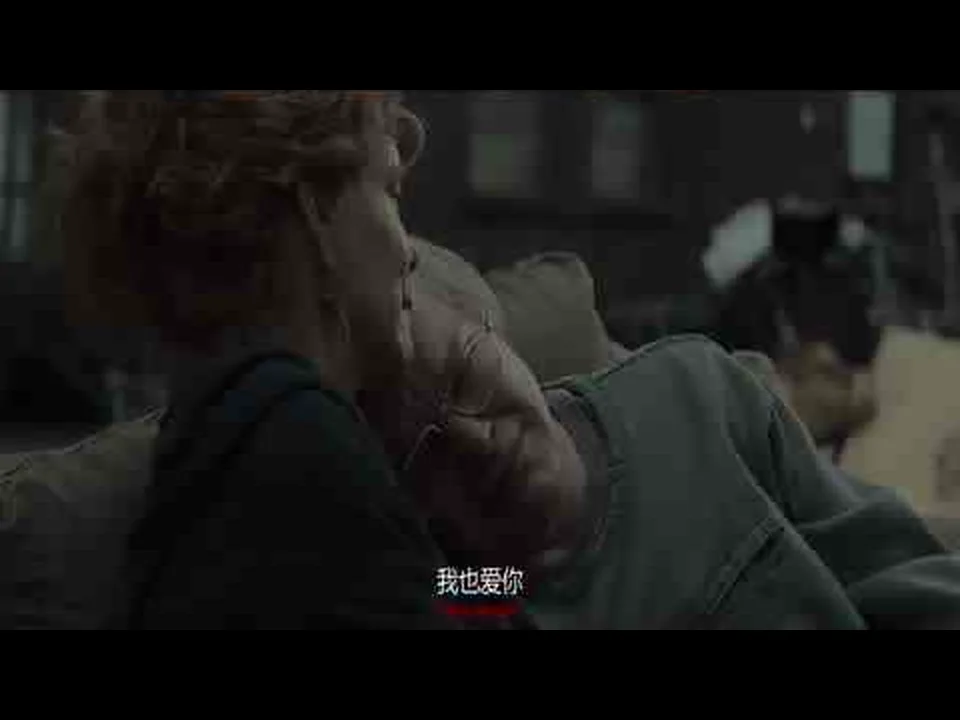
Millicent has assumed Caden's role. The aged Caden moves through the empty city under her voice in an earpiece, embraces ‘Mother,’ and finally awaits the word ‘die.’
The director who once issued instructions becomes a body staged by a voice. The crystal has no recoverable original: life, role, and command exchange around one body until death.
EDITION NOTE The user-supplied Bilibili page divides the feature across fourteen parts and appends Tom and Jerry padding to each. The atlas captures only checked feature windows and always records both part number and within-part time.
The warehouse stage is not a reduced model of reality. It copies its observer, enlarges itself, and rehearses reality's next version until life and performance become one productive machine without an outside.
- 01Stage-seed expands into milieu
Caden begins by copying a room and gradually builds streets, apartments, workplaces, and another warehouse inside the warehouse.
The local model ceases to depend on the external city and keeps crystallizing a new milieu capable of enclosing its inhabitants. - 02The double rehearses the original
Sammy observes Caden for years, plays him, and enters his relationships; actors later replace actors, and life decisions enter rehearsal.
The copy does not merely reflect existing reality; it changes the original's next possible act, making actual and virtual versions condition one another. - 03Instruction takes the final body
After figures and spectators disperse, Caden follows an earpiece through blocking, cleaning, and farewell in the empty city, finally receiving the instruction to die.
Invisible speech becomes editing and action program; brain, stage, and city close into a screen that continues to operate.
Close-reading questions
- 01From the first urban set inside the warehouse to copied apartments, districts, and the warehouse itself, record each change of scale. When does the stage stop representing New York and become an environment that keeps producing rooms, population, and time?
- 02Sammy first watches Caden and then plays him. Compare notes, blocking, dialogue, and Caden's subsequent choices. At what point does the double stop copying the original and begin rehearsing the original's next life?
- 03In the emptied city at the end, an earpiece voice keeps issuing actions until it says 'die.' How do visible body, vacant set, and unseen voice compose a brain-screen machine that no longer separates life, performance, and memory?
Analysis and scene sources
Shots and scenes
Primary texts, scholarship, and locators
Theory coordinate: Deamer, 2016, pp. 314–316
- 01Deleuze’s Cinema Books: Three Introductions to the Taxonomy of Images
Detailed reconstruction with a film index; the nine-cell grid and eleven film cases carry the evidence status of Deamer’s later interpretation.
Open the atlas source record →
This film in books and research
The Crystal-Image: How Actual and Virtual Exchange
The neuro-image: how the crystalline circuit connects to the brain-screen
Claim: The neuro-image carries the actual–virtual problem into networks, interfaces, and prediction systems, but it does not make every digital image crystalline; a distributed circuit must rewrite a body, memory, or choice in return.
Conclusion: Map nodes, feedback, and the body or memory being rewritten before deciding whether the neuro-image advances the crystal's two-sided exchange into networked actualization.
The Neuro-Image · Introduction and chapters on brain-screen and database narration
Viewing gateways and editions
- Bilibili multipart carrier lead: Synecdoche, New Yorkbilibili.comOpen film page ↗
- Page access
- Accessible when checked
- Source type
- User-uploaded page
Edition note: Synecdoche, New York has 14 parts; P1, P2 and P14 show the film. P14 begins with the ending and credits, then switches to unrelated animation. The 3:13:58 combined runtime includes overlapping or extra material. Continuity between all parts remains unresolved; start at P1 and include the part number with each timecode.
Link checked: 2026-08-25
- Sony Picturessonypictures.comOpen film page ↗
- Source type
- Official source