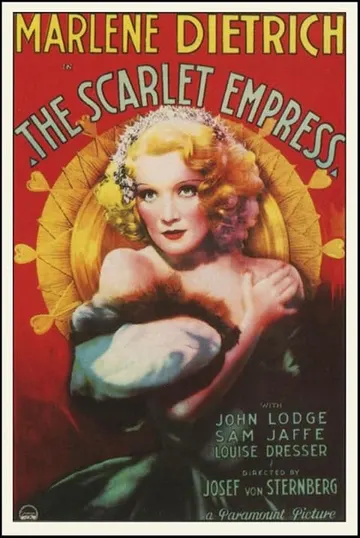
Josef von Sternberg / 约瑟夫·冯·斯坦伯格 · 1934
The Scarlet Empress
The Scarlet Empress
White wall, door, veil, pillow, and sheets detach young Sophia's face from courtly coordinates. White is not innocence but an affective space that reflects, refracts, and imprisons light. Later, a close-up divided by shadow makes choice visible: she renounces intimacy for the cold conquest of power. Alternating light and dark no longer explains psychology; it directly composes a mode of existence.
Film details
- Original title
- The Scarlet Empress
- Director
- Josef von Sternberg / 约瑟夫·冯·斯坦伯格
- Year
- 1934
- Region
- United States
Film analysis: how shots organize concepts
Sternberg changes white from background into an affective space that reflects, refracts, and imprisons light, so a face divided by shadow directly performs an existential choice from intimacy to power.
- 01White circumscribes the face
Young Sophia closes a door; white wall and white door enclose her luminous face within a narrow zone.
The face is detached from courtly narrative coordinates and becomes a qualitative surface reflecting light. - 02Veil refracts shallow depth
During childbirth, veil, pillow, and sheets surround her in white-on-white until the face seems geometrically incrusted in gauze.
Space compresses into refractive layers of light rather than a room traversable by action. - 03Shadow makes choice visible
A close-up is divided by shadow; Catherine then occupies the court through new costume, posture, and mounted procession.
Light and dark do not explain psychology; they directly compose renunciation of intimacy and choice of conquest as a mode of existence.
Close-reading questions
- 01As young Sophia closes the white door and her face is enclosed by a white wall, how do outline and background detach the character from narrative space into an affective surface reflecting light?
- 02In the childbirth sequence, how do layered veil, pillow, and sheets turn the planar close-up into refraction within shallow depth rather than realistic representation of a court chamber?
- 03Before and after the close-up divided by shadow, how do Catherine's posture, costume, and command of space change? How does the image make the choice of power visible before dialogue?
Analysis and scene sources
Shots and scenes
Primary texts, scholarship, and locators
Theory coordinate: Cinema 1, Minnesota 1986, ch. 6, pp. 93–95; ch. 7, pp. 113–114
- 01Cinema 1: The Movement-Image
Standard Minnesota English translation and a principal citation edition in Anglophone scholarship.
Open the atlas source record →
Viewing gateways and editions
No direct viewing link is listed; film search gateways are available above.