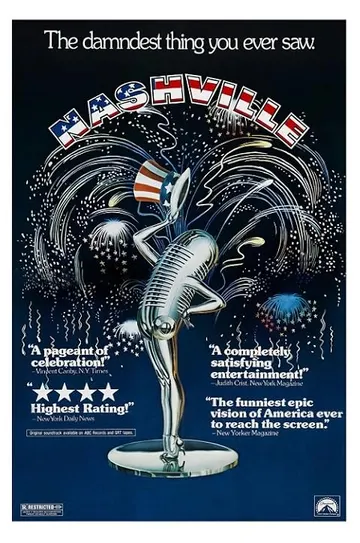
Robert Altman / 罗伯特·奥特曼 · 1975
Nashville
Nashville
The wide frame holds campaigning, performance, traffic, and private life at once, while multiple soundtracks let one city pass through dispersed lives. Assassination restores no centre; the stage absorbs disorder with another familiar song. Once collective action breaks down, the city is doubled by the sounds and media clichés it produces.
Film details
- Original title
- Nashville
- Director
- Robert Altman / 罗伯特·奥特曼
- Year
- 1975
- Region
- United States
Film analysis: how shots organize concepts
Multiple soundtracks do not gather the characters into a whole; performance, broadcast, and cliché double the city that produces them.
- 01Performance is stratified
The studio shows singer, isolation glass, musicians, and console together, with sound separately monitored and adjusted.
One event divides into bodily labour, commodity, and signal; collective expression first becomes technical distribution. - 02City becomes sound field
In the freeway jam, campaign broadcast, car conversations, music, and ambient noise continually override one another.
The characters share no goal of action, only an auditory milieu that keeps them dispersed. - 03A familiar song absorbs crisis
A gunshot interrupts the Parthenon performance; the crowd pauses, then another singer starts a familiar refrain.
Crisis produces no collective action; a sonic cliché merely restores circulation, making the crisis of the action-image audible.
Close-reading questions
- 01As singer, isolation glass, and mixing console share the opening studio frame, how does multitrack sound divide one performance into bodily labour, commodity, and adjustable signal?
- 02During the freeway pile-up, campaign broadcast, car conversations, and ambient noise overlap; how does the city change from community into a sound field that merely places dispersed lives beside one another?
- 03After the Parthenon gunshot, “It Don’t Worry Me” takes over the stage: assassination → a brief collective halt → familiar song restores the flow. Why is this sound a cliché that absorbs crisis rather than a collective solution?
Analysis and scene sources
Shots and scenes
Primary texts, scholarship, and locators
Theory coordinate: Cinema 1, Minnesota 1986, ch. 12, pp. 207, 209–210
- 01Cinema 1: The Movement-Image
Standard Minnesota English translation and a principal citation edition in Anglophone scholarship.
Open the atlas source record →
Viewing gateways and editions
No direct viewing link is listed; film search gateways are available above.