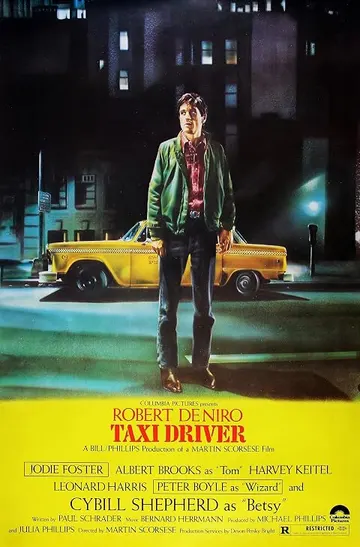
Martin Scorsese / 马丁·斯科塞斯 · 1976
Taxi Driver
Taxi Driver
Windshield, rear-view mirror, neon, and aimless cruising fragment New York into loose clichés. Travis sees everything yet cannot form an adequate response. He forces an action-chain through violence, which the media repackages as heroism, exposing crisis and cliché-production together.
Film details
- Original title
- Taxi Driver
- Director
- Martin Scorsese / 马丁·斯科塞斯
- Year
- 1976
- Region
- United States
Film analysis: how shots organize concepts
Wandering breaks the city into clichés; violence forces an action-chain, and media repackages rupture as heroic causality.
- 01City becomes disconnected fragments
Windshield, rear-view mirror, rain, and neon fragment nocturnal New York into repeated visual units.
Cruising increases perception without producing a route adequate to the city. - 02Stimuli find no adequate act
Travis’s diary, gaze, and bodily training accumulate while his target keeps shifting.
The sensory-motor schema persists through mismatch and cliché. - 03Violence and media fabricate closure
The shootout forces fragments into action, and newspapers and letters name it a heroic event.
The crisis of action appears together with social clichés that fabricate causal closure.
Close-reading questions
- 01How do rain, neon, steam, and reflections on the windscreen turn New York into layers of visual cliché while keeping Travis inside a cab unable to enter the street's relations?
- 02What contradictions among diary voice-over, rear-view-mirror gazes, and repeated cruising prevent Travis's judgments from forming a reliable perception–action connection?
- 03After the bloody rescue, why does the overhead camera's retreat through apartment and stairwell fail to complete a heroic action and instead present its result as a closed dead end?
Analysis and scene sources
Shots and scenes
Primary texts, scholarship, and locators
Theory coordinate: Cinema 1, Minnesota 1986, ch. 12, pp. 207–209
- 01Cinema 1: The Movement-Image
Standard Minnesota English translation and a principal citation edition in Anglophone scholarship.
Open the atlas source record →
Viewing gateways and editions
No direct viewing link is listed; film search gateways are available above.