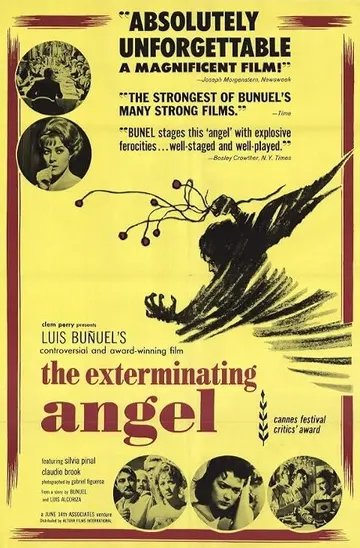
Luis Buñuel / 路易斯·布努埃尔 · 1962
The Exterminating Angel
El ángel exterminador
The drawing room has no visible barrier, yet the guests cannot cross its threshold; civility regresses into occupation, hunger, and attack. The arrival and interior attitudes recur with imperfect differences, and bad repetition closes the space. Only by restaging the decisive arrangement does the boundary loosen, before forming again in the church.
Film details
- Original title
- El ángel exterminador
- Director
- Luis Buñuel / 路易斯·布努埃尔
- Year
- 1962
- Region
- Mexico
Film analysis: how shots organize concepts
An invisible threshold is sustained by bad repetition rather than physical obstacle; reenactment loosens it but cannot prevent its return in another institution.
- 01Repetition disorders the entrance
The guests' arrival and servants' departure are approximately repeated with slight differences.
Social continuity is unreliable before confinement begins; bad repetition starts producing an originary world. - 02Impulse closes the threshold
No wall or guard blocks the drawing-room door, yet guests cannot cross and begin contesting food, place, and bodies.
Civilized roles regress into impulses, giving a local space an inexplicable absolute boundary. - 03Reenactment opens and recloses
The group restores the first night's arrangement and exits, only for a congregation to become trapped in a church.
More exact repetition loosens one boundary but reveals that bad repetition can migrate between institutions.
Close-reading questions
- 01The guests' arrival is repeated with near-identical actions: slight displacement → unstable etiquette → bad repetition begins. Why has the entrance failed before it physically closes?
- 02The drawing-room threshold has neither wall nor guard, yet everyone stops there: impulse to act → inability to cross → originary world. What force produces this spatial boundary?
- 03When the guests reconstruct the first night's positions, they leave: altered precision of repetition → loosened limit → church closes again. How can there be a ‘good repetition’ without final liberation?
Analysis and scene sources
Shots and scenes
Primary texts, scholarship, and locators
Theory coordinate: Cinema 1, Minnesota 1986, ch. 8, pp. 125–127, 132
- 01Cinema 1: The Movement-Image
Standard Minnesota English translation and a principal citation edition in Anglophone scholarship.
Open the atlas source record →
This film in books and research
《缠绕的诗学:德勒兹思维方法研究》 · Atlas extension
The Exterminating Angel
Film relation: Site extension: an invisible prohibition and repeated failures to leave shift the problem from visible obstacle to relational configuration.
Shot question: What must change for the guests to leave; is the answer in the door or in the arrangement of repetition?
Viewing gateways and editions
No direct viewing link is listed; film search gateways are available above.