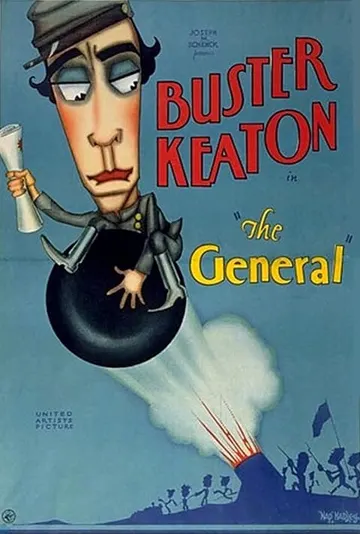
Buster Keaton & Clyde Bruckman / 巴斯特·基顿、克莱德·布鲁克曼 · 1926
The General
The General
War, railway, flood, and broken bridge first compose an immense situation that dwarfs the little man. Continuous trajectories and the ‘miniaturization’ of machines then let a small body transform the whole through the locomotive. The General places burlesque directly inside the large form S–A–S′.
Film details
- Original title
- The General
- Director
- Buster Keaton & Clyde Bruckman / 巴斯特·基顿、克莱德·布鲁克曼
- Year
- 1926
- Region
- United States
Film analysis: how shots organize concepts
An immense situation first surrounds the little man; continuous trajectories and miniaturized machines then let burlesque action transform the whole, forming S–A–S′.
- 01Immense situation surrounds the figure
War front, extended railway, flood, broken bridge, and two locomotives first compose a whole beyond individual scale.
The burlesque figure begins inside a total situation S that must be transformed. - 02Trajectory writes action into the whole
Pursuit, reversal, switching tracks, and bridge movement join local acts into a trajectory crossing the war space.
Action does more than solve local obstacles; it continuously rewrites the figure’s relation to the whole situation. - 03The great machine is miniaturized
Locomotive, cannon, and railway apparatus are turned by Keaton’s small body into manipulable comic partners.
The total situation S passes through action A into S′, bringing burlesque into the large form.
Close-reading questions
- 01How do railway, locomotive, switches, and supplies turn geography into a route of action that the body must solve continuously?
- 02As Johnny drives while moving sleepers, chopping wood, and operating a cannon, how do body and machine form an action-unit that can fail and correct itself?
- 03When the burning bridge collapses beneath the pursuing train, how does previously established spatial information let one gag also complete a decisive transformation of the military situation?
Analysis and scene sources
Shots and scenes
Primary texts, scholarship, and locators
Theory coordinate: Cinema 1, Minnesota 1986, ch. 10, pp. 173–174, 176
- 01Cinema 1: The Movement-Image
Standard Minnesota English translation and a principal citation edition in Anglophone scholarship.
Open the atlas source record →
Viewing gateways and editions
- Verified complete Bilibili carrier: 将军号 (1926)bilibili.comOpen film page ↗
- Page access
- Accessible when checked
- Version extent
- Recorded as a complete version
- Source type
- User-uploaded page
Edition note: Complete single-part film · 1:18:53.
Link checked: 2026-08-14