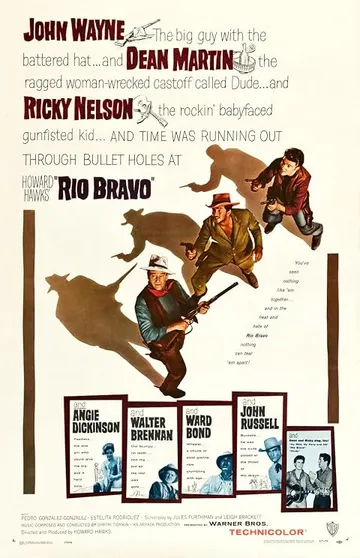
Howard Hawks / 霍华德·霍克斯 · 1959
Rio Bravo
Rio Bravo
The jail scarcely needs the prisoner's body to acquire meaning; it operates as a functional node to be held or breached. Sheriff, recovering alcoholic, disabled old man, and young gunfighter represent no organic community. They form a provisional group through capacities to guard, hear, carry, and shoot, while the final combination of dynamite and rifle compresses Western space into exchangeable functions.
Film details
- Original title
- Rio Bravo
- Director
- Howard Hawks / 霍华德·霍克斯
- Year
- 1959
- Region
- United States
Film analysis: how shots organize concepts
Why does action in this classic western depend not on one complete hero but on people with different lacks catching one another?
Hawks begins with local actions—spittoon, watch duty, song, dynamite—so the situation becomes legible only after action. Deleuze's small form of the action-image is not a ‘small scene’ but A–S–A′: a response discloses the situation and rewrites it for the next response.
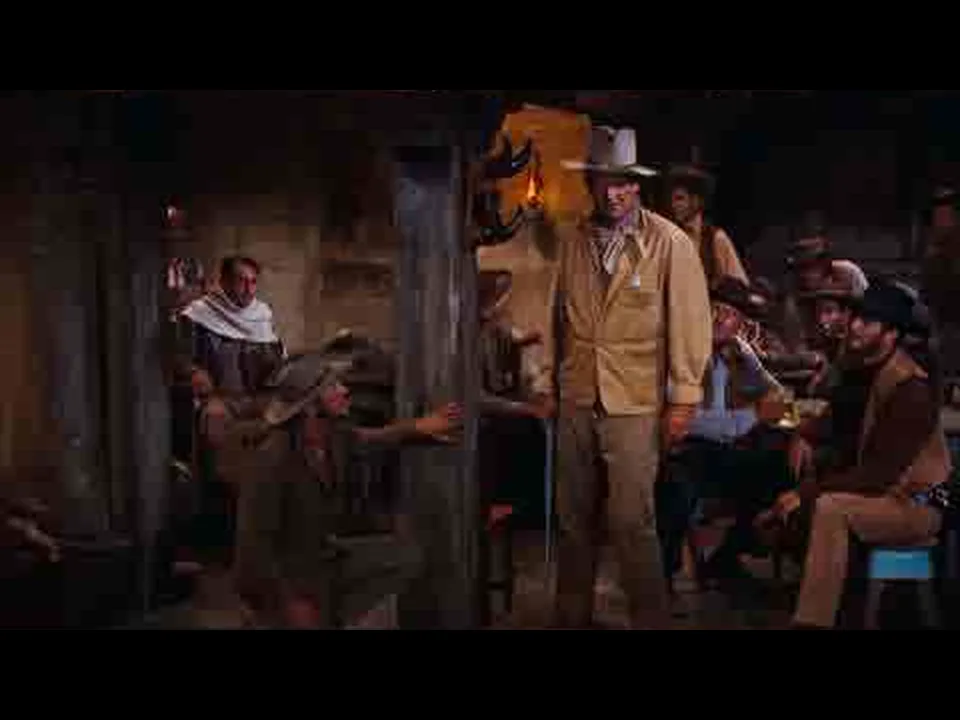
Dude reaches for a coin dropped into a spittoon and Chance kicks it away. Without exposition, dignity, alcoholism, friendship, and charity become visible through action.
Action does not execute a known task. It first gives the situation a readable form: A occurs, and S emerges from its result.
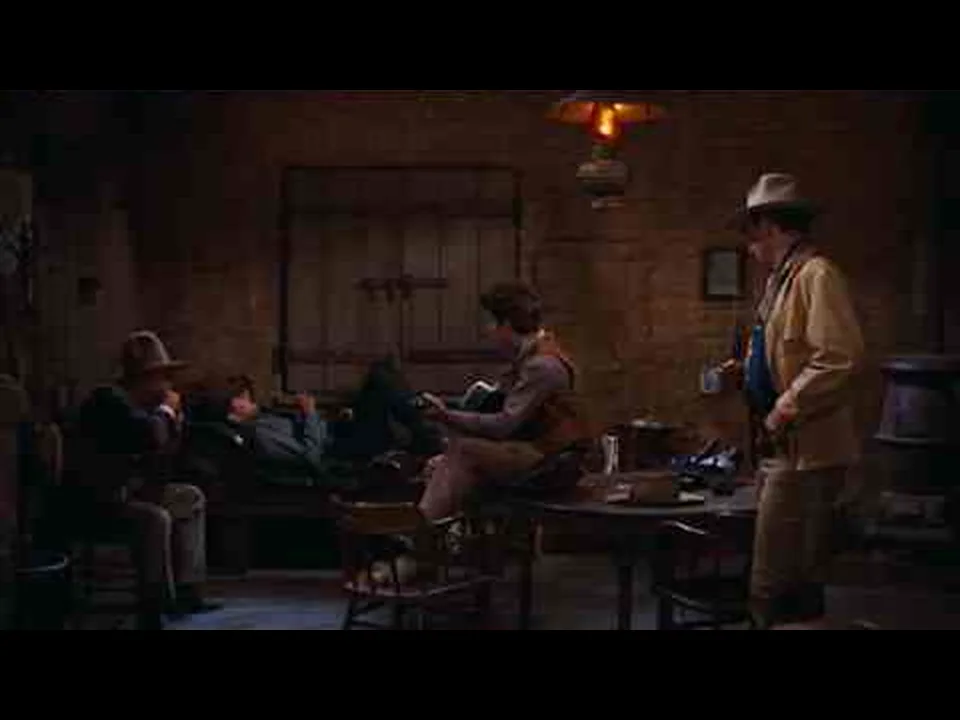
The siege remains, yet Dude, Colorado, and Stumpy compose waiting into song. Gunfighter, alcoholic, old man, and youth provisionally exchange foreground positions.
Music is not decoration that suspends action. It recalibrates attention, breath, and trust so the next act can be borne by a provisional collective rather than a lone hero.
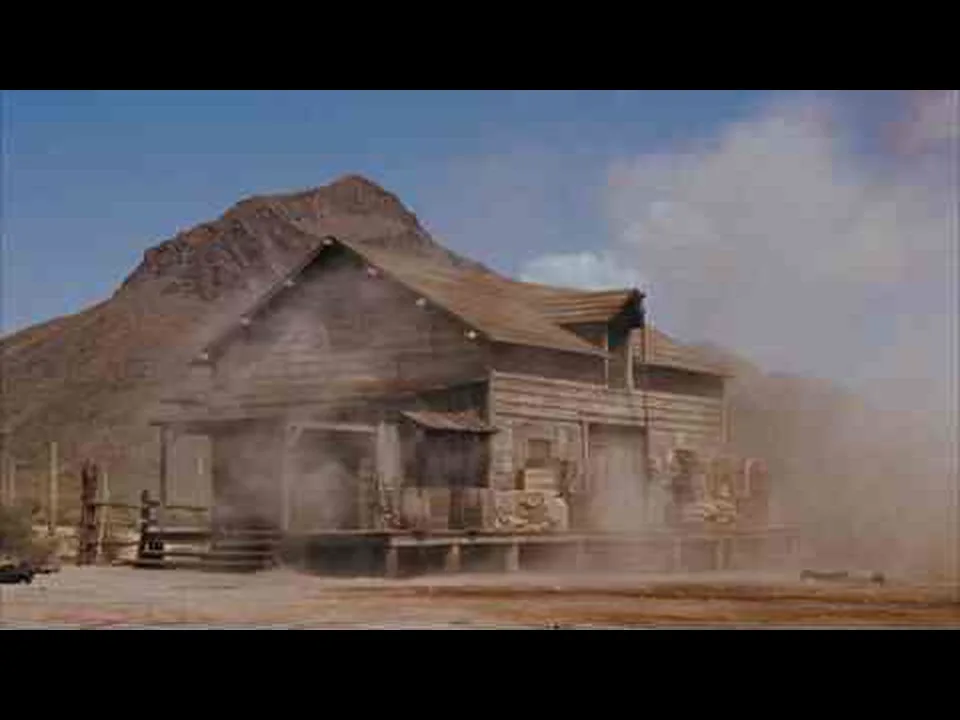
One person throws dynamite and another detonates it by gunfire; cover, observation, and movement relay across positions. Explosions alter the actionable structure of warehouse and street.
Victory does not prove that one person becomes whole. It shows local acts forming a new A′ through functional substitution; the group is the result of relayed action.
EDITION NOTE The three stills and jumps use the user-supplied complete 02:21:06 single-part Bilibili edition; time begins at the film's opening credits.
Rio Bravo weakens the all-encompassing Western milieu, turning jail, sound, doors, windows, and heterogeneous figures into exchangeable functions carried by a provisional group rather than an organic community.
- 01The jail becomes a functional node
Shots repeatedly organize doors, windows, corridor, and guard positions while scarcely needing to show the prisoner.
Place loses organic life and retains functions of holding, entering, watching, and exchange. - 02Heterogeneous capacities connect
Dude recognizes music and sounds, Stumpy guards inside, Colorado observes and shoots, and Chance distributes positions.
Age, disability, and history are not erased but recoded as differences usable by the group. - 03Explosion completes remote coordination
In the finale Stumpy throws dynamite from afar and Chance and Dude detonate it with bullets, connecting several positions within one act.
Heroic action becomes a distributed apparatus; Hawksian functionalism replaces the organic respiration of the Western whole.
Close-reading questions
- 01In the wordless opening, Dude reaches for the coin in the spittoon and Chance kicks it away. How do coin, foot, hand, and fist establish diminished capacity through addiction, humiliation, and a form of help not yet named friendship?
- 02When 'Deguello' arrives from outside town, how does sound press an unseen siege into the interior, and how do Chance, Dude, Stumpy, and Colorado redistribute positions according to capacity?
- 03In the final gunfight, how does the sequence of Stumpy throwing dynamite and Chance and Dude firing at it let a heterogeneous small group replace the organic community of the classical Western?
Analysis and scene sources
Shots and scenes
Primary texts, scholarship, and locators
Theory coordinate: Cinema 1, Minnesota 1986, ch. 10, pp. 165–166
- 01Cinema 1: The Movement-Image
Standard Minnesota English translation and a principal citation edition in Anglophone scholarship.
Open the atlas source record →
Viewing gateways and editions
- Verified complete Bilibili carrier: 《赤胆屠龙》约翰·韦恩bilibili.comOpen film page ↗
- Page access
- Accessible when checked
- Version extent
- Recorded as a complete version
- Source type
- User-uploaded page
Edition note: Complete single-part edition · 2:21:06. Opening credits name John Wayne, Ward Bond, and Howard Hawks; THE END / WB closes the film, followed by roughly six seconds of black.
Link checked: 2026-08-25