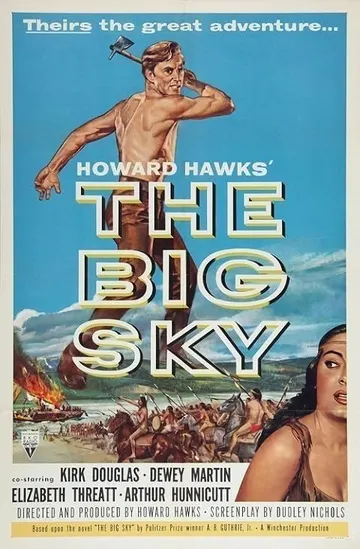
Howard Hawks / 霍华德·霍克斯 · 1952
The Big Sky
The Big Sky
Sky first encompasses land, river, and expedition; the Missouri then stretches the static Western milieu into a long fluid route. Companions of different backgrounds do not fuse into a national community but connect through paddling, negotiation, guarding, and improvisation. The escape by a low branch in the rapids turns the gap between immense nature and small-group action into a locally usable function.
Film details
- Original title
- The Big Sky
- Director
- Howard Hawks / 霍华德·霍克斯
- Year
- 1952
- Region
- United States
Film analysis: how shots organize concepts
Why can this expedition keep advancing without ever becoming an equal community?
The river requires paddling, scouting, translation, care, trade, and negotiation to pass from hand to hand, making local skill more important than a single hero. Yet authority over route, exchange terms, and Teal Eye's position remains unequal. Cooperation increases capacity without automatically cancelling colonial difference in power.
Rapids undo the planned line and the men use a low branch over the bank to escape. No catapult is built; the key is the body's timely reading of a property in the milieu.
The action-image is not a grand will conquering nature but perception selecting from the milieu a property that can continue action; A rewrites the immediate S.
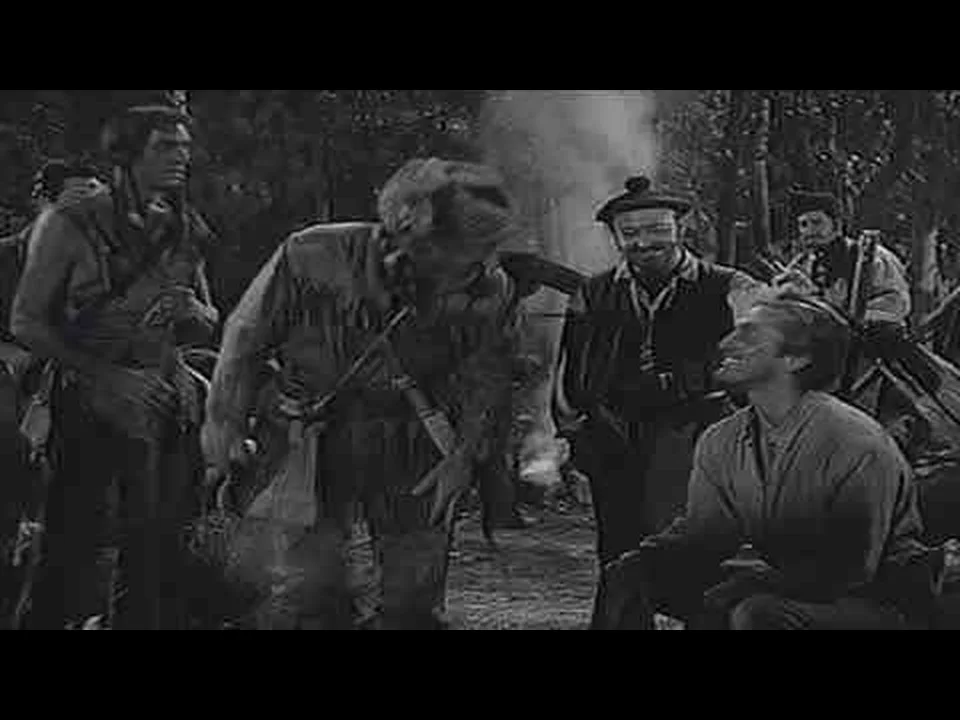
Injury interrupts prior division of labour. Diagnosis, decision, bodily restraint, and treatment must pass provisionally among hands; rank cannot replace the skill required now.
A group forms provisionally only through relayed capacities. The characters do not cooperate because they first share an identity; local action produces a relation that can continue.
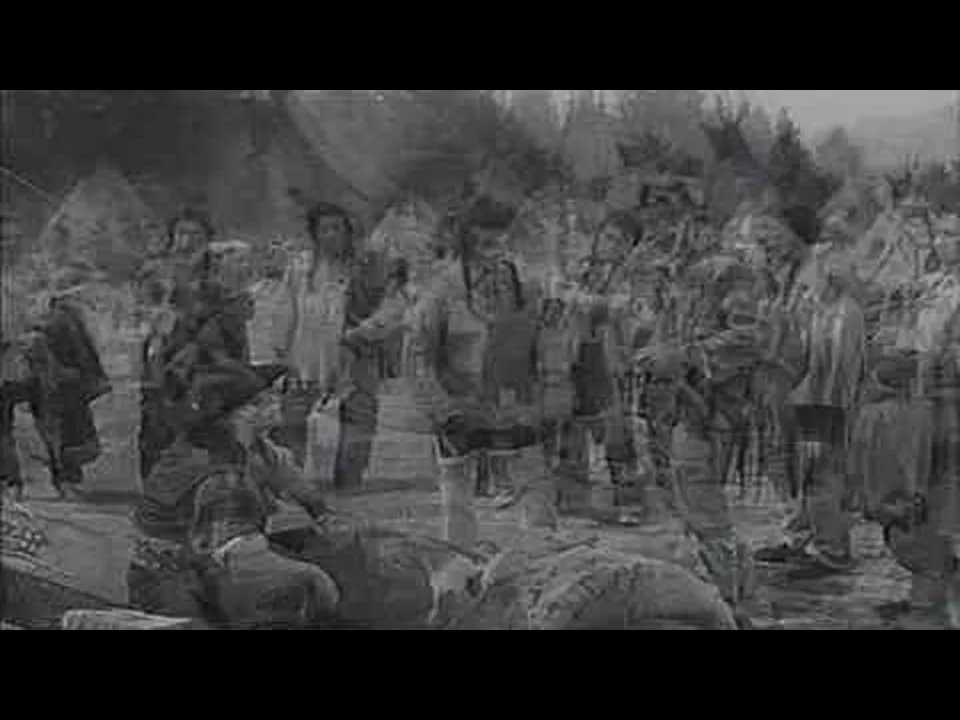
Goods, firearms, translation, marriage, and kinship negotiation overlap in one camp. Teal Eye is both companion and a term within exchange.
Heterogeneous figures can complete a route together without deciding it together. The movement-image's increase in capacity must be read alongside unequal agency in colonial exchange.
EDITION NOTE Stills and timecodes use the user-supplied 02:01:45 / 122-minute theatrical cut and do not present it as the roughly 138–140-minute long edition.
Sky encloses the expedition within a monumental West, but river stretches the whole into a fluid route. Heterogeneous companions advance through local invention and exchanged capacities rather than common identity, while trade, translation, and decisions about route expose the exchange as unequal.
- 01Sky encompasses the expedition
Long shots let sky dominate banks, keelboat, and figures, presenting departure first as a relation between humans and immense milieu.
The milieu supplies the scale and challenge of the large form. - 02River decomposes community
As the expedition moves along the river, paddling, scouting, translating, negotiating, and guarding pass among different figures; Teal Eye is treated at once as companion, translation node, and stake within trade relations.
Community exists only through relayed functions, yet authority over route and terms remains unequal; heterogeneous cooperation does not erase colonial differences in power. - 03A branch acquires a local function
Rapids undo rope and route; the characters use a low branch over the water to escape through the relation among tree, body, and current.
The tree acquires a provisional tool-function within the milieu; Deleuze's ‘catapult-tree’ compresses that functional relation rather than naming a machine built on screen.
Close-reading questions
- 01How do the proportions of open sky, banks, and keelboat first enclose the expedition in an immense milieu, and how does the river's continuous advance rewrite that whole as a fluid route?
- 02Boone, Jim, Zeb, Teal Eye, and the crew share no single identity. How do paddling, translation, scouting, and negotiation compose a group sustained only by functions, and who still decides route, trading terms, and who may represent whom?
- 03When a low branch helps the characters escape the rapids, how do tree, body, and current acquire a provisional function? Why does Deleuze compress the relation as a ‘catapult-tree,’ and what actually occurs on screen?
Shots and scenes
Primary texts, scholarship, and locators
Theory coordinate: Cinema 1, Minnesota 1986, ch. 9, p. 146; ch. 10, pp. 165–166
- 01Cinema 1: The Movement-Image
Standard Minnesota English translation and a principal citation edition in Anglophone scholarship.
Open the atlas source record →
This film in books and research
Cinema After Deleuze · Book case
The Big Sky
pp. 42–44
Film relation: Local action lets characters survive without founding a new order, exemplifying ASA′.
Shot question: Which new situation does each tactic generate, and why does the endpoint not found a community?
Viewing gateways and editions
- Verified complete Bilibili carrier: 【烽火弥天】霍华德·霍克斯The.Big.Sky.1952bilibili.comOpen film page ↗
- Page access
- Accessible when checked
- Version extent
- Cut or altered
- Source type
- User-uploaded page
Edition note: The 122-minute theatrical cut, complete in one part; a longer edition runs approximately 138–140 minutes. Winchester Pictures / Howard Hawks opens this edition and THE END closes it. Resolution is 624×480; no Chinese subtitles were observed.
Link checked: 2026-08-25