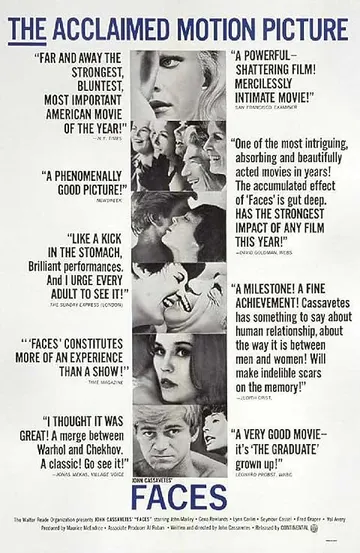
John Cassavetes / 约翰·卡萨维蒂 · 1968
Faces
Faces
Laughter, fatigue, drunkenness, and suddenly frozen faces unsettle stable psychology. The linkage of bodily attitudes directly reveals time wearing relations down.
Film details
- Original title
- Faces
- Director
- John Cassavetes / 约翰·卡萨维蒂
- Year
- 1968
- Region
- United States
Film analysis: how shots organize concepts
Laughter, drunkenness, pauses, and collapse make bodies continually change attitude, placing character truth not behind dialogue but in the time of gestural modulation.
- 01Laughter conceals and exposes relations
Handheld close-ups stay with laughing faces, interruptions, embraces, and sudden silences, making faces modulate within one conversation.
Dialogue cannot stabilize character; attitude bears the fact that relations are changing. - 02Performance slides into endurance
Flirtation, dance, and exaggerated joking gradually become extended fatigue, humiliation, and bodily loss of control.
The body no longer performs social action; it becomes the surface on which time and pressure fall. - 03Morning offers no reconciliation
Rescue after the suicide attempt, sitting on the stairs, and fragmentary talk leave the couple in a new attitude not yet named.
The event is not recovered by psychological explanation; bodily change itself becomes the open ending.
Shots and scenes
Primary texts, scholarship, and locators
Theory coordinate: Cinema 2, ch. 7, p. 159; ch. 8, p. 199
- 01Cinema 2: The Time-Image
Authoritative source for the standard translation, translators, ISBN, and publication date.
Open the atlas source record →
Viewing gateways and editions
No direct viewing link is listed; film search gateways are available above.