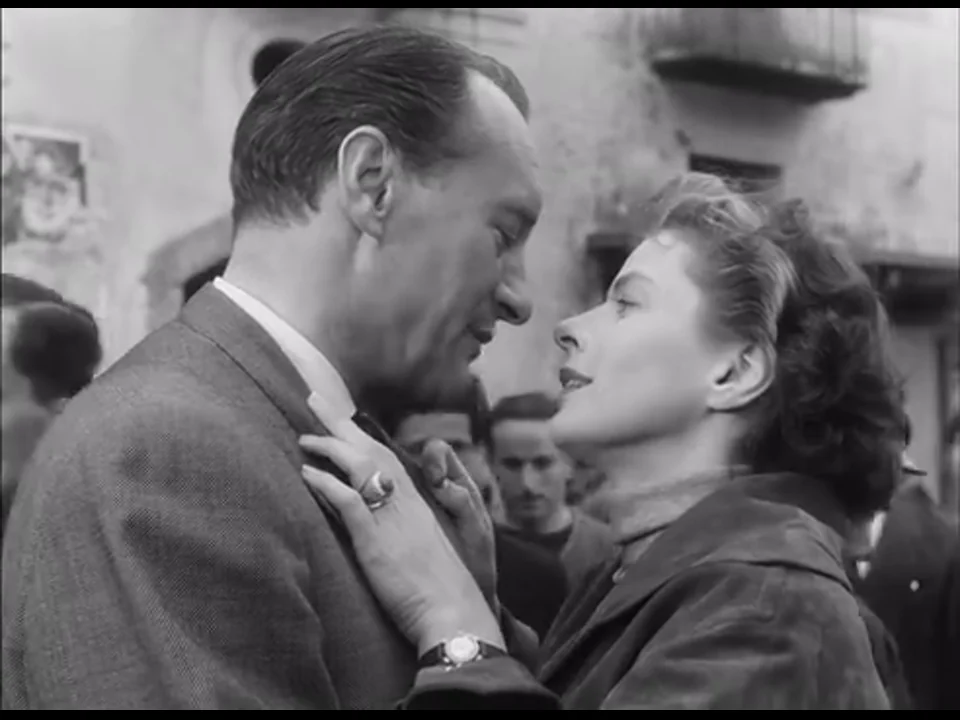
 01:24:50
Action rupture · SHOT EVIDENCE
The crowd takes Katherine away, then presses the couple together
Does the ending restore the couple's capacity to act on the world, or produce a reconnection that can occur only through an external event?
Film and viewing version
Journey to Italy · Viaggio in Italia · Roberto Rossellini / 罗伯托·罗西里尼 · 1954
Frame-checked against the single-part Bilibili repost stream BV1h5MVzfEdW: the page API reports 5,141 seconds, while the retrieved qn16 media runs 5,140.78 seconds at 492×360. Player v2 supplies no usable subtitle track; English dialogue sense was aligned by scene content with an English SDH subtitle file from the Criterion Blu-ray. Every timecode follows the Bilibili carrier.
Version boundary: The timecodes on this page apply only to the named viewing carrier. Restorations, differing leaders, or platform transcodes may shift them.
Passage and still timecodes
01:21:18 to 01:25:28
Passage bounds checked on the named carrier
The passage bounds and Bilibili still at 01:24:50 were checked separately on their named carriers. They remain distinct coordinates and do not establish identical timecodes for other versions.
Visible facts
- 01
A religious procession stops the car; after the couple get out, ranks, band, sacred image, and spectators keep crossing the frame around them.
- 02
The moving crowd carries Katherine away from Alex; he passes through the crowd, finds her, and they grasp and embrace one another.
Audible facts
- 01
Band music, bells, prayer, cheering, and repeated cries of 'miracle' fill the street.
- 02
Katherine calls Alex's name from within the crowd; after they reunite she says she does not want to lose him, while their voices remain surrounded by the collective sound field.
Action relation
The private action-chain of departure and divorce is first interrupted by the procession; searching and embrace occur only after collective movement produces separation.
Temporal relation
The procession's present cuts across the couple's projected future and brings the relation into an instant not directly deducible from their preceding quarrel.
Conceptual reading
The crowd must visibly cause stoppage, separation, and renewed contact; the final embrace alone cannot establish a restored action-schema.
Concepts used in the judgement
- Sensory-motor schemaschème sensori-moteur · SCENE SUPPORT
Stoppage, separation, and search rearrange perception and action, while the outcome is triggered by a collective event.
→ - Pure optical / sound situationopsigne / sonsigne · SCENE SUPPORT
The procession's audio-visual density first overwhelms private dialogue, then opens a place for calling and reunion.
→
Primary and scholarly coordinates
- 01Cinema 2: The Time-Image
Minnesota 1989 translation: ch. 1, p. 2 (listed as The Lonely Woman [Viaggio in Italia]).
Brief primary-text mention: on this page Deleuze includes Katherine among female tourists struck by unfolding images and visual clichés; the fuller argument for the turn from agent to seer comes from the surrounding chapter. This site analyzes each scene window, audio-visual fact, and criterion shot by shot.
Terminological coordinates
- sensory-motor schemaschème sensori-moteur
The ending leaves restoration of the schema as a testable question rather than a foregone answer.
→ - pure optical and sound situationsituation optique et sonore pure
Band, bells, cries, and moving crowd exceed the couple's private line of action.
→ - sonsign / sound signsonsigne
Cries of 'miracle' and Katherine's call meet within the same collective sound field.
→
Chapter relations
Viewing and still sources
Direct scene · Complete single-part film on Bilibili; the page, anonymous Player API, media bytes, and full 5,140.78-second duration were verified. Submission label: repost.