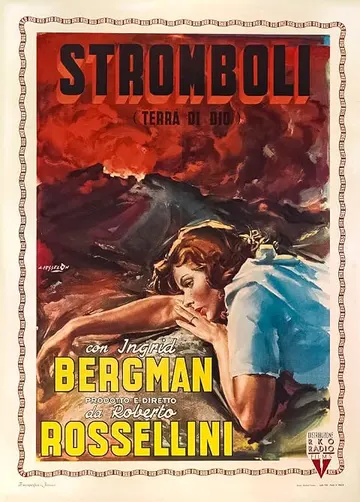
Roberto Rossellini / 罗伯托·罗西里尼 · 1950
Stromboli
Stromboli, terra di Dio
The volcano’s beauty and pain exceed any executable response, turning the protagonist from agent into a seer struck by a limit situation.
Film details
- Original title
- Stromboli, terra di Dio
- Director
- Roberto Rossellini / 罗伯托·罗西里尼
- Year
- 1950
- Region
- Italy
Film analysis: how shots organize concepts
Island custom, tuna slaughter, and volcano progressively close Karin's routes of escape until landscape ceases to be an environment for action and becomes an audio-visual force her body can only endure.
- 01The milieu resists domestication
Karin enters a fishing village enclosed by stone houses, narrow lanes, and an unfamiliar language, attempting to improve the home and persuade her husband to leave.
Domestic work and persuasion remain purposeful acts, yet they cannot reorganize the island into a milieu she can inhabit. - 02The slaughter becomes too strong a sight
The tuna slaughter unfolds through shouting, churning water, ropes, and the impact of fish; Karin watches from the boat and recoils in fear.
Labour no longer offers an action-chain she can join; its visual and sonic intensity overwhelms the body. - 03Climbing ceases to be escape
After the eruption she tries to leave across the volcano, but sulphurous smoke, black rock, wind, and exhaustion force her to the ground; at dawn she looks upward and calls to God.
At its limit the route loses purposiveness, and the fugitive becomes a seer struck by the world's beauty and terror.
Close-reading questions
- 01How do the island’s wind, black sand, nets, and crowds make the environment an actively pressuring perceptual field rather than an exotic backdrop?
- 02Through which bodily attitudes and resistances of terrain does Karin’s escape plan lose its original action-logic?
- 03Does the gaze at the crater obtain a transcendent answer, or does it first make the character endure a world that cannot be mastered?
Analysis and scene sources
Shots and scenes
Primary texts, scholarship, and locators
Theory coordinate: Cinema 2, Preface pp. x–xi; ch. 1, pp. 2, 18; ch. 3, p. 48
- 01Cinema 2: The Time-Image
Authoritative source for the standard translation, translators, ISBN, and publication date.
Open the atlas source record →
This film in books and research
Time-image research chapters
When time stops hiding behind movement
Bearing Time Chinese DOCX, paragraphs 44–133.
Claim: The threshold of the time-image is not slowness but the failure of perception to lead automatically to action that can close the situation.
What to watch for: Record image, sound, body, space, and editing: where does action fail, and which duration cannot be reclaimed as narrative information?
Viewing gateways and editions
- Verified complete Bilibili carrier: 火山边缘之恋【1950】bilibili.comOpen film page ↗
- Page access
- Accessible when checked
- Version extent
- Recorded as a complete version
- Source type
- User-uploaded page
Edition note: Single-part film · 1:45:55 at 25 fps; commonly listed editions run approximately 106 minutes.
Link checked: 2026-08-25