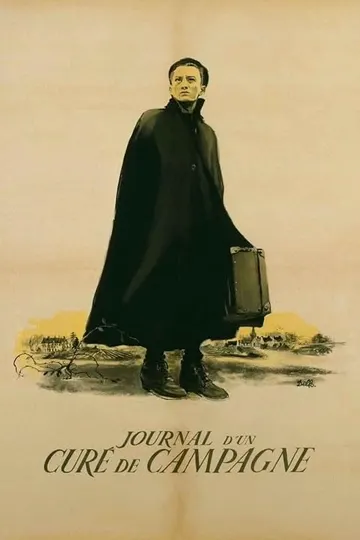
Robert Bresson / 罗伯特·布列松 · 1951
Diary of a Country Priest
Journal d'un curé de campagne
Doors, tabletops, hands, diary pages, and exhausted steps construct the priest's path fragment by fragment; space is never given whole. The face no longer governs emotion, as tactile fragments bear judgment, illness, and faith. Each halt is both interrupted action and another station toward the Cross, producing spiritual affect through broken connections.
Film details
- Original title
- Journal d'un curé de campagne
- Director
- Robert Bresson / 罗伯特·布列松
- Year
- 1951
- Region
- France
Film analysis: how shots organize concepts
Bresson constructs a path from hands, doors, tabletops, and diary pages, letting bodily exhaustion turn action-route into spiritual affect.
- 01The hand replaces the face
Writing hand, diary page, and ink recur between conversations and journeys.
Tactile acts connect space and speech, and the face no longer monopolizes affect. - 02The room is built from fragments
The conversation with the Countess is divided by doorframe, table edge, hands, and partial bodies; the whole room is withheld.
Judgment is not organized by a total stage but produced through continuous linkage of fragments. - 03Each halt becomes a station
The priest cycles, stops, vomits, and continues, his sick body repeatedly interrupting the route.
Exhaustion does not end the path; each interruption becomes a station of spiritual affect.
Close-reading questions
- 01Diary page, ink, and writing hand recur between scenes: verbal content → tactile act → spatial connection. How does the hand replace the face as guiding organ?
- 02The conversation with the Countess is divided by doors, table edges, and partial bodies; once the whole room is withheld, how does judgment arise from fragmentary linkage rather than staged confrontation?
- 03The priest cycles, stops, vomits, and continues: journey → interruption by illness → next station. How does bodily exhaustion turn a route of action into spiritual affect?
Shots and scenes
Primary texts, scholarship, and locators
Theory coordinate: Cinema 1, Minnesota 1986, ch. 7, pp. 108, 113
- 01Cinema 1: The Movement-Image
Standard Minnesota English translation and a principal citation edition in Anglophone scholarship.
Open the atlas source record →
Viewing gateways and editions
No direct viewing link is listed; film search gateways are available above.