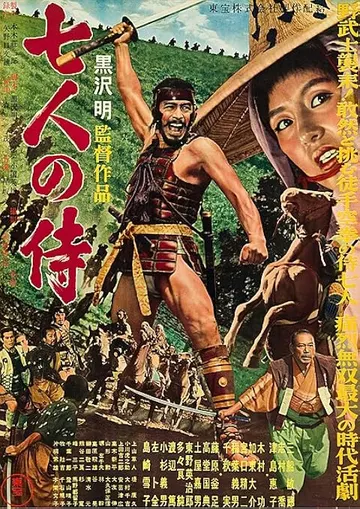
Akira Kurosawa / 黑泽明 · 1954
Seven Samurai
七人の侍
Village maps, formations, and reconnaissance gather every given condition of defence, then force a higher question: ‘What is a samurai at this historical moment?’ The rain battle secures the village, but burial mounds and peasant song answer that the peasants are the true victors and the samurai have become displaced shadows.
Film details
- Original title
- 七人の侍
- Director
- Akira Kurosawa / 黑泽明
- Year
- 1954
- Region
- Japan
Film analysis: how shots organize concepts
The full conditions of defending the village force a higher historical question: what is a samurai at this moment?
- 01Given conditions force a question
Village map, entrances, fields, and possible routes are repeatedly reconnoitred and marked.
These given conditions push the figures toward the historical question ‘What is a samurai today?’ - 02Collective forms through training
Samurai grouping, peasant training, and class conflict repeatedly redistribute roles during preparation.
Employment becomes an incommensurate form of shared obligation. - 03Victory preserves a remainder
The rain battle completes defence, but burial mounds and peasant song juxtapose survival and disappearance.
Action transforms the situation without closing its ethical consequences.
Close-reading questions
- 01How do the village map, mountain pass, paddies, stream, and blocked roads convert an apparently boundless threat into a situation that can be strategically arranged?
- 02How do banner, alarm, squads, and the plan to admit enemies one by one organize peasant and samurai bodies into a collective action?
- 03After the rain battle mixes mud, water, horses, and hand-to-hand combat, how do the graves and planting song at the end reassess whether victory belongs to the samurai or to the village still at work?
Analysis and scene sources
Shots and scenes
Primary texts, scholarship, and locators
Theory coordinate: Cinema 1, Minnesota 1986, ch. 11, pp. 188, 191
- 01Cinema 1: The Movement-Image
Standard Minnesota English translation and a principal citation edition in Anglophone scholarship.
Open the atlas source record →
Viewing gateways and editions
- Verified complete Bilibili carrier: 七武士 1954 BD1080p 日语中字bilibili.comOpen film page ↗
- Page access
- Accessible when checked
- Version extent
- Recorded as a complete version
- Source type
- User-uploaded page
Edition note: Complete single-part film with Japanese audio and Chinese subtitles · 3:27:05.
Link checked: 2026-08-14
- Criterion Collectioncriterion.comOpen film page ↗
- Source type
- Distributor or streaming platform