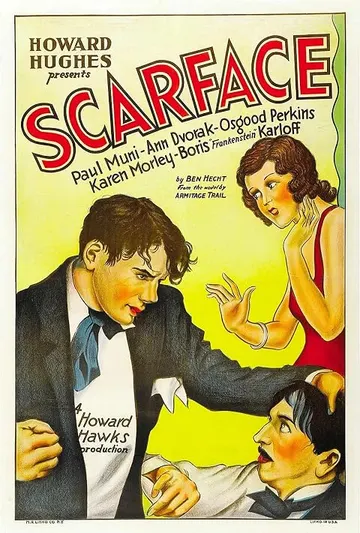
Howard Hawks / 霍华德·霍克斯 · 1932
Scarface
Scarface: The Shame of the Nation
Tony builds an apparently effective gangster habit through assassination, machine-gun fire, and territorial seizure, while recurring X marks inscribe death within each success. The milieu is no stable community but an alliance ready to reverse. When his sister is shot, possessiveness, arrogance, and fear converge into a crack, and the actions that organized situations abruptly fail.
Film details
- Original title
- Scarface: The Shame of the Nation
- Director
- Howard Hawks / 霍华德·霍克斯
- Year
- 1932
- Region
- United States
Film analysis: how shots organize concepts
The gangster milieu trains precise violence into effective behaviour while making Tony's possessiveness and fear a latent crack; his sister's death reverses both milieu and behaviour until they engulf the agent.
- 01Violence forms a stable habit
Tony enlarges territory through assassination, driving, telephone coordination, and machine-gun fire; acts are brief and effective.
Crime appears to become a behaviour capable of reading and changing urban situations. - 02X marks the crack within success
Door shadows, signs, architecture, or bullet marks repeatedly form X shapes around killings, placing death in the image before the character grasps it.
Each victory reveals a pathology: alliances are reversible and behaviour cannot truly integrate itself. - 03The sister's death breaks behaviour
After Cesca is shot, Tony loses the rhythm of command, cowers, cries out, flees, and finally runs into gunfire.
The crack changes from minor disposition into collapsed agency, and the once-controlled milieu captures him.
Close-reading questions
- 01When doorway shadows, streetlights, bullet holes, or architecture repeatedly form an X around killings, how does the mark make each territorial gain carry a failure not yet erupted?
- 02Cars, telephones, and machine guns make Tony's action increasingly rapid and effective. Why does this technical efficiency fail to stabilize the organization and instead accelerate reversed alliances and a pathological milieu?
- 03After his sister dies, Tony moves from commanding others to cowering, crying out, and fleeing. Which bodily and editorial changes make Deleuze's crack in behaviour visible as the collapse of agency?
Analysis and scene sources
Shots and scenes
Primary texts, scholarship, and locators
Theory coordinate: Cinema 1, Minnesota 1986, ch. 9, p. 145
- 01Cinema 1: The Movement-Image
Standard Minnesota English translation and a principal citation edition in Anglophone scholarship.
Open the atlas source record →
Viewing gateways and editions
- Verified complete Bilibili carrier: 疤面人 (1932)bilibili.comOpen film page ↗
- Page access
- Accessible when checked
- Version extent
- Recorded as a complete version
- Source type
- User-uploaded page
Edition note: Single-part film · 1:33:30; related analysis discusses X-shaped compositions and gunfight sequences.
Link checked: 2026-08-25