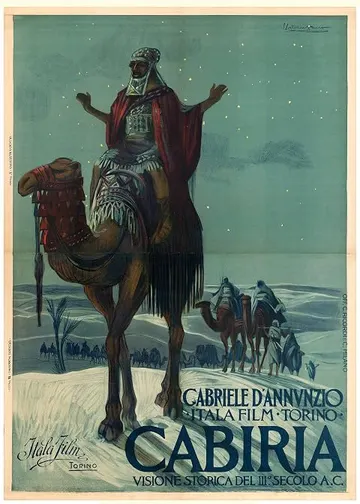
Giovanni Pastrone / 乔瓦尼·帕斯特洛纳 · 1914
Cabiria
Cabiria
Temple, colossus, fire, and crowds remain layered in the frontal staging of early cinema, yet the camera travels slowly across and into those planes. Pastrone makes camera movement an ordinary way of organizing space rather than a conspicuous trick. The shot records not only displacement of figures but remeasures the relations among set, crowd, and action as it moves.
Film details
- Original title
- Cabiria
- Director
- Giovanni Pastrone / 乔瓦尼·帕斯特洛纳
- Year
- 1914
- Region
- Italy
Film analysis: how shots organize concepts
Cabiria normalizes camera movement within early cinema's frontal layers, changing movement from exceptional trick into a method for continually remeasuring relations among set, crowd, and action.
- 01Frontal staging separates planes
The Moloch temple arranges colossus, altar, fire, priests, and crowd in legible layers of depth.
Space remains organized by the frontal order of a spectator facing a stage. - 02Camera traverses the planes
The camera slowly advances or travels laterally without any one figure carrying the centre of movement.
The shot actively changes scale and distance among planes rather than merely recording characters' displacement. - 03Movement becomes ordinary grammar
Comparable movements recur through palace, temple, and crowd scenes without being isolated as a one-off spectacle.
Mobile camera and frontality coexist, producing movement-image capacity from within an older spatial regime.
Close-reading questions
- 01How does the Moloch temple arrange colossus, fire, priests, victims, and crowd in legible frontal layers, and which distances between layers does the moving camera remeasure?
- 02When the camera slowly advances or travels laterally without a character carrying the centre of movement, how does the shot shift from recording action to actively constructing relations between set and bodies?
- 03Why does Deleuze's note stress that Cabiria normalized camera movement while retaining early cinema's frontality? How do these two regimes rub against each other within the same shot?
Analysis and scene sources
Shots and scenes
Primary texts, scholarship, and locators
Theory coordinate: Cinema 1, Minnesota 1986, ch. 2, p. 27 n. 23
- 01Cinema 1: The Movement-Image
Standard Minnesota English translation and a principal citation edition in Anglophone scholarship.
Open the atlas source record →
Viewing gateways and editions
No direct viewing link is listed; film search gateways are available above.